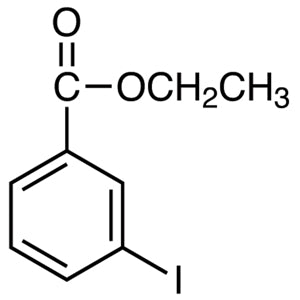
TCI I0536 Ethyl 3-Iodobenzoate is the ethyl ester of 3-iodobenzoic acid, an aromatic compound carrying an ester group at one position and an iodine atom at the meta position relative to it. As a non-heterocyclic building block, this compound presents two distinct functional groups on a single benzene ring that can be addressed separately. This arrangement is highly valued in multistep synthesis because it allows researchers to construct complex molecules sequentially, using the iodine atom first for coupling reactions and then processing the ester group at a later stage according to the synthetic design.
The property that makes this material widely used is the orthogonal reactivity of its two functional groups. The carbon–iodine bond is highly responsive to palladium and copper catalysts, so coupling reactions can be carried out without disturbing the ester group, which remains relatively inert under those conditions. Conversely, the ester group can be hydrolysed to the carboxylic acid, reduced to the benzylic alcohol, or converted to an amide when required. The meta substitution pattern provides a characteristic angular geometry that is often deliberately chosen in ligand design and in the construction of porous molecular frameworks, because it produces a shape that linear isomers cannot reproduce.
In Indonesian laboratories, this building block is typically found in university and institutional organic synthesis groups working on medicinal chemistry intermediates, materials precursors, and ligand preparation. It is ordinarily ordered as part of a planned reaction sequence rather than kept as a routine bulk consumable, and researchers generally handle it under standard synthetic laboratory conditions with inert-atmosphere technique where the following coupling step requires it. Pack sizes are usually chosen to match the scale of the intended research programme.
- Palladium-catalysed cross-coupling reactions: the aryl–iodine bond undergoes oxidative addition readily under mild conditions, making this substrate a dependable partner in Suzuki, Sonogashira, Heck, and related transformations where the ester survives untouched.
- Copper-mediated bond formation: the iodine substituent is well suited to Ullmann-type couplings and related copper-catalysed carbon–heteroatom bond formation, allowing nitrogen, oxygen, or sulfur nucleophiles to be introduced at the meta position.
- Multistep medicinal chemistry intermediates: the two orthogonal handles let synthetic chemists elaborate one position at a time, building substituted benzoate scaffolds step by step without recourse to additional protecting group manipulation.
- Ligand synthesis: the meta geometry gives a defined angular relationship between the coupled substituent and the ester or derived carboxylate, a feature routinely exploited when designing chelating and bridging ligands for coordination chemistry.
- Porous framework and materials precursors: after coupling and ester hydrolysis, the resulting carboxylic acid serves as a linker whose angular shape directs framework topology in ways that linear para-substituted analogues cannot achieve.
| Brand | TCI (Tokyo Chemical Industry) |
|---|---|
| CAS number | 58313-23-8 |
| Molecular formula | — |
| Purity | — |
| Category | Chemistry > Building Blocks > Non-Heterocyclic Building Blocks |
| Pack sizes | available in standard research-scale TCI packaging; please confirm the currently offered sizes when ordering |
| Physical form | — |
| Storage | store in a cool, dark place in a tightly sealed container |
- Catalogue number: I0536
Keep the container tightly closed and store it in a cool, dark place away from direct sunlight, heat sources, and strong oxidising agents. Aryl iodides are generally light-sensitive, so amber glass or an opaque secondary container is preferred, and the original manufacturer packaging should be retained wherever possible. Handle the material in a functioning fume hood while wearing safety glasses, a laboratory coat, and chemically resistant gloves. Avoid inhalation of vapours and contact with skin and eyes. Allow cold containers to reach room temperature before opening to prevent moisture condensation, and always consult the manufacturer's safety data sheet before first use and before disposal.
—
Produk Terkait
-
Methyl5-Bromo-2-iodobenzoate TCI M3084
Regular price From Rp 903.000,00Regular price -
Methyl4-Iodobenzoate TCI I0593
Regular price From Rp 1.167.600,00Regular price -
Methyl2-Iodobenzoate TCI I0586
Regular price From Rp 2.254.350,00Regular price -
Ethyl4-Iodobenzoate TCI I0369
Regular price From Rp 664.650,00Regular price -
Ethyl2-Iodobenzoate TCI E1273
Regular price From Rp 743.400,00Regular price -
5-Bromo-2-iodobenzoicAcid TCI B4296
Regular price Rp 1.696.800,00Regular price -
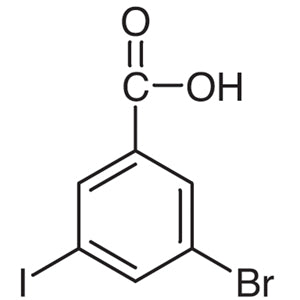
3-Bromo-5-iodobenzoicAcid TCI B1807
Regular price From Rp 1.273.650,00Regular price -
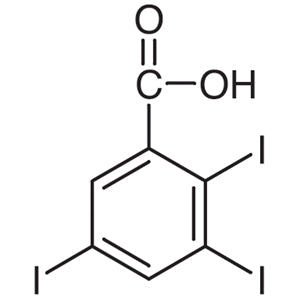
2,3,5-TriiodobenzoicAcid TCI T0451
Regular price From Rp 1.220.100,00Regular price