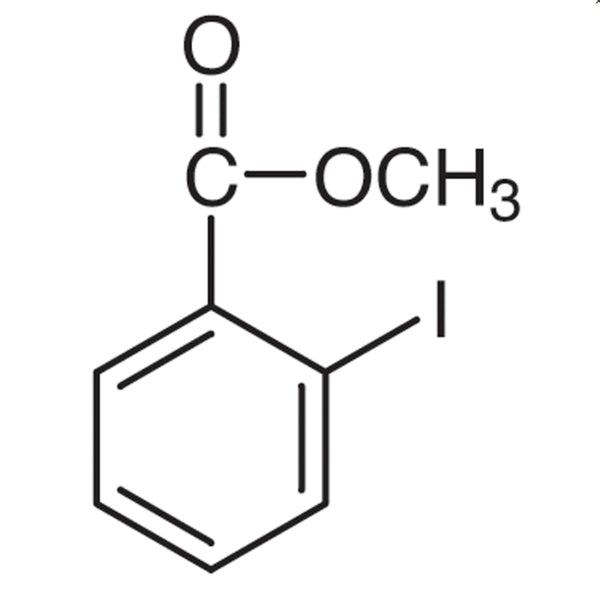
TCI I0586 Methyl 2-Iodobenzoate is the methyl ester of 2-iodobenzoic acid: a benzene ring carrying an ester group at one position and an iodine atom directly adjacent to it, at the ortho position. In organic synthesis laboratories, this compound belongs to the family of non-heterocyclic building blocks that are drawn on very frequently, because iodine is the best leaving group among the aromatic halogens in transition-metal-catalysed reactions. Its role is to provide a reliable entry point for installing new groups onto the aromatic ring, while the ortho-positioned ester stands ready to act as the reaction partner in a subsequent ring-closing step.
The property that makes this material a preferred choice is the ease with which the C–I bond can be activated. The carbon–iodine bond is comparatively weak, so oxidative addition to palladium, copper, or nickel proceeds at milder temperatures and over shorter reaction times than with the corresponding bromo or chloro analogues. The practical consequence is that reactions can be run under gentler conditions that are far more forgiving of sensitive functional groups elsewhere in the molecule. The ortho relationship between the iodine and the ester adds further value: once a new group has been installed, the ester sits at exactly the right distance for lactonisation or lactamisation, which makes this compound a natural starting point for building fused ring systems in a controlled sequence.
In Indonesian laboratories, this building block is typically found in university and institutional research groups working on organic synthesis, medicinal chemistry, and natural product analogue programmes, as well as in industrial R&D groups preparing intermediates on a small scale. It is normally handled at bench scale in reactions ranging from a few millimoles upward, where a well-defined, reliably reactive aryl iodide shortens method development and improves the reproducibility of a synthetic route between operators.
- Palladium-catalysed cross-coupling reactions: the weak C–I bond undergoes oxidative addition readily, allowing Suzuki, Stille, or Negishi couplings to be run at lower temperatures with shorter reaction times than bromo analogues require.
- Sonogashira alkynylation: the aryl iodide couples efficiently with terminal alkynes under palladium–copper catalysis, and the ortho ester is positioned to cyclise onto the resulting alkyne in a following step.
- Copper-catalysed Ullmann-type coupling: iodine is the most reactive halogen partner in copper-mediated carbon–heteroatom bond formation, enabling amination or etherification under conditions that tolerate the ester group.
- Construction of fused lactone and lactam ring systems: after a new substituent is installed at the iodine position, the adjacent ester is correctly placed geometrically for intramolecular ring closure.
- Synthesis of medicinal chemistry intermediates and analogue libraries: the compound offers a single, predictable reactive site, which makes it a dependable scaffold for generating a series of related aromatic structures.
| Brand | TCI (Tokyo Chemical Industry) |
|---|---|
| CAS number | 610-97-9 |
| Molecular formula | — |
| Purity | — |
| Category | Chemistry > Building Blocks > Non-Heterocyclic Building Blocks |
| Pack sizes | supplied in standard TCI research-scale packaging; please refer to the current product listing for available pack options |
| Physical form | — |
| Storage | store in a cool, dark place in a tightly closed container |
- Chemical name: Methyl 2-Iodobenzoate; product code I0586
Store the container tightly closed in a cool, dark, well-ventilated place, away from heat, direct sunlight, and incompatible materials such as strong oxidising agents. Keep the compound in its original supplier container, or in an equivalent tightly sealed glass or amber glass vessel that protects the contents from light, and reseal it immediately after each use to limit exposure to air and moisture. Handle the material inside a fume hood, and wear safety glasses, chemical-resistant gloves, and a laboratory coat. Avoid inhalation of vapours and contact with skin and eyes. Allow refrigerated stock to warm to room temperature before opening to prevent condensation of atmospheric moisture inside the container. Dispose of residues and contaminated materials in accordance with institutional chemical waste procedures, and consult the manufacturer's Safety Data Sheet before first use.
—
Produk Terkait
-
Methyl5-Bromo-2-iodobenzoate TCI M3084
Regular price From Rp 903.000,00Regular price -
Methyl4-Iodobenzoate TCI I0593
Regular price From Rp 1.167.600,00Regular price -
Ethyl3-Iodobenzoate TCI I0536
Regular price From Rp 848.400,00Regular price -
Ethyl4-Iodobenzoate TCI I0369
Regular price From Rp 664.650,00Regular price -
Ethyl2-Iodobenzoate TCI E1273
Regular price From Rp 743.400,00Regular price -
5-Bromo-2-iodobenzoicAcid TCI B4296
Regular price Rp 1.696.800,00Regular price -
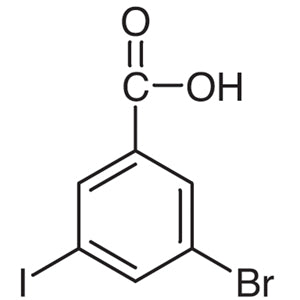
3-Bromo-5-iodobenzoicAcid TCI B1807
Regular price From Rp 1.273.650,00Regular price -
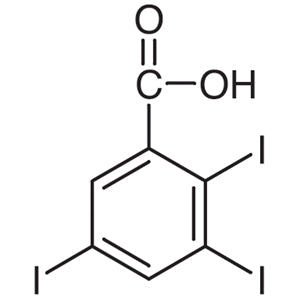
2,3,5-TriiodobenzoicAcid TCI T0451
Regular price From Rp 1.220.100,00Regular price