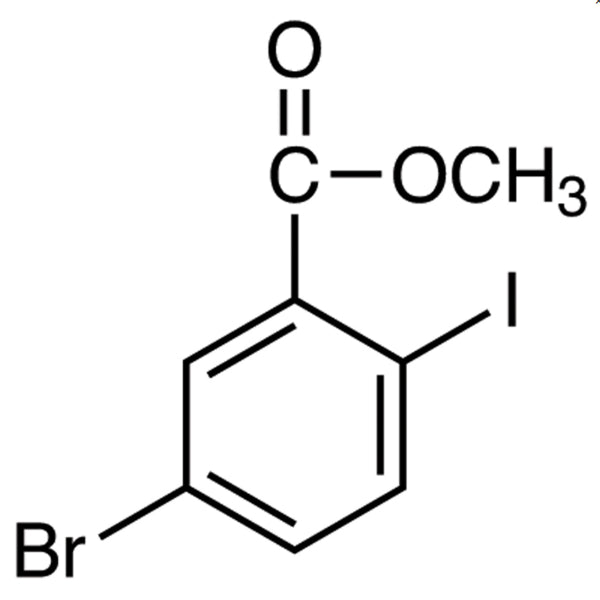
TCI M3084 is Methyl 5-Bromo-2-iodobenzoate, CAS number 181765-86-6, a non-heterocyclic building block that presents two different halogen atoms on a single benzene ring alongside a methyl ester group. The combination of bromine and iodine within one molecule makes this compound a highly valued starting material in stepwise organic synthesis, because the two halogens display distinctly different reactivity toward transition metal catalysts. For researchers designing routes toward multiply substituted aromatic molecules, a compound of this kind allows structures to be assembled in a controlled manner without depending on the troublesome separation of isomer mixtures.
The principal advantage of this material is orthogonal reactivity between its halogens. The carbon–iodine bond is considerably weaker than the carbon–bromine bond, so the iodine position reacts first under relatively mild palladium-catalysed cross-coupling conditions, while the bromine position remains intact and available for a second coupling step carried out under more forcing conditions. This pattern gives chemists a degree of selectivity control that is difficult to achieve when both halogens are identical. In addition, the ortho relationship between the ester group and the iodine atom opens further opportunities for directed transformations and subsequent ring construction, since the two functional groups sit close enough to participate in the same reaction sequence.
In Indonesian laboratories, materials of this type are typically used in university research groups and institutional synthesis facilities working on medicinal chemistry, materials chemistry, and methodology development. Because such building blocks are ordered for multi-step route work rather than routine analysis, they are usually handled in small quantities by trained synthetic chemists, weighed out under controlled conditions, and reserved for specific target-oriented projects where a reliable, well-defined halogenated starting material is required.
- Sequential cross-coupling route design: the differing strengths of the carbon–iodine and carbon–bromine bonds let researchers install two distinct substituents on the same ring in separate, controlled steps.
- Medicinal chemistry scaffold construction: the dual-halogen aromatic core serves as a starting point for building substituted benzene frameworks found in many drug discovery target structures.
- Palladium-catalysed coupling methodology studies: the compound acts as a well-defined substrate for comparing catalyst systems and conditions that discriminate between iodide and bromide positions.
- Directed ortho-functionalisation work: the ester group positioned ortho to the iodine atom can guide subsequent transformations, supporting ring construction sequences within the same synthetic route.
- Avoidance of isomer separation problems: because substitution positions are fixed in the starting material, chemists build target structures directly instead of purifying difficult mixtures of regioisomers.
| Brand | TCI (Tokyo Chemical Industry) |
|---|---|
| CAS number | 181765-86-6 |
| Molecular formula | — |
| Purity | — |
| Category | Chemistry > Building Blocks > Non-Heterocyclic Building Blocks |
| Pack sizes | available in standard TCI research-scale packaging; please confirm the currently listed sizes when ordering |
| Physical form | — |
| Storage | keep in a cool, dry place in the tightly closed original container |
- Chemical name: Methyl 5-Bromo-2-iodobenzoate
- Product code: M3084
Store this product in its original tightly closed container in a cool, dry, and well-ventilated area, away from direct sunlight, heat sources, and incompatible materials. Amber glass or the supplier's original packaging is preferred, since halogenated aromatic compounds are generally better protected from light exposure. Handle the material inside a fume hood, wearing safety goggles, a laboratory coat, and chemically resistant gloves, and avoid the generation of dust, contact with skin and eyes, and inhalation of vapours. Allow refrigerated containers to reach room temperature before opening to prevent moisture condensation. Consult the manufacturer's current Safety Data Sheet before use, and dispose of residues and contaminated materials through your institution's approved chemical waste channels.
—
Produk Terkait
-
Methyl4-Iodobenzoate TCI I0593
Regular price From Rp 1.167.600,00Regular price -
Methyl2-Iodobenzoate TCI I0586
Regular price From Rp 2.254.350,00Regular price -
Ethyl3-Iodobenzoate TCI I0536
Regular price From Rp 848.400,00Regular price -
Ethyl4-Iodobenzoate TCI I0369
Regular price From Rp 664.650,00Regular price -
Ethyl2-Iodobenzoate TCI E1273
Regular price From Rp 743.400,00Regular price -
5-Bromo-2-iodobenzoicAcid TCI B4296
Regular price Rp 1.696.800,00Regular price -
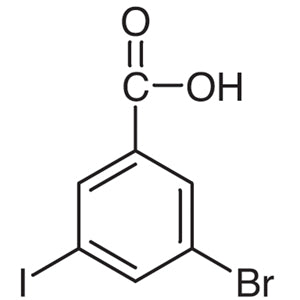
3-Bromo-5-iodobenzoicAcid TCI B1807
Regular price From Rp 1.273.650,00Regular price -
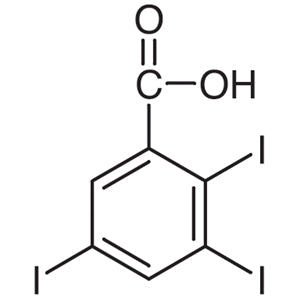
2,3,5-TriiodobenzoicAcid TCI T0451
Regular price From Rp 1.220.100,00Regular price