

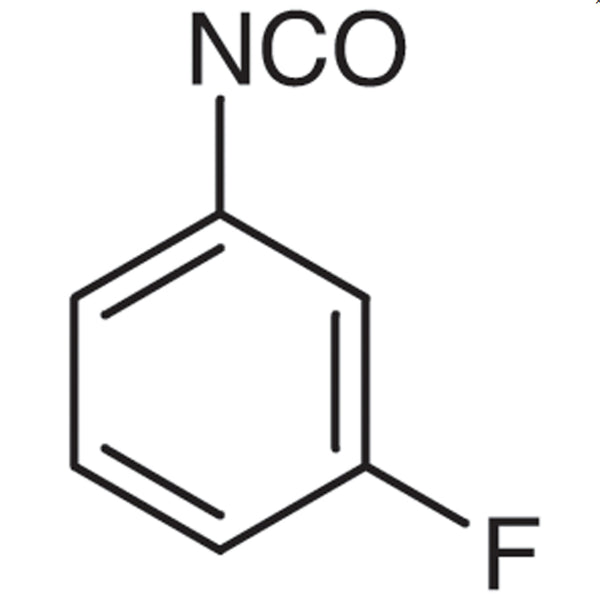
3-Fluorophenyl Isocyanate is a fluorinated aryl isocyanate carrying a single fluorine atom at the meta position relative to the isocyanate group. In the laboratory, this compound serves as a fluorinated building block used to introduce a fluoroaromatic ring into target molecules through the formation of urea and carbamate linkages. Its reaction with amines proceeds rapidly and cleanly at mild temperatures, producing fluorinated aryl ureas of the kind frequently encountered in drug candidate compounds. Because the addition of fluorine often modifies the physicochemical properties of a molecule in favourable ways, this material has become an important reagent in modern drug discovery and agrochemical programmes.
The characteristic property that makes this reagent a preferred choice is the influence the fluorine atom exerts on the resulting molecule. Fluorine is highly electronegative yet small in size, so it can lower the electron density of the ring and alter the acidity of neighbouring groups without adding significant steric hindrance. In drug design, fluorine substitution is commonly used to slow oxidative metabolism at specific positions and to fine-tune the lipophilicity of a molecule. From an analytical standpoint, the presence of fluorine allows reaction progress to be monitored by magnetic resonance spectroscopy, giving chemists a convenient handle for following conversion.
In Indonesian laboratories, this reagent is typically used in synthetic organic chemistry groups at universities and research institutes, as well as in pharmaceutical and agrochemical research units preparing urea and carbamate derivatives. It is generally handled on a small to moderate scale within a fume hood, using anhydrous solvents and standard amine coupling procedures. Because the material is moisture sensitive, laboratories usually schedule its use around planned synthetic campaigns so that opened containers are consumed within a reasonable period.
TCI brochures (PDF)
- Fluorination Reagents, Fluorinated Building Blocks 2026-03-18 · p. 13
Related TCI products
- TCI I0339 1195-45-5 4-Fluorophenyl Isocyanate
- TCI I0338 16744-98-2 2-Fluorophenyl Isocyanate
- TCI I0766 16588-74-2 3,5-Bis(trifluoromethyl)phenyl Isocyanate
- TCI T2487 35037-73-1 4-(Trifluoromethoxy)phenyl Isocyanate
- TCI T2403 1548-13-6 4-(Trifluoromethyl)phenyl Isocyanate
- TCI I0412 2285-12-3 2-(Trifluoromethyl)phenyl Isocyanate
- Fluorinated aryl urea synthesis: reaction with primary and secondary amines proceeds quickly and cleanly under mild conditions, delivering the urea linkage that appears widely in pharmaceutical candidate structures.
- Carbamate formation from alcohols: the isocyanate group couples with hydroxyl functionality to build carbamate linkages, allowing a fluoroaromatic ring to be attached to alcohol-bearing scaffolds.
- Medicinal chemistry scaffold construction: introduces a meta-fluorinated aromatic ring that adjusts lipophilicity and slows oxidative metabolism at selected positions during lead optimisation work.
- Agrochemical research synthesis: supports preparation of fluorine-containing urea and carbamate derivatives of the type pursued in modern crop protection discovery programmes.
- Reaction monitoring by fluorine NMR: the fluorine atom acts as a spectroscopic handle, letting chemists follow conversion and product formation by magnetic resonance spectroscopy.
| Brand | TCI |
|---|---|
| CAS number | 404-71-7 |
| Molecular formula | — |
| Purity | — |
| Category | Chemistry > Building Blocks > Fluorinated Building Blocks |
| Pack sizes | available in standard TCI catalogue pack sizes; please confirm the size required when ordering. |
| Physical form | — |
| Storage | keep in a tightly closed container under dry conditions, protected from moisture. |
- Product code: I0554
Store the container tightly closed in a cool, dry, well-ventilated area away from moisture, since isocyanates react readily with water. Original manufacturer containers or compatible sealed glass vessels are suitable; keep closures secure and consider storing under an inert atmosphere for frequently opened stock. Handle the material inside a fume hood, wearing safety goggles, chemical-resistant gloves, and a laboratory coat, because isocyanates are irritating to the eyes, skin, and respiratory tract. Keep away from amines, alcohols, and other incompatible reagents during storage, use anhydrous solvents and dry glassware when dispensing, and dispose of residues and contaminated materials through the laboratory's chemical waste procedure.
—
Produk Terkait
-
4-FluorophenylIsocyanate TCI I0339
Regular price From Rp 1.220.100,00Regular price -
2-FluorophenylIsocyanate TCI I0338
Regular price From Rp 1.565.550,00Regular price -
3,5-Bis(trifluoromethyl)phenylIsocyanate TCI I0766
Regular price From Rp 4.108.650,00Regular price -
4-(Trifluoromethoxy)phenylIsocyanate TCI T2487
Regular price From Rp 1.696.800,00Regular price -
4-(Trifluoromethyl)phenylIsocyanate TCI T2403
Regular price From Rp 1.829.100,00Regular price -
2-(Trifluoromethyl)phenylIsocyanate TCI I0412
Regular price Rp 2.889.600,00Regular price -
3-(Trifluoromethyl)phenylIsocyanate TCI I0340
Regular price From Rp 1.298.850,00Regular price -
3,4-DifluorophenylIsocyanate TCI D3696
Regular price Rp 2.730.000,00Regular price


