

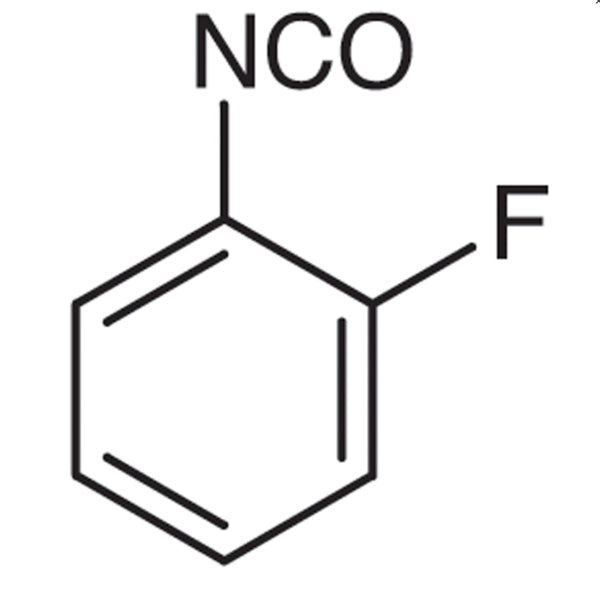
2-Fluorophenyl Isocyanate is a chemical compound widely used in laboratory settings for the synthesis of complex organic molecules. As a fluorinated building block, it plays a crucial role in the development of compounds with tailored fluorine-containing structures. Its reactivity and versatility make it an essential reagent in various synthetic pathways. This compound is particularly valuable in organic chemistry for its ability to participate in substitution, coupling, and functional group transformation reactions.
The compound’s unique chemical properties, including its reactive isocyanate group and fluorinated phenyl ring, make it a preferred choice for researchers. These features enable precise control over molecular structure during synthesis, which is vital in drug development and material science. Its stability under controlled conditions ensures reliable performance in laboratory experiments, supporting consistent results. The combination of reactivity and stability allows it to be a key component in the creation of advanced chemical compounds.
In Indonesian laboratories, 2-Fluorophenyl Isocyanate is commonly used in organic chemistry research, pharmaceutical development, and material science. Its application is particularly relevant in projects requiring the synthesis of fluorinated compounds with specific functional groups. The compound’s role in enabling precise molecular design makes it a valuable tool for scientists working on innovative chemical solutions. Its use is widespread in academic and industrial research settings across Indonesia.
TCI brochures (PDF)
- Fluorination Reagents, Fluorinated Building Blocks 2026-03-18 · p. 12
Related TCI products
- TCI I0554 404-71-7 3-Fluorophenyl Isocyanate
- TCI I0339 1195-45-5 4-Fluorophenyl Isocyanate
- TCI I0766 16588-74-2 3,5-Bis(trifluoromethyl)phenyl Isocyanate
- TCI T2487 35037-73-1 4-(Trifluoromethoxy)phenyl Isocyanate
- TCI T2403 1548-13-6 4-(Trifluoromethyl)phenyl Isocyanate
- TCI I0412 2285-12-3 2-(Trifluoromethyl)phenyl Isocyanate
- Organic synthesis where precise functional group modification is required due to its reactive isocyanate group and fluorinated phenyl structure.
- Pharmaceutical research for the development of fluorinated compounds with enhanced biological activity and stability.
- Material science applications in the creation of fluorinated polymers and specialty chemicals with unique properties.
- Functional group transformation reactions where the compound serves as a versatile intermediate in complex synthetic pathways.
- Coupling reactions that benefit from the compound’s ability to form stable bonds with various functional groups under controlled conditions.
| Brand | TCI |
|---|---|
| CAS number | 16744-98-2 |
| Molecular formula | — |
| Purity | — |
| Category | Chemistry > Building Blocks > Fluorinated Building Blocks |
| Pack sizes | Available in standard laboratory quantities as per supplier specifications |
| Physical form | Liquid |
| Storage | Store in a cool, dry place away from moisture and direct sunlight |
This compound should be stored in a cool, dry environment, away from moisture and direct sunlight to maintain its chemical stability. It is recommended to use airtight containers made of materials compatible with organic solvents to prevent contamination and evaporation. Due to its reactivity, it should be handled in a well-ventilated area, preferably under a fume hood, to minimize exposure. Proper personal protective equipment, including gloves and safety goggles, should be worn when handling the compound. Avoid contact with skin and eyes, and ensure that spill containment measures are in place to prevent accidental exposure. The compound is not classified as hazardous under standard laboratory conditions but should be treated with standard chemical safety protocols.
—
Produk Terkait
-
3-FluorophenylIsocyanate TCI I0554
Regular price Rp 1.856.400,00Regular price -
4-FluorophenylIsocyanate TCI I0339
Regular price From Rp 1.220.100,00Regular price -
3,5-Bis(trifluoromethyl)phenylIsocyanate TCI I0766
Regular price From Rp 4.108.650,00Regular price -
4-(Trifluoromethoxy)phenylIsocyanate TCI T2487
Regular price From Rp 1.696.800,00Regular price -
4-(Trifluoromethyl)phenylIsocyanate TCI T2403
Regular price From Rp 1.829.100,00Regular price -
2-(Trifluoromethyl)phenylIsocyanate TCI I0412
Regular price Rp 2.889.600,00Regular price -
3-(Trifluoromethyl)phenylIsocyanate TCI I0340
Regular price From Rp 1.298.850,00Regular price -
3,4-DifluorophenylIsocyanate TCI D3696
Regular price Rp 2.730.000,00Regular price


