

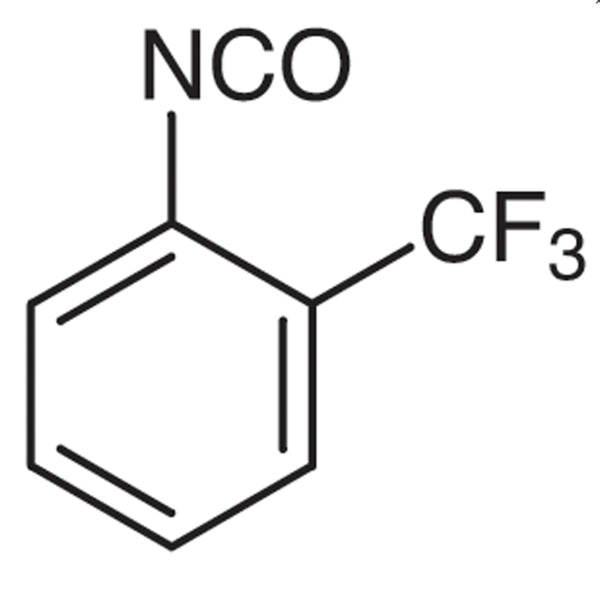
2-(Trifluoromethyl)phenyl Isocyanate is a chemical compound widely used in organic reactions for the synthesis of complex molecules. This compound contains a trifluoromethyl group, which imparts unique properties and high reactivity. Its presence in laboratory settings makes it a valuable reagent for fluorinated compound synthesis, especially in pharmaceutical and advanced material research. Due to its fluorine content, it exhibits high polarity and reactivity, making it suitable for substitution and cross-reaction processes in organic synthesis.
The compound’s structural characteristics and chemical reactivity make it a preferred choice for researchers working with fluorinated compounds. The trifluoromethyl group enhances the molecule’s stability and functional versatility, allowing it to participate in a variety of chemical transformations. Its solid form and stability under controlled conditions make it convenient for storage and use in laboratory environments. These properties ensure that it remains a reliable and effective reagent in both academic and industrial research settings.
In Indonesian laboratories, 2-(Trifluoromethyl)phenyl Isocyanate is commonly used in scientific research focused on fluorinated compound synthesis. It plays a key role in the development of new drugs and innovative chemical materials. Its relevance extends to material science and high-technology research, where its unique properties are leveraged to create advanced chemical applications. The compound is an essential tool for researchers aiming to explore new synthetic pathways and functional materials.
Related TCI products
- TCI I0766 16588-74-2 3,5-Bis(trifluoromethyl)phenyl Isocyanate
- TCI T2403 1548-13-6 4-(Trifluoromethyl)phenyl Isocyanate
- TCI I0340 329-01-1 3-(Trifluoromethyl)phenyl Isocyanate
- TCI C2778 327-78-6 4-Chloro-3-(trifluoromethyl)phenyl Isocyanate
- TCI C2258 50528-86-4 2-Chloro-5-(trifluoromethyl)phenyl Isocyanate
- TCI T2487 35037-73-1 4-(Trifluoromethoxy)phenyl Isocyanate
- Fluorinated Compound Synthesis: This compound is ideal for creating fluorinated molecules due to its reactive trifluoromethyl group, which facilitates substitution and cross-reaction processes in organic synthesis.
- Pharmaceutical Research: Its use in drug development is critical for synthesizing compounds with enhanced stability and biological activity, particularly in the pharmaceutical industry.
- Advanced Material Development: The compound is used in the creation of innovative materials with unique properties, such as high thermal stability and chemical resistance.
- Organic Chemistry Reactions: Its high reactivity makes it suitable for a wide range of organic reactions, including cross-coupling and substitution reactions, which are essential in synthetic chemistry.
- Scientific Research in Indonesia: It is widely utilized in Indonesian laboratories for research in fluorinated chemistry, contributing to advancements in both academic and industrial fields.
| Brand | TCI |
|---|---|
| CAS number | 2285-12-3 |
| Molecular formula | — |
| Purity | — |
| Category | Chemistry > Building Blocks > Fluorinated Building Blocks |
| Pack sizes | — |
| Physical form | Solid |
| Storage | Store in a cool, dry place away from light and moisture |
This compound should be stored in a cool, dry environment, away from direct light and moisture to maintain its stability and reactivity. It is recommended to use airtight containers to prevent exposure to air and moisture, which could affect its chemical integrity. Due to its reactivity, it should be handled with care, using appropriate personal protective equipment such as gloves and safety goggles. It is important to ensure proper ventilation in the laboratory when working with this compound to minimize any potential exposure. The compound should not be stored near incompatible materials, such as strong acids or bases, to avoid any chemical interactions. Regular inspection of storage conditions is advised to ensure the compound remains in optimal condition for use.
—
Produk Terkait
-
3,5-Bis(trifluoromethyl)phenylIsocyanate TCI I0766
Regular price From Rp 4.108.650,00Regular price -
4-(Trifluoromethyl)phenylIsocyanate TCI T2403
Regular price From Rp 1.829.100,00Regular price -
3-(Trifluoromethyl)phenylIsocyanate TCI I0340
Regular price From Rp 1.298.850,00Regular price -
4-Chloro-3-(trifluoromethyl)phenylIsocyanate TCI C2778
Regular price From Rp 717.150,00Regular price -
2-Chloro-5-(trifluoromethyl)phenylIsocyanate TCI C2258
Regular price Rp 3.021.900,00Regular price -
4-(Trifluoromethoxy)phenylIsocyanate TCI T2487
Regular price From Rp 1.696.800,00Regular price -
3-FluorophenylIsocyanate TCI I0554
Regular price Rp 1.856.400,00Regular price -
4-FluorophenylIsocyanate TCI I0339
Regular price From Rp 1.220.100,00Regular price


