

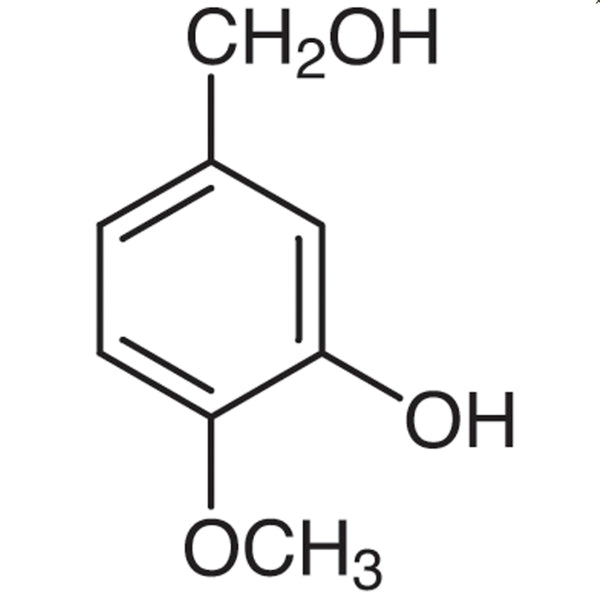
Isovanillyl Alcohol is an aromatic compound that carries a benzylic alcohol group on a benzene ring which also bears a hydroxyl group and a methoxy group. This arrangement of substituents is characteristic of the guaiacol framework, a structural motif encountered widely in lignin-derived compounds and in a broad range of plant natural products. The name of the compound relates to isovanillin, the isomer of vanillin in which the positions of the hydroxyl and methoxy groups are exchanged. In the laboratory, this material is used extensively as a building block for constructing larger and more complex molecules.
The property that makes this compound attractive to synthetic chemists is the presence of three functional groups with distinctly different reactivity within a single molecule. The benzylic alcohol is readily oxidised to the corresponding aldehyde, converted into a halide or another leaving group, or esterified. The phenolic hydroxyl group, by contrast, is more acidic in character and can be etherified or selectively protected. The methoxy group is electron-donating, so it directs electrophilic substitution reactions to particular positions on the ring and influences the antioxidant behaviour of derivatives prepared from it. This difference in reactivity allows researchers to carry out stepwise, directed modifications without the individual transformations interfering with one another.
In Indonesian laboratories, this building block is typically found in university research groups and institutional synthesis facilities working on organic chemistry and natural product chemistry. It suits work programmes centred on the preparation of guaiacol-type derivatives, studies of lignin-related structures, and multi-step synthetic routes in which a selectively addressable aromatic scaffold is required. Supplied by TCI, it fits research settings where a defined starting material is needed for method development and repeatable synthetic work.
- Multi-step organic synthesis: the three differentiated functional groups permit sequential, directed transformations, so chemists can elaborate a complex target without the individual reaction steps interfering with each other.
- Preparation of guaiacol-type derivatives: the hydroxyl and methoxy substitution pattern reproduces the guaiacol framework directly, giving a ready-made scaffold for derivatives built around that recurring structural motif.
- Benzylic alcohol transformation studies: the benzylic position is readily oxidised to the aldehyde or converted into a halide or other leaving group, making it a convenient substrate for such reactions.
- Selective protection and etherification work: the phenolic hydroxyl is more acidic than the benzylic alcohol, allowing researchers to address one oxygen function selectively while leaving the other intact.
- Antioxidant derivative research: the electron-donating methoxy group influences the antioxidant properties of compounds prepared from this scaffold, supporting structure-activity investigations on that class of derivative.
| Brand | TCI |
|---|---|
| CAS number | 4383-06-6 |
| Molecular formula | — |
| Purity | — |
| Category | Chemistry > Building Blocks > Non-Heterocyclic Building Blocks |
| Pack sizes | available in the pack sizes listed for this catalogue item |
| Physical form | — |
| Storage | store according to the conditions stated on the manufacturer's label and safety data sheet |
- Catalogue number: I0648
Store this product in its original tightly closed container, in a cool, dry and well-ventilated area away from direct sunlight and from incompatible materials, following the conditions stated on the manufacturer's label and safety data sheet. Glass containers with chemically resistant closures are suitable for dispensing and short-term laboratory storage. Handle the material in a fume hood, wearing safety glasses, a laboratory coat and appropriate chemical-resistant gloves. Keep containers closed when not in use to limit exposure to moisture and air, use clean dry spatulas to avoid contamination of the stock, and label all secondary containers clearly. Consult the safety data sheet before first use and dispose of residues and contaminated materials through the laboratory's chemical waste procedures.
—
Produk Terkait
-
4-IodobenzylAlcohol TCI I0810
Regular price From Rp 2.889.600,00Regular price -
2-IodobenzylAlcohol TCI I0858
Regular price Rp 1.035.300,00Regular price -
3-IodobenzylAlcohol TCI I0866
Regular price From Rp 1.510.950,00Regular price -
SyringylAlcohol TCI Y0033
Regular price From Rp 1.273.650,00Regular price -
VeratrylAlcohol TCI V0020
Regular price Rp 1.485.750,00Regular price -
VanillylAlcohol TCI V0018
Regular price From Rp 1.273.650,00Regular price -
2,4,6-TrimethylbenzylAlcohol TCI T1905
Regular price Rp 2.041.200,00Regular price -
3,4,5-Tris(benzyloxy)benzylAlcohol TCI T1840
Regular price From Rp 1.829.100,00Regular price


