

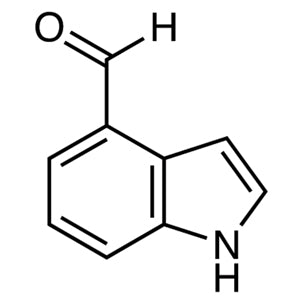
Indole-4-carboxaldehyde is a chemical compound widely used as a building block in the synthesis of complex molecules. It is a versatile reagent that plays a critical role in organic chemistry laboratories, particularly in the development of heterocyclic compounds and bioactive molecules. Its unique molecular structure, consisting of an indole ring fused with a carboxaldehyde group, makes it a valuable tool for chemists seeking to create new chemical entities with specific functional properties. This compound is commonly used in research settings to facilitate the formation of diverse molecular structures through various chemical reactions.
One of the key properties that make indole-4-carboxaldehyde a preferred choice is its reactivity. It readily participates in condensation, substitution, and catalytic reactions, enabling the synthesis of a wide range of derivatives. Additionally, its chemical stability under controlled conditions allows for reliable use in laboratory experiments. However, it is important to note that the compound is sensitive to moisture and air exposure, which can affect its integrity and performance. This sensitivity necessitates careful handling and storage to maintain its effectiveness.
In Indonesian laboratories, indole-4-carboxaldehyde is frequently utilized in organic chemistry, pharmaceutical, and biochemical research. Researchers rely on this compound to develop new compounds with potential medical or industrial applications. Its ability to form bonds with various functional groups makes it an essential component in the creation of novel molecules with tailored properties. This versatility ensures its continued relevance in both academic and industrial research environments.
Related TCI products
- Organic synthesis applications benefit from indole-4-carboxaldehyde due to its ability to participate in condensation and substitution reactions, enabling the creation of complex heterocyclic compounds.
- Pharmaceutical research utilizes this compound to develop bioactive molecules, as its structure can be modified to produce compounds with therapeutic potential.
- Biochemical studies often incorporate indole-4-carboxaldehyde to explore its role in enzyme interactions and molecular recognition processes.
- Industrial chemical production leverages its reactivity to synthesize intermediates for a variety of chemical products.
- Analytical chemistry uses it as a reference standard for identifying and quantifying related compounds in complex mixtures.
| Brand | TCI |
|---|---|
| CAS number | 1074-86-8 |
| Molecular formula | — |
| Purity | — |
| Category | Chemistry > Building Blocks > Non-Heterocyclic Building Blocks |
| Pack sizes | Available in various quantities as per supplier specifications |
| Physical form | Solid or liquid, depending on the specific product variant |
| Storage | Requires protection from moisture and air exposure |
Indole-4-carboxaldehyde should be stored in a cool, dry place away from direct sunlight and sources of moisture. It is recommended to use airtight containers to prevent exposure to air, which can lead to degradation. The compound is sensitive to oxidation, so it should be handled with care to avoid prolonged contact with air. In a laboratory setting, it is advisable to use fume hoods when working with this material to ensure proper ventilation and minimize exposure. Proper labeling of containers is essential to ensure safe handling and prevent accidental use. Regular monitoring of storage conditions is necessary to maintain the integrity of the compound and ensure its effectiveness for research purposes.
—
Produk Terkait
-
Imidazo[1,5-a]pyridine-3-carboxaldehyde TCI I0754
Regular price Rp 5.062.050,00Regular priceRp 3.555.300,00Sale price Rp 5.062.050,00 -
Indole-6-carboxaldehyde TCI I0743
Regular price Rp 2.411.850,00Regular priceRp 1.702.050,00Sale price Rp 2.411.850,00 -
Indole-2-carboxaldehyde TCI I0852
Regular price Rp 4.001.550,00Regular priceRp 2.814.000,00Sale price Rp 4.001.550,00 -
1H-Indole-3-carboxaldehydeOxime TCI I1060
Regular price Rp 2.279.550,00Regular priceRp 1.609.650,00Sale price Rp 2.279.550,00 -
Indole-5-carboxaldehyde TCI I0674
Regular price Rp 3.578.400,00Regular priceRp 2.517.900,00Sale price Rp 3.578.400,00 -
Indole-3-carboxaldehyde TCI I0027
Regular price Rp 717.150,00Regular priceRp 516.600,00Sale price Rp 717.150,00 -
AcidMonohydrate TCI T4293
Regular price Rp 1.749.300,00Regular priceRp 1.239.000,00Sale price Rp 1.749.300,00 -
2-(p-Tolyl)indole TCI T3351
Regular price Rp 2.677.500,00Regular priceRp 1.887.900,00Sale price Rp 2.677.500,00
![56671-66-0 Imidazo[1,5-a]pyridine-3-carboxaldehyde - AMI Scientific](http://amiscientific.com/cdn/shop/files/TCI2510I0754.jpg?v=1767120255&width=533)


![1,1,2-Trimethyl-1H-benzo[e]indole-7-sulfonic Acid Monohydrate - AMI Scientific](http://amiscientific.com/cdn/shop/files/TCI2510T4293.jpg?v=1767145027&width=533)
