


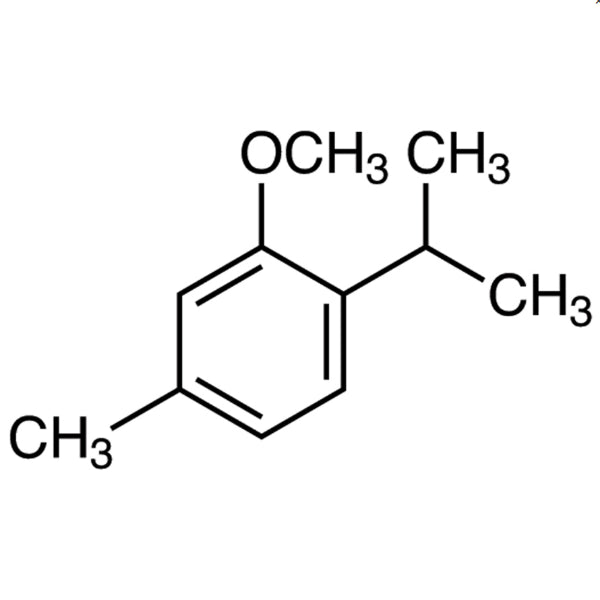
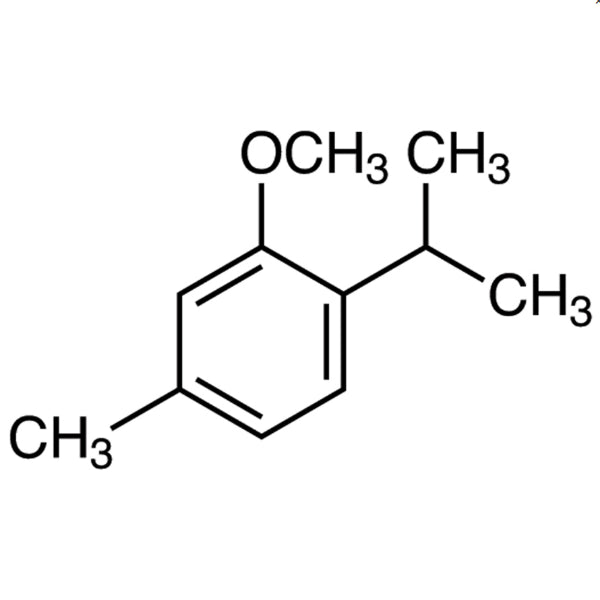
2-Isopropyl-5-methylanisole is a chemical compound widely used in laboratory settings for the synthesis of complex molecules. It belongs to the class of aromatic compounds and is a derivative of aniline, featuring a phenyl ring with substituted functional groups. This compound plays a crucial role in organic chemistry by serving as a building block for the creation of various functionalized derivatives. Its structural complexity makes it a valuable reagent in synthetic pathways, enabling the development of compounds with specific chemical properties.
The compound is known for its chemical stability and moderate reactivity, which allows it to participate effectively in substitution and redox reactions. These properties make it a preferred choice for researchers aiming to develop new materials, pharmaceuticals, and chemical intermediates. Its ability to undergo various chemical transformations under controlled conditions ensures its versatility across different experimental setups.
In Indonesian laboratories, 2-Isopropyl-5-methylanisole is commonly utilized in organic chemistry research, particularly in academic and industrial settings. It is an essential component in the study of aromatic compounds and is frequently used in chemical synthesis projects. Its presence in educational and research institutions highlights its importance in advancing scientific knowledge and innovation in the field of chemistry.
- Organic synthesis projects benefit from this compound due to its structural versatility and reactivity in forming complex molecules.
- Pharmaceutical research utilizes it as a precursor for developing new drug compounds with specific functional groups.
- Material science applications leverage its aromatic structure for creating advanced polymers and functional materials.
- Chemical education programs incorporate it as a key reagent for teaching synthetic methodologies and reaction mechanisms.
- Industrial research and development uses it to explore new chemical pathways and improve existing synthetic processes.
| Brand | TCI |
|---|---|
| CAS number | 1076-56-8 |
| Molecular formula | — |
| Purity | — |
| Category | Chemistry > Building Blocks > Non-Heterocyclic Building Blocks |
| Pack sizes | Available in various quantities as per standard laboratory supply |
| Physical form | Liquid or solid, depending on the specific product variant |
| Storage | Store in a cool, dry place away from direct sunlight and incompatible materials |
This compound should be stored in a cool, dry environment to maintain its chemical stability. It is recommended to keep it in a tightly sealed container to prevent exposure to moisture and air. Due to its potential reactivity, it should be stored away from strong oxidizers and reducing agents to avoid unwanted chemical interactions. Laboratory personnel should handle it with appropriate personal protective equipment, such as gloves and safety goggles, to ensure safe usage. Proper ventilation is essential when working with this compound to minimize inhalation risks. Regular monitoring of storage conditions is advised to ensure the compound remains in optimal condition for use in research and development activities.
—
Produk Terkait
-
2,3,5-Trimethylanisole TCI T2456
Regular price Rp 1.936.200,00Regular price -
4-Bromo-2,6-dimethylanisole TCI B3016
Regular price From Rp 1.590.750,00Regular price -
2-Ethylanisole TCI E0509
Regular price From Rp 1.220.100,00Regular price -
4-Ethylanisole TCI E0436
Regular price Rp 2.677.500,00Regular price -
3,5-Dimethylanisole TCI D2441
Regular price Rp 5.619.600,00Regular price -
2,5-Dimethylanisole TCI D2440
Regular price Rp 1.431.150,00Regular price -
2,6-Dimethylanisole TCI D2383
Regular price Rp 1.670.550,00Regular price -
2,3-Dimethylanisole TCI D2200
Regular price Rp 1.749.300,00Regular price


