

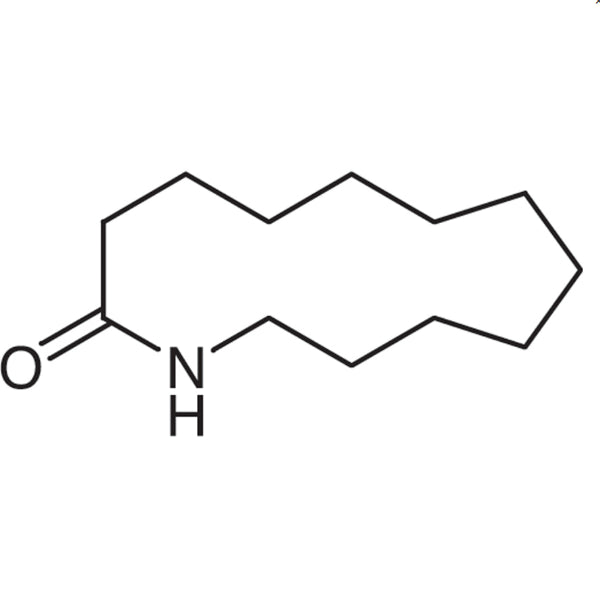
omega-Laurinlactam, more commonly known as laurolactam, is a twelve-membered lactam that serves as the key monomer for the production of polyamide 12, also called nylon 12. The compound is obtained through the cyclisation of a long-chain amino acid and functions as an important building block in polymer chemistry. In the laboratory, laurolactam is used to study ring-opening polymerisation, to synthesise polyamides with a defined methylene chain length, and as a reference material in the analysis and characterisation of long-chain nylon products.
The property that makes laurolactam valuable is the length of the methylene segment that sits between the amide groups of the resulting polymer. The longer that segment, the lower the density of hydrogen bonding along the chain, so polyamide 12 absorbs considerably less water and retains better dimensional stability and flexibility than short-chain nylons. It presents as a solid that is stable at room temperature and straightforward to weigh, while its twelve-membered ring is sufficiently stable that polymerisation normally requires a suitable catalyst or activator.
In Indonesian laboratories, laurolactam is used by groups working on polymer synthesis and materials characterisation. It supports academic and institutional research into ring-opening polymerisation, the preparation of reference polyamide samples, and comparative studies of long-chain nylon behaviour. Because the material is a stable weighable solid, it fits well into routine bench workflows in university and research-institute settings where monomers are handled on a small preparative scale.
- Ring-opening polymerisation studies: the twelve-membered ring is stable enough to allow controlled initiation, so reaction conditions, catalysts and activators can be compared systematically.
- Synthesis of polyamide 12: laurolactam is the direct monomer for nylon 12, giving researchers a defined route to polyamides with a specific methylene chain length between amide groups.
- Reference material for nylon analysis: as a well-defined monomer it serves as a comparison standard in the characterisation of long-chain polyamide products and reaction mixtures.
- Polymer structure–property research: the long methylene segment lets researchers study how reduced hydrogen-bond density affects water uptake, dimensional stability and flexibility.
- Building-block chemistry: as a non-heterocyclic building block, laurolactam supports preparative work where a long-chain lactam framework is required for further transformation.
| Brand | TCI |
|---|---|
| CAS number | 947-04-6 |
| Molecular formula | — |
| Purity | — |
| Category | Chemistry > Building Blocks > Non-Heterocyclic Building Blocks |
| Pack sizes | available in the standard TCI catalogue pack sizes; please confirm the required quantity when ordering |
| Physical form | solid at room temperature |
| Storage | keep in a tightly closed container in a cool, dry place |
Store laurolactam in a tightly closed container in a cool, dry and well-ventilated place, away from moisture and from sources of heat or ignition. Original manufacturer packaging or a clean, chemically compatible glass or high-density plastic container with a secure closure is suitable; label all secondary containers clearly. Handle the solid in a fume hood or a well-ventilated area to limit dust formation, and wear a laboratory coat, safety glasses and chemical-resistant gloves. Weigh out portions promptly and reseal the container to avoid moisture pickup, keep the material separate from strong oxidising agents and strong acids, and consult the manufacturer safety data sheet before use and for disposal guidance.
—
Produk Terkait
-
omega-Octalactam TCI O0162
Regular price Rp 6.970.950,00Regular price -
omega-Heptalactam TCI H0525
Regular price Rp 3.630.900,00Regular price -
(S)-1-Octyn-3-ol[omegaSide-ChainUnitforPGSynthesis] TCI O0235
Regular price From Rp 2.916.900,00Regular price


![32556-71-1 (S)-1-Octyn-3-ol [omega Side-Chain Unit for PG Synthesis] - AMI Scientific](http://amiscientific.com/cdn/shop/files/TCI2510O0235.jpg?v=1767131630&width=533)