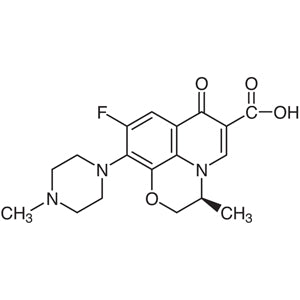
Levofloxacin is a fluoroquinolone antibiotic that represents the optically active enantiomer of ofloxacin. The compound works by inhibiting bacterial DNA gyrase and topoisomerase IV, two enzymes that play essential roles in the supercoiling, replication, and separation of bacterial DNA. When these enzymes are blocked, the bacterial cell fails to complete replication of its genetic material and ultimately dies. In the laboratory, this compound is used as a reagent and reference substance for microbiological testing, antimicrobial resistance research, and the development and validation of analytical methods in pharmaceutical and quality testing work.
The property that makes levofloxacin particularly useful is its broad spectrum of activity, covering both Gram-positive and Gram-negative bacteria, which is why it is frequently placed as a reference comparator on susceptibility testing panels. As a single pure enantiomer, levofloxacin delivers results that are easier to interpret than a racemic mixture when researchers correlate structure with activity. The molecule carries a carboxylate group and a basic nitrogen, making it amphoteric, which means its solubility is influenced by the pH of the solution. Understanding this behaviour is important for reliable preparation of working solutions.
In Indonesian laboratories, this material is typically encountered in pharmaceutical quality control units, university microbiology and pharmacy departments, and research groups studying antimicrobial resistance. It serves as the reference point against which test isolates and candidate compounds are compared, and as the analyte used when an analytical method is being developed or verified. Supplied under the TCI brand, it fits routine bench work where a consistent, well-characterised antibiotic standard is required across repeated experiments.
- Antimicrobial susceptibility testing: levofloxacin serves as a reference comparator on test panels because its broad spectrum covers both Gram-positive and Gram-negative organisms consistently.
- Antimicrobial resistance research: the compound provides a defined fluoroquinolone challenge for studying how bacterial populations respond when DNA gyrase and topoisomerase IV are inhibited.
- Analytical method development: as a reference substance it supports the construction of chromatographic and spectroscopic procedures for pharmaceutical and quality testing laboratories.
- Analytical method validation: the compound is used as the analyte when confirming that an established procedure performs reliably and reproducibly across repeated runs.
- Structure-activity relationship studies: being a single pure enantiomer rather than a racemate, it yields results that researchers can interpret more directly when linking molecular structure to biological activity.
| Brand | TCI (Tokyo Chemical Industry) |
|---|---|
| CAS number | 100986-85-4 |
| Molecular formula | — |
| Purity | — |
| Category | Life Science > Biochemicals and Reagents > Antibiotics |
| Pack sizes | available in the pack sizes listed for this catalogue item; please refer to the product listing |
| Physical form | — |
| Storage | — |
- Catalogue number: L0193
- Compound class: fluoroquinolone antibiotic; optically active enantiomer of ofloxacin
Store the material in its original tightly closed container, kept in a cool, dry place away from direct sunlight and sources of heat or moisture. Amber glass or the manufacturer's supplied packaging is suitable for protecting the contents, and containers should be resealed promptly after each use to limit exposure to atmospheric humidity. Handle the powder in a well-ventilated area or fume hood, wearing a laboratory coat, gloves, and safety glasses, and avoid generating dust when weighing. Because the molecule is amphoteric, the pH of the solvent affects its solubility, so working solutions should be prepared with this behaviour in mind and used according to the laboratory's own procedures. Consult the manufacturer's safety data sheet before handling.
—
Produk Terkait
-
TCI B5774 5,10-Bis(4,4,5,5-tetramethyl-1,3,2-dioxaborolan-2-yl)naphtho[1,2-c:5,6-c']bis([1,2,5]oxadiazole)
Regular price Rp 10.255.350,00Regular price -
Dihydroiodide TCI B6569
Regular price From Rp 1.936.200,00Regular price -
Trifluoromethanesulfonate TCI B7003
Regular price From Rp 1.936.200,00Regular price
![5,10-Bis(4,4,5,5-tetramethyl-1,3,2-dioxaborolan-2-yl)naphtho[1,2-c:5,6-c']bis([1,2,5]oxadiazole) - TCI B5774 - AMI Scientific](http://amiscientific.com/cdn/shop/files/TCI2510B5774.jpg?v=1769180228&width=533)