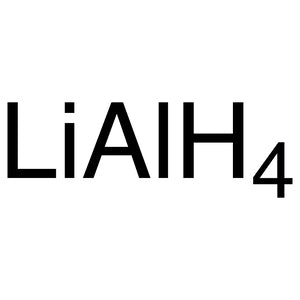
Lithium Aluminum Hydride (LiAlH₄), with the CAS number 16853-85-3, is a powerful reducing agent widely used in chemical laboratories for its ability to facilitate complex reduction reactions. As a metallic salt, it plays a critical role in organic chemistry by converting carbonyl compounds into alcohols and esters into alcohols. Its effectiveness in these transformations makes it an essential reagent for synthetic chemists. This compound is particularly valuable in reactions that require precise control over reduction conditions, such as those involving halogenated compounds.
LiAlH₄ is known for its high reactivity and strong reducing properties, which make it a preferred choice in controlled laboratory environments. It is highly sensitive to moisture and oxygen, necessitating careful handling and storage. These chemical properties allow it to participate in a variety of reactions, including the synthesis of complex organic molecules. Its reactivity also means it must be used in anhydrous conditions to prevent decomposition or unwanted side reactions.
In Indonesian laboratories, LiAlH₄ is commonly used in organic chemistry research and synthesis. It is a key component in the development of new compounds and materials, especially in academic and industrial settings where precise chemical reactions are required. Its use is prevalent in both teaching and research environments, supporting the advancement of chemical knowledge and innovation.
TCI brochures (PDF)
- Reducing Agents 2026-04-06 · p. 2
- Titanium Reagents Julia-Kocienski Olefination Reagents Peterson Reaction Reagents Z-Selective Horner-Wadsworth-Emmons Reagents 2025-03-28 · p. 4
- Metallic Salts 2025-11-06 · p. 10
Related TCI products
- Organic synthesis reactions where precise reduction of carbonyl groups is required, due to its strong reducing properties and ability to selectively reduce functional groups.
- Preparation of alcohols from esters and ketones, as it efficiently converts these compounds into their corresponding alcohols under controlled conditions.
- Reduction of halogenated compounds, such as alkyl halides, to form simpler alkyl compounds, making it ideal for synthetic pathways involving halogenated intermediates.
- Catalytic processes in inorganic chemistry where metallic salts are needed for redox reactions, due to its role as a strong reducing agent.
- Research applications in chemical synthesis requiring anhydrous and controlled environments, as it reacts vigorously with moisture and oxygen.
From the TCI brochure
- Reductant with TiCl3 in McMurry coupling of benzophenone in THF at reflux
| Brand | TCI |
|---|---|
| CAS number | 16853-85-3 |
| Molecular formula | — |
| Purity | — |
| Category | Chemistry > Catalysis and Inorganic Chemistry > Metallic Salts |
| Pack sizes | As listed on the product page |
| Physical form | Powder |
| Storage | Must be stored in a dry, inert atmosphere to prevent reaction with moisture and oxygen. |
LiAlH₄ must be stored in a dry, airtight container under an inert atmosphere to prevent exposure to moisture and oxygen, which can cause rapid decomposition. It is typically kept in a cool, dark place to minimize thermal degradation. Suitable containers include sealed glass or metal vessels with a drying agent to absorb any trace moisture. Due to its reactivity, it should only be handled in a fume hood with appropriate personal protective equipment. Regular monitoring of storage conditions is essential to ensure the material remains stable and safe for use in laboratory settings.
—
Produk Terkait
-
SodiumHydride(60%,dispersioninParaffinLiquid) TCI S0481
Regular price From Rp 955.500,00Regular price -
Zinc(Powder) TCI Z0015
Regular price Rp 477.750,00Regular price -
PotassiumHydroxide(Powder) TCI P2844
Regular price From Rp 505.050,00Regular price -
CalciumChlorideAnhydrous(Powder) TCI C4209
Regular price Rp 689.850,00Regular price -
XanthaneHydride TCI X0001
Regular price From Rp 2.889.600,00Regular price -
Aluminumsec-Butoxide TCI A0244
Regular price From Rp 584.850,00Regular price -
Aluminum(III)Oxide,AEROXIDE(regR)AluC TCI A3546
Regular price Rp 1.220.100,00Regular price -
Aluminum(III)Fluoride TCI A3470
Regular price From Rp 1.220.100,00Regular price