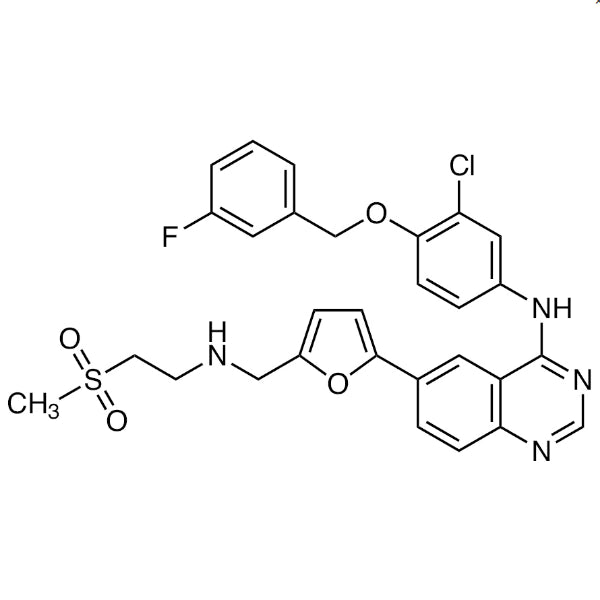
Lapatinib is a chemical compound widely used in pharmacological research to study the mechanisms of action of specific drugs. As a pharmacological reagent, it plays a crucial role in experiments related to the inhibition of protein tyrosine kinase, particularly in cancer research. This compound is essential for understanding how cells respond to various treatments and for evaluating the effectiveness of potential therapeutic agents. Its application in laboratories supports the development of more targeted and effective treatments by providing insights into cellular behavior under different conditions.
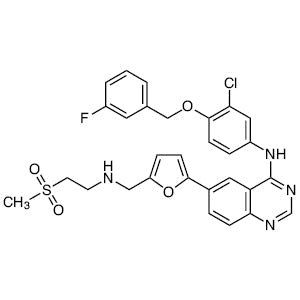
Lapatinib is preferred due to its stable chemical properties, which allow it to be used in a variety of experimental conditions. Its molecular structure enables specific interactions with biological targets, making it a key component in pharmacological studies. The compound is available in solid form and dissolves well in organic solvents, enhancing its practicality for use in various analytical methods. Additionally, Lapatinib exhibits non-toxic properties under certain conditions, reducing the risk of cell toxicity during experiments and ensuring safer handling in laboratory settings.
In Indonesian laboratories, Lapatinib is commonly used in cancer and pharmacology research. It supports studies aimed at understanding the mechanisms of drug action and developing new therapeutic strategies. Its reliability and effectiveness make it a valuable tool for researchers working on drug discovery and biological response analysis. The compound’s versatility and stability contribute to its widespread use in both academic and industrial research environments.
- Cancer Research: Lapatinib is used to study the inhibition of protein tyrosine kinase, which is crucial in understanding tumor growth and treatment resistance.
- Pharmacological Testing: It serves as a reagent for evaluating drug efficacy and cellular response to various therapeutic agents.
- Drug Development: Lapatinib helps in the development of targeted therapies by analyzing how specific compounds interact with biological targets.
- Biochemical Analysis: Its solubility in organic solvents makes it suitable for use in various analytical techniques and experimental protocols.
- Cellular Response Studies: It is employed to investigate how cells react to different treatments, aiding in the assessment of drug effectiveness and toxicity.
| Brand | TCI |
|---|---|
| CAS number | 231277-92-2 |
| Molecular formula | — |
| Purity | — |
| Category | Life Science > Biochemicals and Reagents > Pharmaceutical Research Reagents |
| Pack sizes | Available in various quantities as per standard reagent packaging |
| Physical form | Solid |
| Storage | Store in a cool, dry place away from direct sunlight |
Lapatinib should be stored in a cool, dry environment to maintain its chemical stability and prevent degradation. It is recommended to keep the compound in a tightly sealed container to avoid exposure to moisture and air, which could affect its integrity. Suitable storage conditions include a controlled room temperature, typically between 15°C and 25°C, with low humidity levels. When handling Lapatinib, it is important to use appropriate personal protective equipment, such as gloves and safety goggles, to ensure safety. The compound should be kept away from incompatible substances to prevent any potential chemical reactions. Proper labeling of storage containers is essential for safe handling and easy identification in a laboratory setting.
—
Product Categories
- Biochemicals and ReagentsPharmaceutical Research Reagents (for Experimental Use)Antitumor Research Reagents (for Experimental Use)
- Cell BiologyCancer ResearchAntitumor Agents for Research
- Cell BiologyCell Signaling and NeuroscienceKinase/Phosphatase Biology
- Pharmaceutical Development and Drug Discovery ResearchPharmaceutical Research Reagents (for Experimental Use)Antitumor Research Reagents (for Experimental Use)
Produk Terkait
-
Imatinib TCI I0906
Regular price From Rp 1.326.150,00Regular price -
Vandetanib TCI V0199
Regular price From Rp 2.121.000,00Regular price -
SunitinibMalate TCI U0095
Regular price Rp 3.021.900,00Regular price -
TyrphostinAG835 TCI T3540
Regular price From Rp 2.016.000,00Regular price -
TyrphostinA1 TCI T3074
Regular price From Rp 1.670.550,00Regular price -
TyrphostinAG490 TCI T2962
Regular price Rp 1.378.650,00Regular price -
TyrphostinAG1478 TCI T2944
Regular price Rp 6.651.750,00Regular price -
Bosutinib TCI B4824
Regular price Rp 4.718.700,00Regular price