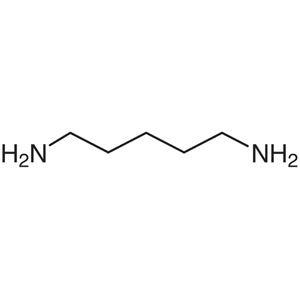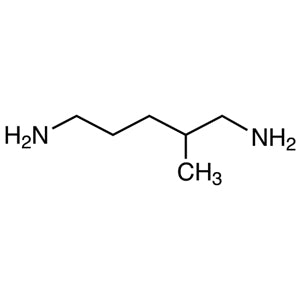
TCI M0205 2-Methyl-1,5-diaminopentane is a branched aliphatic diamine supplied as a liquid, carrying two primary amine groups at the ends of its carbon chain. These two nucleophilic centres make it a versatile material, serving both as a surface ligand in colloidal quantum dot research and as a curing agent and chain extender in polymer chemistry. In materials laboratories, the compound is frequently used to modify nanoparticle surfaces so that dispersions remain more stable, while at the same time providing functional groups that can be reacted further during device assembly stages.
The properties that make it a preferred choice are the strong basicity of its amine groups, the flexibility of a chain that carries a methyl branch, and the liquid form that simplifies volumetric measurement and mixing. The methyl branch on the pentane backbone lowers the tendency toward crystallisation and introduces useful steric spacing when the ligand attaches to a nanocrystal surface, so aggregation can be suppressed. Its two primary amine groups are capable of binding metals as well as reacting with epoxides, isocyanates, and carboxylic acids, making this compound a practical connection point for building larger molecular networks.
In Indonesian laboratories, this reagent typically appears in materials science and electronic materials work, particularly where colloidal quantum dots are prepared, ligand-exchanged, or integrated into devices. It is also drawn on in polymer formulation work that requires a difunctional amine building block. Handling is normally carried out by trained personnel inside a fume hood, with volumes dispensed from the liquid stock as required by the experimental protocol.
TCI brochures (PDF)
- Colloidal Quantum Dot (QD) Research Reagents 2026-05-21 · p. 8
- Biomaterials Research Reagents 2025-02-19 · p. 18
- Monomers 2025-05-28 · p. 32
- Colloidal quantum dot surface ligand chemistry: the two primary amine groups coordinate to nanocrystal surfaces, improving dispersion stability while leaving reactive functionality available for later assembly steps.
- Ligand exchange for nanoparticle dispersions: the branched, flexible chain provides steric spacing on the nanocrystal surface, suppressing aggregation and helping dispersions remain workable through subsequent processing.
- Epoxy curing agent formulation: the difunctional primary amine reacts readily with epoxide rings, allowing the compound to act as a hardener in polymer chemistry work carried out in the laboratory.
- Polymer chain extension: because both ends of the molecule carry reactive amine groups, it links smaller units into longer chains and larger molecular networks during formulation studies.
- Metal coordination and complexation studies: the two nucleophilic amine centres bind metal species, making the compound useful as a bidentate connection point in coordination chemistry investigations.
| Brand | TCI |
|---|---|
| CAS number | 15520-10-2 |
| Molecular formula | — |
| Purity | — |
| Category | Materials Science > Electronic Materials > Colloidal Quantum Dot (QD) Research Reagents |
| Pack sizes | available in standard TCI catalogue pack sizes; please confirm the size required when ordering |
| Physical form | liquid |
| Storage | store in a tightly closed container in a cool, well-ventilated area away from incompatible materials |
Store the container tightly closed in a cool, dry, and well-ventilated place, kept away from oxidising agents, acids, and other incompatible materials. Original supplier packaging or chemically compatible bottles are preferred, and containers should be resealed promptly after use to limit exposure to air and moisture. Because this is a strongly basic amine liquid, handle it inside a fume hood with appropriate gloves, safety glasses, and a laboratory coat. Dispense volumes carefully, avoid contact with skin and eyes, and follow local institutional procedures for waste collection and disposal.
—
Product Categories
- Electronic MaterialsColloidal Quantum Dot (QD) Research ReagentsCapping Agents [Colloidal Quantum Dot (QD) Research Reagents]
- Polymer/Macromolecule ReagentsMonomersDiamine Monomers
- Biomaterials/Biocompatible Materials Research ReagentsMonomers and Macromonomers [Biomaterials/Biocompatible Materials Research Reagents]Diamine Monomers [Biomaterials/Biocompatible Materials Research Reagents]
Produk Terkait
-
1,5-Diaminopentane TCI D0108
Regular price From Rp 2.227.050,00Regular priceRp 1.557.150,00Sale price From Rp 2.227.050,00 -
1,3-Diaminopentane TCI D2252
Regular price Rp 3.870.300,00Regular priceRp 2.705.850,00Sale price Rp 3.870.300,00 -
1,5-DiaminopentaneDihydrochloride TCI D0099
Regular price From Rp 1.458.450,00Regular priceRp 1.019.550,00Sale price From Rp 1.458.450,00 -
1,3-Phenylenediamine TCI P1911
Regular price From Rp 1.193.850,00Regular priceRp 834.750,00Sale price From Rp 1.193.850,00 -
1,3-Phenylenediamine TCI P1892
Regular price From Rp 505.050,00Regular priceRp 352.800,00Sale price From Rp 505.050,00 -
1,4-Phenylenediamine TCI P0170
Regular price From Rp 557.550,00Regular priceRp 389.550,00Sale price From Rp 557.550,00 -
EthylenediamineAnhydrous TCI E0077
Regular price From Rp 505.050,00Regular priceRp 352.800,00Sale price From Rp 505.050,00 -
1,11-Diaminoundecane TCI D2075
Regular price From Rp 2.147.250,00Regular priceRp 1.501.500,00Sale price From Rp 2.147.250,00