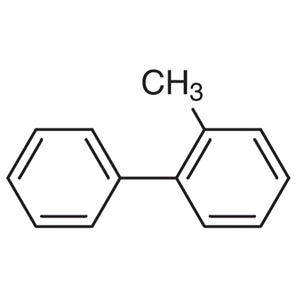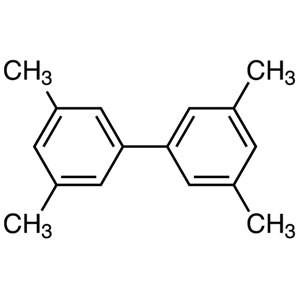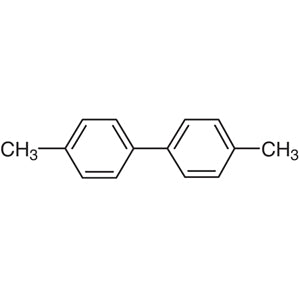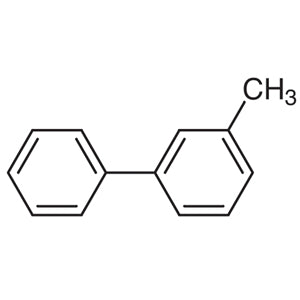
TCI M0296 3-Methylbiphenyl (CAS 643-93-6) is an aromatic hydrocarbon compound consisting of two benzene rings joined by a direct bond, with a single methyl group occupying the meta position on one of the rings. The compound belongs to the non-heterocyclic building block family, meaning it serves as a starting material that chemists use to construct larger molecular frameworks. In organic synthesis laboratories, biaryl structures such as this one form the core scaffold for ligands, organic materials, pharmaceutical active compounds, and reference substances used in studies of cross-coupling reactions and aromatic C–H bond functionalization.
The principal appeal of this compound lies in the two distinct types of reactive sites it offers at the same time. The aromatic rings can undergo electrophilic substitution reactions, while the methyl group provides a benzylic position that is relatively straightforward to functionalize — for example by converting it into benzylic derivatives or oxidizing it further. The placement of the methyl group at the meta position produces a pattern of steric hindrance and electron distribution that differs from both the ortho and para isomers, which is why this compound is frequently used to probe the positional selectivity of a given reaction. The biaryl framework additionally contributes lipophilicity and conformational rigidity, both of which matter in ligand design.
In Indonesian laboratories, 3-Methylbiphenyl is typically encountered in university and institutional organic synthesis groups, in methodology research where reaction selectivity is being mapped, and in materials and medicinal chemistry programmes that build outward from biaryl cores. It also serves as a well-defined reference compound when analytical methods are being developed or validated, and as a teaching substrate in advanced synthesis courses where students explore aromatic reactivity patterns.
- Cross-coupling reaction studies — the biaryl framework makes this compound a useful reference and model substrate when researchers evaluate catalyst performance, coupling efficiency, and reaction conditions in carbon–carbon bond-forming chemistry.
- Aromatic C–H functionalization research — the meta-substituted arrangement provides a clearly defined electronic and steric environment, allowing investigators to determine which aromatic positions a given C–H activation protocol actually targets.
- Ligand synthesis and design — the rigid biaryl backbone combined with lipophilic character makes it an appropriate starting framework for constructing ligands whose conformational behaviour must be controlled and predictable.
- Benzylic derivatization chemistry — the methyl substituent gives synthetic chemists an accessible benzylic site that can be converted into benzylic derivatives or carried forward through further oxidation into related functional groups.
- Positional selectivity screening — because the meta isomer behaves differently from its ortho and para counterparts, it is regularly employed to test and compare how selectively a reaction distinguishes between aromatic substitution positions.
| Brand | TCI (Tokyo Chemical Industry) |
|---|---|
| CAS number | 643-93-6 |
| Molecular formula | — |
| Purity | — |
| Category | Chemistry > Building Blocks > Non-Heterocyclic Building Blocks |
| Pack sizes | available in standard TCI research-scale packaging; please confirm the specific size when ordering |
| Physical form | — |
| Storage | store according to the conditions stated on the manufacturer's label and safety data sheet |
- Product code: M0296
- Chemical name: 3-Methylbiphenyl
Store this product in a tightly closed original container, kept in a cool, dry, and well-ventilated area away from direct sunlight, heat sources, ignition sources, and strong oxidizing agents. As an aromatic organic compound, it should be handled inside a properly functioning fume hood to limit vapour exposure. Laboratory personnel should wear appropriate personal protective equipment, including chemical-resistant gloves, safety goggles, and a laboratory coat. Avoid contact with skin and eyes and avoid breathing vapours. Keep containers clearly labelled, and always consult the manufacturer's safety data sheet before use, during handling, and when arranging waste disposal in accordance with applicable institutional and local regulations.
—
Produk Terkait
-
2-Methylbiphenyl TCI M1242
Regular price From Rp 1.405.950,00Regular price -
4-Methylbiphenyl TCI M0563
Regular price From Rp 1.060.500,00Regular price -
4-(3-Buten-1-yl)-4'-methylbiphenyl TCI B5872
Regular price Rp 2.094.750,00Regular price -
3,3',5,5'-Tetramethylbiphenyl TCI T2948
Regular price From Rp 2.597.700,00Regular price -
3-Ethylbiphenyl TCI E0568
Regular price Rp 5.857.950,00Regular price -
2,2'-Dimethylbiphenyl TCI D1717
Regular price From Rp 1.590.750,00Regular price -
3,3'-Dimethylbiphenyl TCI D1430
Regular price From Rp 2.650.200,00Regular price -
4,4'-Dimethylbiphenyl TCI D1234
Regular price From Rp 823.200,00Regular price