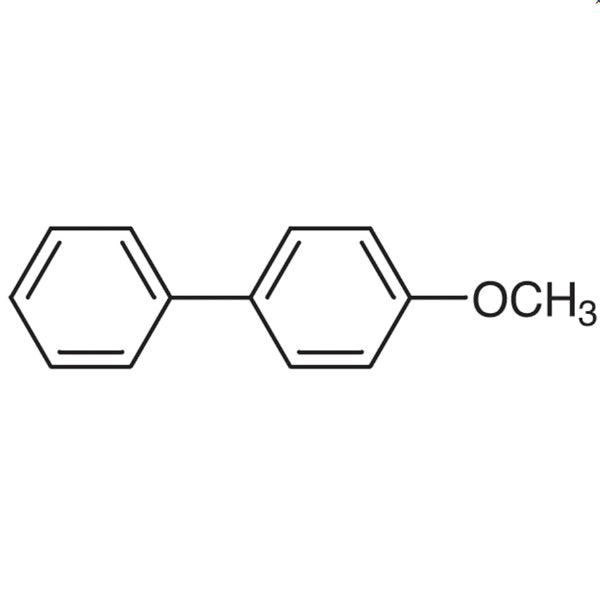
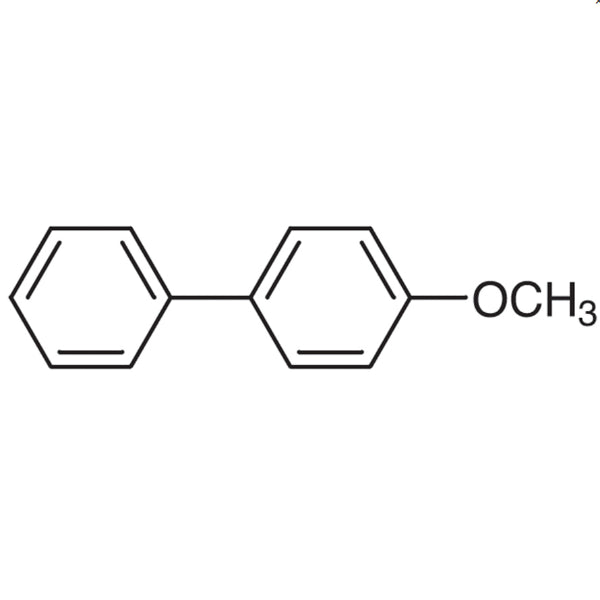
TCI M0944 4-Methoxybiphenyl, CAS 613-37-6, is an aromatic compound built from two benzene rings joined directly to one another, with a methoxy group at the para position of one ring. This conjugated biphenyl framework makes it a widely used non-heterocyclic building block in the synthesis of functional materials. In the laboratory, the compound frequently appears as a reference product for cross-coupling reactions, as the core scaffold of optoelectronic materials, and as a precursor on the route toward more elaborate biphenyl derivatives.
The property that makes it attractive is the methoxy group, which is electron-donating and therefore directs electrophilic substitution reactions toward particular positions while influencing the electronic and photophysical behaviour of the biphenyl framework. The compound is a stable crystalline solid that is easy to weigh out, straightforward to purify by recrystallisation or chromatography, and dissolves readily in organic solvents such as dichloromethane, toluene, and ethyl acetate. Its ether group can also be demethylated to give 4-hydroxybiphenyl, opening a pathway to ester, ether, and biphenol-based polymer derivatives.
Laboratories in Indonesia typically use this compound in organic chemistry research, in synthetic work where a well-defined biphenyl core is required, and in method development where a dependable reference compound for coupling chemistry is needed. Because it handles predictably as a crystalline solid and behaves consistently in common organic solvents, it fits comfortably into the routine workflows of university research groups, institutional laboratories, and industrial research units.
- Cross-coupling reaction reference — the compound is a recognised product of cross-coupling chemistry, so it serves as a dependable comparison standard when verifying that a coupling procedure has performed as intended.
- Optoelectronic materials synthesis — its conjugated biphenyl core acts as the central scaffold in functional materials work, where the extended aromatic system governs the electronic behaviour of the target compound.
- Precursor for complex biphenyl derivatives — the defined substitution pattern gives synthetic chemists a clean starting point for building more elaborate biphenyl structures without ambiguity in regiochemistry.
- Demethylation to 4-hydroxybiphenyl — the ether group can be cleaved to unmask a phenol, opening synthetic routes toward ester, ether, and biphenol-based polymer derivatives from a single starting material.
- Electrophilic substitution studies — the electron-donating methoxy group directs incoming electrophiles to specific ring positions, making this a useful substrate for teaching and investigating directing-group effects.
| Brand | TCI |
|---|---|
| CAS number | 613-37-6 |
| Molecular formula | — |
| Purity | — |
| Category | Chemistry > Building Blocks > Non-Heterocyclic Building Blocks |
| Pack sizes | available in the standard laboratory pack sizes supplied by the manufacturer |
| Physical form | stable crystalline solid; soluble in organic solvents including dichloromethane, toluene, and ethyl acetate |
| Storage | keep in a closed container under the conditions stated on the manufacturer's label |
- Chemical name: 4-Methoxybiphenyl
Store 4-Methoxybiphenyl in its original tightly closed container, kept in a cool, dry, well-ventilated place away from direct sunlight, moisture, and sources of ignition. Amber glass or the manufacturer's supplied packaging is suitable, and containers should be resealed promptly after each use to limit exposure to air and humidity. Handle the solid in a fume hood when weighing or transferring quantities that may generate dust, and wear a laboratory coat, safety glasses, and chemical-resistant gloves. Avoid inhalation of dust and contact with skin and eyes. Keep the material separate from strong oxidising agents, and always consult the manufacturer's safety data sheet before use and before disposing of any residues.
—
Produk Terkait
-
2-Methoxybiphenyl TCI M1713
Regular price Rp 1.565.550,00Regular price -
3-Methoxybiphenyl TCI M1358
Regular price Rp 4.743.900,00Regular price -
4-Hydroxy-4'-methoxybiphenyl TCI H0819
Regular price From Rp 1.881.600,00Regular price -
3,3'-Dibromo-4,4'-dimethoxybiphenyl TCI D3603
Regular price From Rp 1.565.550,00Regular price -
4,4'-Diethoxybiphenyl TCI D1127
Regular price Rp 2.650.200,00Regular price -
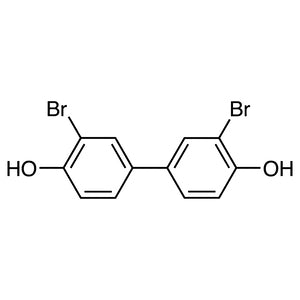
3,3'-Dibromo-4,4'-dihydroxybiphenyl TCI D3602
Regular price From Rp 5.539.800,00Regular price -
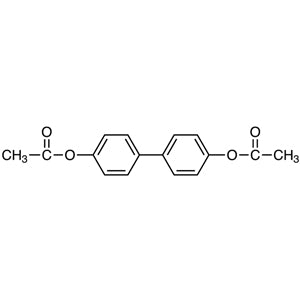
4,4'-Diacetoxybiphenyl TCI D2266
Regular price Rp 3.127.950,00Regular price -
4-(6-Hydroxyhexyloxy)-4'-methoxybiphenyl TCI H0767
Regular price Rp 1.405.950,00Regular price