

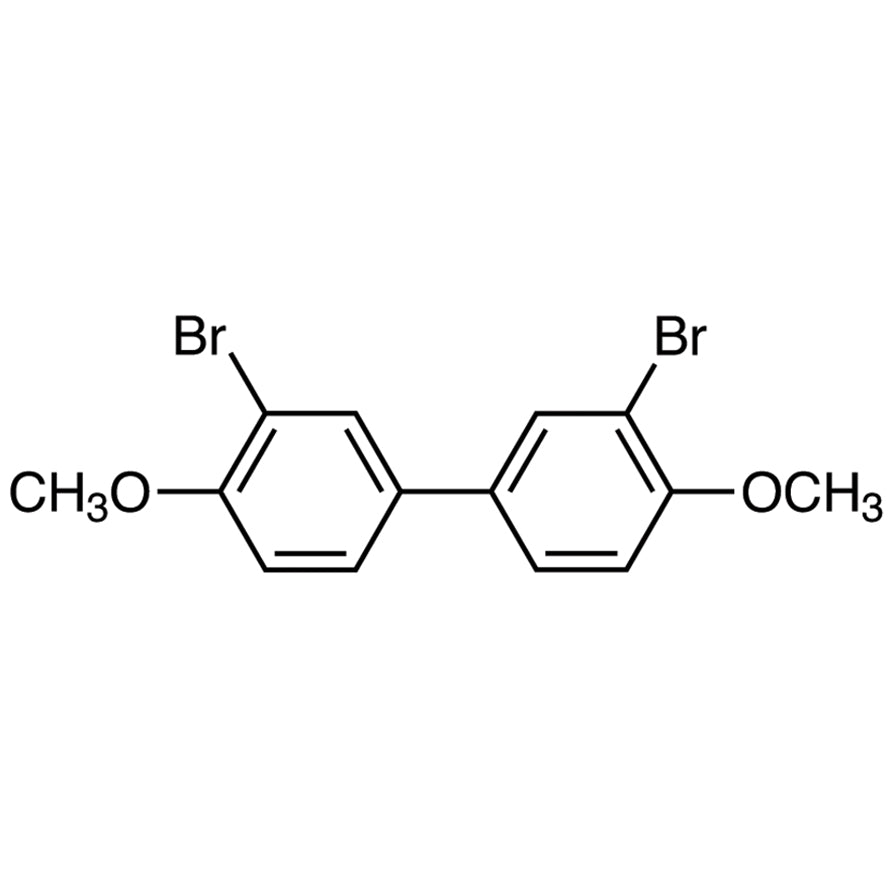
3,3'-Dibromo-4,4'-dimethoxybiphenyl is a non-heterocyclic building block built on a biphenyl framework, carrying two bromine atoms together with two methoxy groups arranged symmetrically across both aromatic rings. The compound is essentially a protected form of its dihydroxy analogue, since the phenolic groups have been converted into methyl ethers that are far more resistant to bases and organometallic reagents. In the laboratory, its primary role is to supply a rigid aromatic scaffold with two ready-to-use coupling points, without the concern that free hydroxyl groups will interfere with the course of the reaction.
Its main advantage lies in the combination of stability and directed reactivity. The methoxy groups are electron-donating, so they modulate the electron density of the rings while at the same time protecting the oxygen positions from deprotonation, which makes this compound suitable for directed lithiation, halogen–metal exchange, and cross-coupling reactions that require basic conditions. The carbon–bromine bonds, positioned ortho to the methoxy groups, are readily activated by palladium or nickel catalysts, so the installation of aryl, alkynyl, amine, or boronate groups proceeds selectively. Where required, the methyl ethers can be cleaved again to reveal the free phenols.
In Indonesian laboratories, this building block is typically used in synthetic organic chemistry and materials research groups that assemble biphenyl-based structures step by step. It serves university research laboratories, institutional research centres, and industrial R&D units that need a symmetrical, difunctional aromatic core as a starting point. Because the material is handled in small synthetic quantities, it is usually stored alongside other halogenated building blocks in a dedicated chemical store and weighed out as individual reactions require.
- Suzuki–Miyaura cross-coupling: the two aryl–bromine bonds are readily activated by palladium catalysts, allowing boronic acids or esters to be attached selectively at both positions of the biphenyl core.
- Directed ortho-lithiation and halogen–metal exchange: the methoxy groups protect the oxygen positions from deprotonation, so strongly basic organolithium conditions can be applied without degrading the substrate.
- Buchwald–Hartwig amination: the bromine positions accept aryl or alkyl amines under palladium or nickel catalysis, giving access to nitrogen-substituted biphenyl derivatives from a single symmetrical precursor.
- Sonogashira alkynylation: the activated carbon–bromine bonds allow alkynyl groups to be introduced, extending the rigid biphenyl framework into longer conjugated architectures for materials work.
- Protected-phenol synthetic routes: the compound acts as a masked dihydroxybiphenyl, letting chemists complete coupling steps first and then cleave the methyl ethers to liberate the free phenols.
| Brand | TCI |
|---|---|
| CAS number | 108989-36-2 |
| Molecular formula | — |
| Purity | — |
| Category | Chemistry > Building Blocks > Non-Heterocyclic Building Blocks |
| Pack sizes | available in standard TCI research-scale pack sizes; please confirm the currently offered options when ordering. |
| Physical form | — |
| Storage | keep in a cool, dry place in a tightly closed original container, protected from light and moisture. |
- Catalogue number: D3603
Store the container tightly closed in a cool, dry, and well-ventilated chemical store, away from light, moisture, and sources of ignition, and keep it separated from strong oxidising agents and strong bases. The original supplier container is the most suitable primary packaging; if transfer is necessary, use clean, dry, tightly sealing amber glass with chemically resistant closures and clear labelling that includes the compound name and CAS number. Handle the material in a fume hood using safety glasses, nitrile gloves, and a laboratory coat, avoid the generation of dust, and wash hands after use. As with other halogenated aromatic building blocks, weigh out only the quantity required, reseal the container promptly to limit moisture uptake, and dispose of residues and contaminated consumables through the laboratory's designated chemical waste stream in line with local regulations and the manufacturer's safety data sheet.
—
Produk Terkait
-
2-Methoxybiphenyl TCI M1713
Regular price Rp 1.565.550,00Regular price -
3-Methoxybiphenyl TCI M1358
Regular price Rp 4.743.900,00Regular price -
4-Methoxybiphenyl TCI M0944
Regular price From Rp 769.650,00Regular price -
4-Hydroxy-4'-methoxybiphenyl TCI H0819
Regular price From Rp 1.881.600,00Regular price -
4,4'-Diethoxybiphenyl TCI D1127
Regular price Rp 2.650.200,00Regular price -
2,7-Dibromo-9-phenyl-9H-fluoren-9-ol TCI D5448
Regular price From Rp 1.749.300,00Regular price -
2,4-Dibromo-6-nitrophenol TCI D5323
Regular price Rp 1.881.600,00Regular price -
3,5-Dibromo-p-cresol TCI D5093
Regular price Rp 1.458.450,00Regular price


