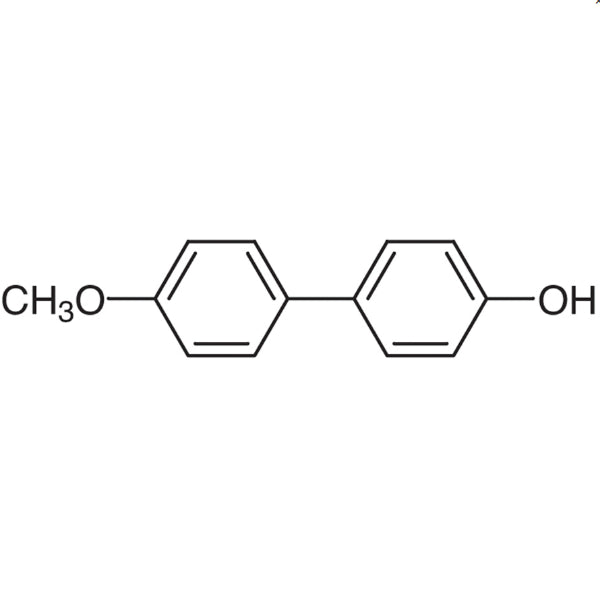
TCI H0819 4-Hydroxy-4'-methoxybiphenyl is a substituted biphenyl compound carrying a hydroxyl group on one ring and a methoxy group on the other, with both substituents located precisely at the para positions. In the laboratory it serves as a non-heterocyclic building block, that is, an intermediate used to assemble larger target molecules. Its free phenol group provides a practical connection point for etherification and esterification reactions, allowing researchers to attach alkyl chains, polymerizable groups, or other aromatic fragments without having to construct the biphenyl framework from scratch.
The principal property that makes this compound a preferred choice is its rigid and almost linear biphenyl backbone. This rigidity matters in the design of molecules that require an elongated and well-defined shape, such as mesogenic compounds and optoelectronic materials, because molecular shape strongly governs phase behaviour and optical properties. The para-para substitution pattern gives the molecule a straight axis, while the combination of an electron-donating methoxy group with a modifiable hydroxyl group offers considerable freedom to tune the polarity and electronic character of the final product.
The compound is supplied as a solid. In Indonesian laboratories it is typically used in university and institutional research settings where synthetic organic chemistry, liquid crystal work, and functional materials development are carried out. Researchers generally draw on it during the preparation of intermediates for multi-step syntheses, where a ready-made biphenyl core shortens the route considerably. It is normally ordered in research-scale quantities alongside other building blocks used in the same synthetic programme.
- Organic synthesis intermediate preparation: the free phenolic hydroxyl provides a reliable handle for building larger target molecules without first constructing the biphenyl framework from scratch.
- Etherification reactions: the phenol group readily undergoes O-alkylation, letting researchers attach alkyl chains of chosen length to tune solubility and packing behaviour of the product.
- Esterification chemistry: the hydroxyl functionality can be acylated to introduce ester linkages, a common step when assembling elongated molecules from separate aromatic fragments.
- Mesogenic and liquid crystal material research: the rigid, nearly linear para-para substituted biphenyl core supplies the elongated molecular shape that phase-forming compounds require.
- Optoelectronic materials development: the electron-donating methoxy group combined with the modifiable hydroxyl allows systematic adjustment of polarity and electronic properties in candidate materials.
| Brand | TCI (Tokyo Chemical Industry) |
|---|---|
| CAS number | 16881-71-3 |
| Molecular formula | — |
| Purity | — |
| Category | Chemistry > Building Blocks > Non-Heterocyclic Building Blocks |
| Pack sizes | available in standard TCI research-scale packaging; please confirm the size required when ordering |
| Physical form | solid |
| Storage | keep in a tightly closed container in a cool, dry place away from light |
- Product code: H0819
Store this material in its original tightly closed container in a cool, dry, well-ventilated area, protected from direct sunlight and away from strong oxidising agents. Amber glass or the manufacturer's supplied packaging is suitable for keeping the solid dry and shielded from light. Handle the compound inside a fume hood, and weigh it carefully to limit dust formation. Standard laboratory personal protective equipment applies: safety glasses, chemical-resistant gloves, and a laboratory coat. Keep the container properly labelled, close it immediately after use, and consult the manufacturer's safety data sheet before first handling and before any disposal of residues.
—
Produk Terkait
-
4,4'-Diethoxybiphenyl TCI D1127
Regular price Rp 2.650.200,00Regular price -
2-Methoxybiphenyl TCI M1713
Regular price Rp 1.565.550,00Regular price -
3-Methoxybiphenyl TCI M1358
Regular price Rp 4.743.900,00Regular price -
4-Methoxybiphenyl TCI M0944
Regular price From Rp 769.650,00Regular price -
4-(6-Hydroxyhexyloxy)-4'-methoxybiphenyl TCI H0767
Regular price Rp 1.405.950,00Regular price -
3,3'-Dibromo-4,4'-dimethoxybiphenyl TCI D3603
Regular price From Rp 1.565.550,00Regular price -
4'-Decyloxybiphenyl-4-carboxylicAcid TCI D2041
Regular price Rp 3.446.100,00Regular price -
2-Hydroxy-3,5,5-trimethyl-2-cyclohexen-1-one TCI T2723
Regular price Rp 1.273.650,00Regular price