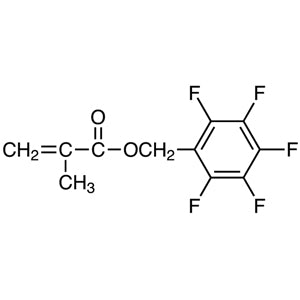
TCI M0988 1,1,1,3,3,3-Hexafluoroisopropyl Methacrylate is a methacrylate monomer whose ester group carries a hexafluoroisopropyl fragment, a chain in which every methyl position has been replaced by fluorine atoms. The monomer is supplied stabilized with the polymerization inhibitor MEHQ so that it does not self-polymerize during storage and shipping. In materials science and polymer laboratories, this reagent is used to build highly fluorinated polymers, either as a homopolymer or as a comonomer inserted to modify the surface and optical properties of an acrylate polymer system.
The main reason researchers select this monomer is the strong influence that fluorine atoms exert on the properties of the resulting polymer. The presence of the hexafluoroisopropyl group lowers surface energy, so films formed from it tend to repel both water and oil, while at the same time lowering the refractive index — a characteristic much in demand for optical applications such as optical fiber cladding. Fluorinated polymers also generally show good chemical resistance and thermal stability. The methacrylate group remains reactive toward conventional free radical polymerization as well as controlled polymerization techniques, so polymer architecture can be directed as needed.
In Indonesian laboratories, this monomer is typically handled in university and institutional polymer research groups, materials science laboratories, and coating or optical materials development units. It is generally used at bench scale for synthesizing experimental copolymers, preparing low-surface-energy films for characterization, and screening formulations before any larger trial. Because the material is inhibited rather than inert, laboratories normally plan their experiments around a defined working window and record the handling conditions applied to each batch.
TCI brochures (PDF)
- Fluorination Reagents, Fluorinated Building Blocks 2026-03-18 · p. 53
Related TCI products
- TCI H1582 2160-89-6 1,1,1,3,3,3-Hexafluoroisopropyl Acrylate (stabilized with TBC)
- TCI T3728 45102-52-1 2,2,3,3-Tetrafluoropropyl Methacrylate (stabilized with MEHQ)
- TCI T3414 2144-53-8 1H,1H,2H,2H-Tridecafluoro-n-octyl Methacrylate (stabilized with HQ + MEHQ)
- TCI P2546 114859-23-3 Pentafluorobenzyl Methacrylate (stabilized with BHT)
- TCI P2353 45115-53-5 2,2,3,3,3-Pentafluoropropyl Methacrylate (stabilized with TBC)
- TCI P2289 13642-97-2 Pentafluorophenyl Methacrylate (stabilized with MEHQ)
- Fluorinated homopolymer synthesis — the methacrylate group polymerizes under conventional free radical conditions, giving a highly fluorinated backbone whose properties derive directly from the hexafluoroisopropyl ester fragment.
- Copolymer modification of acrylate systems — inserted as a comonomer, it adjusts the surface and optical behaviour of an existing acrylate polymer without requiring a completely new polymerization chemistry to be developed.
- Low-surface-energy coating research — the hexafluoroisopropyl group lowers surface energy so that the resulting films tend to repel both water and oil, supporting repellent coating studies.
- Optical material development — the fluorine content lowers the refractive index of the resulting polymer, which is the property required for applications such as optical fiber cladding work.
- Controlled polymerization studies — the methacrylate function remains reactive toward controlled polymerization techniques, allowing researchers to direct polymer architecture rather than relying on conventional radical polymerization alone.
| Brand | TCI |
|---|---|
| CAS number | 3063-94-3 |
| Molecular formula | — |
| Purity | — |
| Category | Materials Science > Polymer/Macromolecule Reagents > Monomers |
| Pack sizes | please refer to the current TCI catalogue listing for available pack configurations |
| Physical form | — |
| Storage | store so that the inhibitor remains effective and premature polymerization is avoided |
- Chemical class: methacrylate monomer bearing a hexafluoroisopropyl ester fragment
- Stabilizer: supplied stabilized with MEHQ polymerization inhibitor
Store the monomer in its original tightly closed container, protected from heat and from sources of radical initiation, since the MEHQ inhibitor is present specifically to prevent self-polymerization during storage and shipping. Keep containers well sealed to limit evaporative loss and contamination, and avoid conditions that would deplete the inhibitor before the material is used. Handle in a fume hood using gloves, safety glasses, and a laboratory coat, and follow the manufacturer's safety data sheet for the product. Record the date of opening so that laboratories can judge the remaining working window of each container, and keep the monomer separated from initiators and incompatible reagents.
—
Produk Terkait
-
1,1,1,3,3,3-HexafluoroisopropylAcrylate(stabilizedwithTBC) TCI H1582
Regular price Rp 3.446.100,00Regular price -
2,2,3,3-TetrafluoropropylMethacrylate(stabilizedwithMEHQ) TCI T3728
Regular price From Rp 557.550,00Regular price -
1H,1H,2H,2H-Tridecafluoro-n-octylMethacrylate(stabilizedwithHQ+MEHQ) TCI T3414
Regular price From Rp 1.273.650,00Regular price -
PentafluorobenzylMethacrylate(stabilizedwithBHT) TCI P2546
Regular price From Rp 4.399.500,00Regular price -
2,2,3,3,3-PentafluoropropylMethacrylate(stabilizedwithTBC) TCI P2353
Regular price From Rp 1.696.800,00Regular price -
PentafluorophenylMethacrylate(stabilizedwithMEHQ) TCI P2289
Regular price From Rp 2.227.050,00Regular price -
1H,1H,5H-OctafluoropentylMethacrylate(stabilizedwithMEHQ) TCI O0481
Regular price From Rp 903.000,00Regular price -
1H,1H,2H,2H-NonafluorohexylMethacrylate(stabilizedwithTBC) TCI N1143
Regular price From Rp 1.485.750,00Regular price