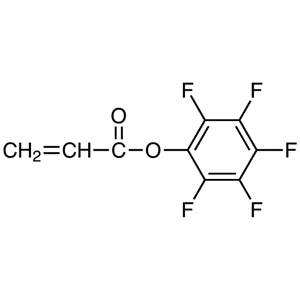
1,1,1,3,3,3-Hexafluoroisopropyl Acrylate (stabilized with TBC) is a chemical monomer widely used in polymerization reactions to produce polymers with specialized properties. This compound plays a crucial role in materials science and macromolecular chemistry research, serving as a foundational element in the synthesis of thermoplastic and elastic polymers. In the laboratory, it is essential for creating materials with unique chemical and physical characteristics, making it a key component in various experimental processes. Its versatility and reactivity make it an important tool for researchers aiming to develop advanced materials with tailored properties.
The properties of 1,1,1,3,3,3-Hexafluoroisopropyl Acrylate make it a preferred choice in laboratory settings. It exhibits good solubility in organic solvents, which enhances its usability in a wide range of chemical reactions. Additionally, its stability under specific conditions allows for consistent results in experiments. The stabilization with tert-Butylcatechol (TBC) ensures that the material remains chemically stable during storage and use, preventing degradation and maintaining its effectiveness. These characteristics contribute to its reliability and make it a valuable asset in material science research.
In Indonesian laboratories, this compound is frequently used in material science and macromolecular chemistry research. Its role in synthesizing polymers with specialized properties makes it a popular choice for applications such as protective coatings, composite materials, and advanced chemical formulations. Researchers in Indonesia rely on its stability and reactivity to develop innovative materials for various industrial and scientific applications.
TCI brochures (PDF)
- Fluorinated Monomers 2025-10-03 · p. 1
- Monomers 2025-05-28 · p. 4
Related TCI products
- TCI M0988 3063-94-3 1,1,1,3,3,3-Hexafluoroisopropyl Methacrylate (stabilized with MEHQ)
- TCI T2240 7383-71-3 2,2,3,3-Tetrafluoropropyl Acrylate (stabilized with MEHQ)
- TCI A1152 407-47-6 2,2,2-Trifluoroethyl Acrylate (stabilized with MEHQ)
- TCI P2179 71195-85-2 Pentafluorophenyl Acrylate (stabilized with MEHQ)
- TCI O0318 376-84-1 1H,1H,5H-Octafluoropentyl Acrylate (stabilized with MEHQ)
- TCI N1107 52591-27-2 1H,1H,2H,2H-Nonafluorohexyl Acrylate (stabilized with TBC)
- Polymer synthesis for creating thermoplastic and elastic materials due to its reactivity and ability to form stable polymer chains.
- Development of protective coatings and surface treatments because of its chemical stability and compatibility with organic solvents.
- Composite material fabrication where controlled polymerization is required to achieve desired mechanical and thermal properties.
- Research in macromolecular chemistry for studying the behavior of functional monomers in different reaction conditions.
- Formulation of specialized chemical products that require precise control over polymer structure and properties.
| Brand | TCI |
|---|---|
| CAS number | 2160-89-6 |
| Molecular formula | — |
| Purity | — |
| Category | Materials Science > Polymer/Macromolecule Reagents > Monomers |
| Pack sizes | Available in various quantities as per standard laboratory supply |
| Physical form | Liquid |
| Storage | Store in a cool, dry place away from direct sunlight and incompatible materials |
This material should be stored in a cool, dry environment, away from direct sunlight and sources of heat. It is recommended to use sealed containers made of materials compatible with organic solvents to prevent contamination and evaporation. Proper ventilation should be maintained in the laboratory to minimize exposure to vapors. Avoid contact with incompatible substances such as strong oxidizers or acids. Always follow standard safety protocols when handling chemical reagents to ensure a safe working environment. Regular inspection of storage conditions is advised to maintain the integrity and stability of the material.
—
Produk Terkait
-
1,1,1,3,3,3-HexafluoroisopropylMethacrylate(stabilizedwithMEHQ) TCI M0988
Regular price From Rp 1.035.300,00Regular priceRp 723.450,00Sale price From Rp 1.035.300,00 -
2,2,3,3-TetrafluoropropylAcrylate(stabilizedwithMEHQ) TCI T2240
Regular price From Rp 1.220.100,00Regular priceRp 852.600,00Sale price From Rp 1.220.100,00 -
2,2,2-TrifluoroethylAcrylate(stabilizedwithMEHQ) TCI A1152
Regular price From Rp 689.850,00Regular priceRp 481.950,00Sale price From Rp 689.850,00 -
PentafluorophenylAcrylate(stabilizedwithMEHQ) TCI P2179
Regular price Rp 2.862.300,00Regular priceRp 2.001.300,00Sale price Rp 2.862.300,00 -
1H,1H,5H-OctafluoropentylAcrylate(stabilizedwithMEHQ) TCI O0318
Regular price From Rp 1.035.300,00Regular priceRp 723.450,00Sale price From Rp 1.035.300,00 -
1H,1H,2H,2H-NonafluorohexylAcrylate(stabilizedwithTBC) TCI N1107
Regular price From Rp 1.670.550,00Regular priceRp 1.167.600,00Sale price From Rp 1.670.550,00 -
2,2,3,3,4,4,5,5,6,6,7,7-DodecafluoroheptylAcrylate(stabilizedwithTBC) TCI D4989
Regular price Rp 1.829.100,00Regular priceRp 1.278.900,00Sale price Rp 1.829.100,00 -
ZincAcrylate TCI Z0069
Regular price From Rp 769.650,00Regular priceRp 537.600,00Sale price From Rp 769.650,00