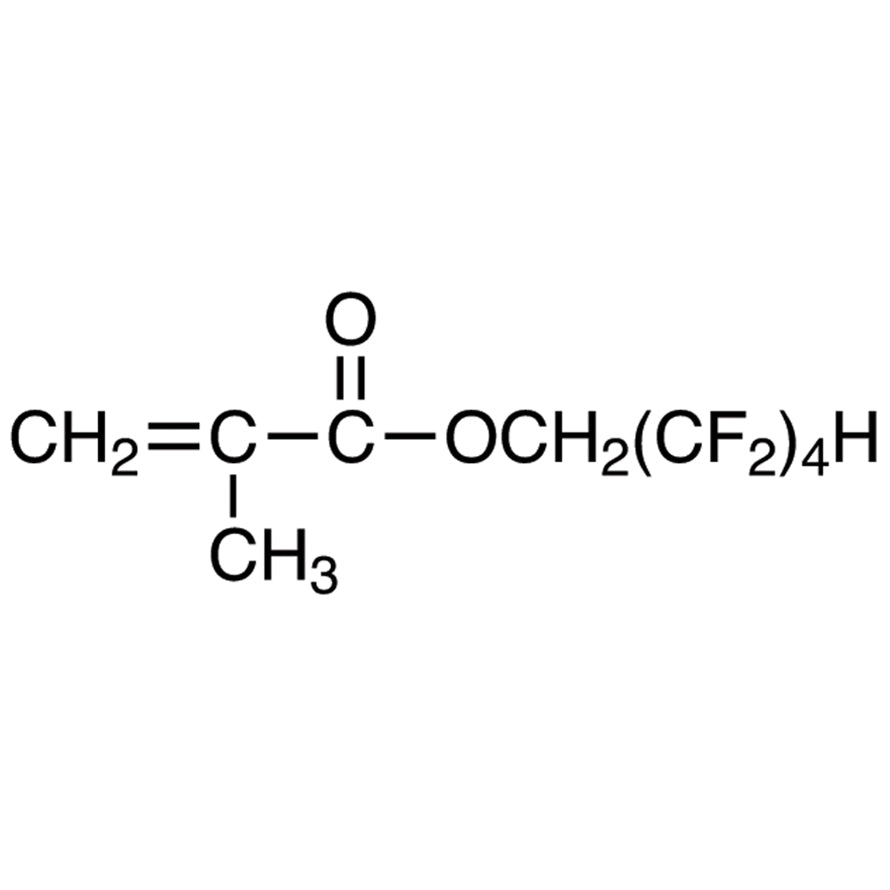
1H,1H,5H-Octafluoropentyl Methacrylate (stabilized with MEHQ) is a specialized chemical compound used in polymerization reactions to produce polymers with specific properties. As a monomer, it plays a crucial role in the synthesis of functional polymers, particularly in materials science and polymer chemistry. Its unique molecular structure, featuring multiple fluorine atoms, imparts hydrophobicity and thermal stability, making it ideal for applications requiring high-performance materials. This compound is commonly used in research settings to develop advanced materials with tailored characteristics, supporting innovation in various scientific fields.
The compound’s high purity and chemical stability ensure consistent results in experimental processes. Its stabilization with MEHQ significantly reduces oxidative degradation, enhancing its shelf life and reliability in laboratory settings. This makes it a preferred choice for researchers aiming to achieve reproducible outcomes in polymer synthesis. The compound’s non-flammable nature also contributes to its safety profile, aligning with standard laboratory safety protocols.
In Indonesian laboratories, this material is widely used in research and development projects focused on polymer technology and industrial applications. It is a key component in the creation of specialized polymers for use in pharmaceuticals, materials engineering, and other advanced scientific fields. Its availability through AMI Scientific ensures that researchers in Indonesia have access to high-quality reagents essential for cutting-edge experimentation.
TCI brochures (PDF)
- Fluorinated Monomers 2025-10-03 · p. 1
- Fluorous Chemistry 2025-01-21 · p. 8
- Monomers 2025-05-28 · p. 6
Related TCI products
- TCI O0318 376-84-1 1H,1H,5H-Octafluoropentyl Acrylate (stabilized with MEHQ)
- TCI T3728 45102-52-1 2,2,3,3-Tetrafluoropropyl Methacrylate (stabilized with MEHQ)
- TCI T3414 2144-53-8 1H,1H,2H,2H-Tridecafluoro-n-octyl Methacrylate (stabilized with HQ + MEHQ)
- TCI P2546 114859-23-3 Pentafluorobenzyl Methacrylate (stabilized with BHT)
- TCI P2353 45115-53-5 2,2,3,3,3-Pentafluoropropyl Methacrylate (stabilized with TBC)
- TCI P2289 13642-97-2 Pentafluorophenyl Methacrylate (stabilized with MEHQ)
- Polymer synthesis for creating high-performance materials due to its hydrophobic and thermal stability properties.
- Development of functional polymers in pharmaceutical research for drug delivery systems and biocompatible materials.
- Advanced materials engineering applications where fluorinated compounds are needed for enhanced chemical resistance.
- Research in nanotechnology and surface modification due to its reactivity in controlled polymerization processes.
- Industrial coating and protective film production where chemical stability and durability are critical requirements.
| Brand | TCI |
|---|---|
| CAS number | 355-93-1 |
| Molecular formula | — |
| Purity | — |
| Category | Materials Science > Polymer/Macromolecule Reagents > Monomers |
| Pack sizes | Available in standard laboratory quantities as per supplier specifications |
| Physical form | Liquid |
| Storage | Store in a cool, dark place away from heat and direct sunlight |
This compound should be stored in a cool, dry environment, away from sources of heat and direct sunlight to maintain its stability and prevent degradation. It is recommended to use airtight containers made of materials compatible with its chemical properties to avoid contamination. Due to its stabilization with MEHQ, it is less prone to oxidative degradation, but proper storage is still essential for long-term use. Laboratory personnel should handle it with care, using appropriate personal protective equipment when necessary. The compound’s non-flammable nature enhances its safety profile, but standard laboratory safety practices should always be followed to ensure a secure working environment.
—
Produk Terkait
-
1H,1H,5H-OctafluoropentylAcrylate(stabilizedwithMEHQ) TCI O0318
Regular price Rp 1.035.300,00Regular priceRp 723.450,00Sale price Rp 1.035.300,00 -
2,2,3,3-TetrafluoropropylMethacrylate(stabilizedwithMEHQ) TCI T3728
Regular price Rp 557.550,00Regular priceRp 389.550,00Sale price Rp 557.550,00 -
1H,1H,2H,2H-Tridecafluoro-n-octylMethacrylate(stabilizedwithHQ+MEHQ) TCI T3414
Regular price Rp 1.273.650,00Regular priceRp 890.400,00Sale price Rp 1.273.650,00 -
PentafluorobenzylMethacrylate(stabilizedwithBHT) TCI P2546
Regular price Rp 4.399.500,00Regular priceRp 3.076.500,00Sale price Rp 4.399.500,00 -
2,2,3,3,3-PentafluoropropylMethacrylate(stabilizedwithTBC) TCI P2353
Regular price Rp 1.696.800,00Regular priceRp 1.186.500,00Sale price Rp 1.696.800,00 -
PentafluorophenylMethacrylate(stabilizedwithMEHQ) TCI P2289
Regular price Rp 2.227.050,00Regular priceRp 1.557.150,00Sale price Rp 2.227.050,00 -
1H,1H,2H,2H-NonafluorohexylMethacrylate(stabilizedwithTBC) TCI N1143
Regular price Rp 1.485.750,00Regular priceRp 1.038.450,00Sale price Rp 1.485.750,00 -
1H,1H,2H,2H-NonafluorohexylMethacrylate(stabilizedwithMEHQ) TCI N1014
Regular price Rp 1.590.750,00Regular priceRp 1.111.950,00Sale price Rp 1.590.750,00