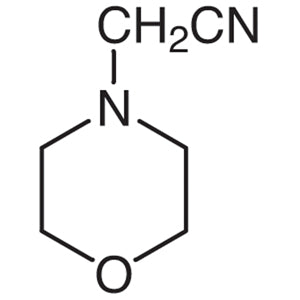
TCI M1095 Morpholinoacetonitrile is an aminonitrile compound that joins a morpholine ring to an acetonitrile group through a single methylene bridge. Although the molecule is small, it carries three functional elements at once: the tertiary amine nitrogen of the morpholine ring, the ether oxygen within that same ring, and the highly versatile cyano group. In the laboratory this compound serves as a building block that links amine chemistry with nitrile chemistry, which is why it is frequently chosen as a starting point for the preparation of more complex nitrogen-containing compounds in organic synthesis and medicinal chemistry research.
The most notable characteristic of this material is the dual reactivity of the cyano group combined with the leaving-group behaviour of the morpholine amine. The cyano group can be reduced to a primary amine, hydrolysed to a carboxylic acid or an amide, converted into a tetrazole through cycloaddition with an azide, or attacked by organometallic reagents to form ketones. At the same time, the hydrogen positioned between the amine nitrogen and the cyano group is relatively acidic, so it can be deprotonated for alkylation reactions, while the morpholine unit can be displaced by other nucleophiles in Strecker-type reactions. This flexibility is what makes the compound a preferred choice for synthetic route design.
In Indonesian laboratories, TCI M1095 is typically used in university and institutional research settings where organic synthesis and medicinal chemistry work are carried out. It commonly appears in heterocyclic building block collections held by synthesis groups, in graduate-level research on nitrogen-containing scaffolds, and in method development work where a compact multifunctional intermediate is needed. Its role is usually that of an early-stage reagent consumed in exploratory route-finding rather than in routine analysis.
Related TCI products
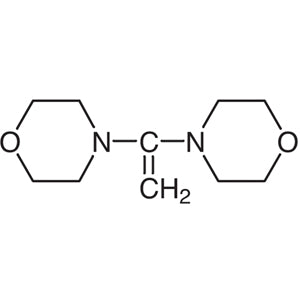
- TCI B1180 14212-87-4 1,1-Bis(morpholino)ethylene
- TCI E0784 20120-24-5 Ethyl 3-(Morpholino)propionate
- TCI B6410 1468-28-6 Morpholino(phenyl)methanone
- TCI M3601 3235-69-6 2-Morpholinoacetic Acid
- TCI M2608 89531-58-8 Morpholinoacetic Acid Hydrochloride
- TCI T2050 1894677-16-7 Thiomorpholinoacetic Acid 1',1'-Dioxide Monohydrate
- Heterocyclic scaffold construction: the cyano group can undergo cycloaddition with azides to yield tetrazole rings, giving synthesis groups a direct route from a simple aminonitrile to a nitrogen-rich heterocyclic core.
- Primary amine synthesis: reduction of the cyano group produces a primary amine while the morpholine ring remains intact, providing a convenient way to build diamine-type structures from a single compact starting material.
- Strecker-type nucleophilic substitution: the morpholine unit behaves as a leaving group and can be displaced by other nucleophiles, allowing chemists to diversify the amine portion of the molecule without redesigning the whole route.
- Carboxylic acid and amide preparation: controlled hydrolysis of the nitrile function delivers either the carboxylic acid or the amide, which makes this reagent useful when a carbonyl-bearing morpholine derivative is required.
- Alkylation at the activated carbon: the hydrogen between the amine nitrogen and the cyano group is acidic enough to be deprotonated, so the resulting carbanion can be alkylated to extend the carbon framework in medicinal chemistry programmes.
| Brand | TCI (Tokyo Chemical Industry) |
|---|---|
| CAS number | 5807-02-3 |
| Molecular formula | — |
| Purity | — |
| Category | Chemistry > Building Blocks > Heterocyclic Building Blocks |
| Pack sizes | available in standard TCI research-scale packaging; please confirm the size options when ordering |
| Physical form | — |
| Storage | keep in a closed container under the conditions stated on the product label and in the manufacturer's safety data sheet |
- Catalogue number: M1095
Store the compound in a tightly closed original container, kept in a cool, dry and well-ventilated chemical store away from direct sunlight and sources of ignition, and follow the specific storage conditions given on the product label and safety data sheet. Because the material is a nitrile-bearing organic compound, all handling, weighing and transfer operations should be carried out inside a functioning fume hood using appropriate personal protective equipment, including chemical-resistant gloves, safety goggles and a laboratory coat. Keep the container separated from strong oxidising agents, strong acids and strong bases, close it immediately after use to limit moisture uptake, and dispose of residues and contaminated materials as chemical waste in accordance with your institution's laboratory waste procedures. Always consult the manufacturer's safety data sheet before first use.
—
Produk Terkait
-
1,1-Bis(morpholino)ethylene TCI B1180
Regular price Rp 4.399.500,00Regular price -
Ethyl3-(Morpholino)propionate TCI E0784
Regular price From Rp 980.700,00Regular price -
Morpholino(phenyl)methanone TCI B6410
Regular price From Rp 1.644.300,00Regular price -
2-MorpholinoaceticAcid TCI M3601
Regular price Rp 2.386.650,00Regular price -
MorpholinoaceticAcidHydrochloride TCI M2608
Regular price From Rp 1.035.300,00Regular price -
ThiomorpholinoaceticAcid1',1'-DioxideMonohydrate TCI T2050
Regular price From Rp 1.776.600,00Regular price -
2,4-Dichloro-6-morpholino-1,3,5-triazine TCI D4814
Regular price From Rp 689.850,00Regular price -
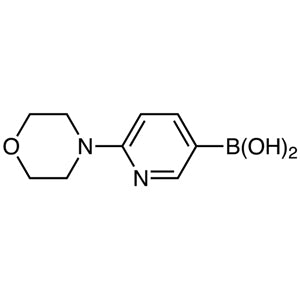
6-(Morpholino)pyridine-3-boronicAcid(containsvaryingamountsofAnhydride) TCI M2967
Regular price Rp 2.332.050,00Regular price