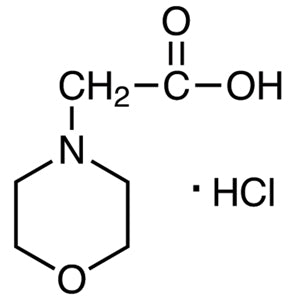
Morpholinoacetic Acid Hydrochloride is a chemical compound widely used in laboratory settings for its role in the synthesis of heterocyclic compounds. This compound is a key building block in organic chemistry, particularly in the development of complex molecular structures. Its unique molecular structure combines a morpholine ring with an acetic acid group, and the presence of a chloride ion gives it a positive charge. This makes it a versatile reagent that can participate in various chemical reactions, including substitution and addition reactions. Its stability and controlled reactivity make it a reliable choice for a wide range of chemical experiments.
The compound’s chemical properties make it a preferred choice in laboratory applications. It exhibits good solubility in organic solvents such as ethylamine and dimethylformamide, which facilitates purification and separation processes. The presence of the chloride ion enhances its solubility and stability under different reaction conditions. These characteristics allow it to be used effectively in a variety of synthetic pathways. Its predictable behavior and compatibility with other reagents make it a valuable tool for chemists working on complex molecule synthesis.
In Indonesian laboratories, Morpholinoacetic Acid Hydrochloride is commonly used in the development of pharmaceuticals, agrochemicals, and specialty chemicals. Its role in heterocyclic synthesis is critical for creating compounds with specific biological activities. The compound’s availability and reliability make it a staple in both academic and industrial research settings. Its application in Indonesia is supported by the growing demand for advanced chemical synthesis techniques in the region.
Related TCI products
- TCI M3601 3235-69-6 2-Morpholinoacetic Acid
- TCI T2050 1894677-16-7 Thiomorpholinoacetic Acid 1',1'-Dioxide Monohydrate
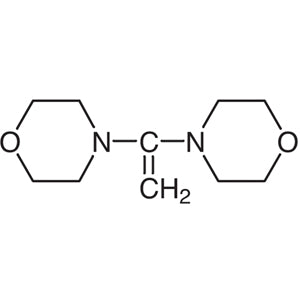
- TCI B1180 14212-87-4 1,1-Bis(morpholino)ethylene
- TCI E0784 20120-24-5 Ethyl 3-(Morpholino)propionate
- TCI B6410 1468-28-6 Morpholino(phenyl)methanone
- TCI M1095 5807-02-3 Morpholinoacetonitrile
- Heterocyclic Compound Synthesis: Morpholinoacetic Acid Hydrochloride is ideal for building complex ring structures due to its morpholine and acetic acid components.
- Organic Reaction Mediation: Its positive charge and solubility in organic solvents make it suitable for participating in substitution and addition reactions.
- Pharmaceutical Development: The compound is used in the synthesis of drug molecules that require heterocyclic frameworks for biological activity.
- Agrochemical Research: It plays a role in the creation of pesticides and herbicides through its ability to form stable intermediates in synthetic pathways.
- Analytical Chemistry: Its chemical stability and reactivity make it useful in analytical procedures that require controlled chemical environments.
| Brand | TCI |
|---|---|
| CAS number | 89531-58-8 |
| Molecular formula | — |
| Purity | — |
| Category | Chemistry > Building Blocks > Heterocyclic Building Blocks |
| Pack sizes | Available in various quantities as per standard laboratory requirements |
| Physical form | Solid, typically in crystalline form |
| Storage | Store in a cool, dry place away from moisture and direct sunlight |
Morpholinoacetic Acid Hydrochloride should be stored in a cool, dry environment to maintain its chemical stability. It is recommended to keep the compound in airtight containers to prevent moisture absorption, which could affect its solubility and reactivity. Laboratory personnel should handle the compound with care, using appropriate personal protective equipment such as gloves and safety goggles. It is important to ensure that the compound is stored separately from incompatible substances to avoid any potential chemical interactions. Regular monitoring of storage conditions is advised to maintain the integrity of the material during long-term use.
—
Produk Terkait
-
2-MorpholinoaceticAcid TCI M3601
Regular price Rp 2.386.650,00Regular price -
ThiomorpholinoaceticAcid1',1'-DioxideMonohydrate TCI T2050
Regular price From Rp 1.776.600,00Regular price -
1,1-Bis(morpholino)ethylene TCI B1180
Regular price Rp 4.399.500,00Regular price -
Ethyl3-(Morpholino)propionate TCI E0784
Regular price From Rp 980.700,00Regular price -
Morpholino(phenyl)methanone TCI B6410
Regular price From Rp 1.644.300,00Regular price -
Morpholinoacetonitrile TCI M1095
Regular price From Rp 2.704.800,00Regular price -
2,4-Dichloro-6-morpholino-1,3,5-triazine TCI D4814
Regular price From Rp 689.850,00Regular price -
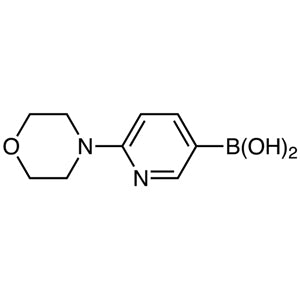
6-(Morpholino)pyridine-3-boronicAcid(containsvaryingamountsofAnhydride) TCI M2967
Regular price Rp 2.332.050,00Regular price