

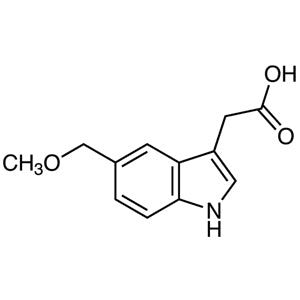
TCI M1303 with CAS number 3471-31-6 is 5-Methoxyindole-3-acetic Acid, a derivative of indole-3-acetic acid carrying a methoxy group at the 5-position of the aromatic ring. The compound is closely related to the framework of naturally occurring indole metabolites, which makes it an important material in biochemical research, plant physiology, and medicinal chemistry. In the laboratory it serves as a reference compound, a model substrate, and a synthetic building block that supplies an acetic acid side chain at the three-position of the indole nucleus, a motif frequently encountered in bioactive molecules and in metabolites of the tryptophan pathway.
The property that makes this material a preferred choice is the presence of two complementary functional groups within a single scaffold. The carboxylic acid group is readily esterified, amidated, or reduced, giving chemists a direct handle for further transformation, while the electron-donating methoxy group modulates the electron density of the ring and mimics the substitution pattern of oxygenated indole metabolites. This combination gives the structure a close resemblance to natural plant growth regulators, making it attractive for study in plant biology experiments. As a solid, the compound is relatively easy to weigh accurately and to dissolve in polar solvents or dilute basic solutions when preparing working solutions.
In Indonesian laboratories, 5-Methoxyindole-3-acetic Acid is typically handled in university research groups, plant physiology and agricultural science units, and analytical or medicinal chemistry laboratories. It is commonly used in small-scale work where a well-defined indole derivative is needed as a standard or as a starting material for further synthesis. Researchers generally weigh out modest quantities, prepare stock solutions in polar or mildly basic media, and store the remaining solid for later experiments across a research programme.
- Synthetic building block in heterocyclic chemistry: the indole core with a reactive carboxylic acid side chain allows direct coupling, esterification, or amidation toward more elaborate target molecules.
- Reference and comparison compound in analytical work: the defined structure and known CAS identity make it suitable as a marker when identifying indole derivatives in chromatographic or spectroscopic studies.
- Plant physiology research: its structural similarity to natural indole-3-acetic acid compounds makes it a useful test substance in experiments examining plant growth regulation and related biological responses.
- Tryptophan pathway and metabolite studies: the oxygenated indole substitution pattern mirrors natural metabolites, supporting biochemical investigations of indole metabolism and enzyme substrate behaviour.
- Medicinal chemistry exploration: the dual functionality provides a versatile scaffold for preparing analogue series when researchers screen indole-based structures for biological activity.
| Brand | TCI |
|---|---|
| CAS number | 3471-31-6 |
| Molecular formula | — |
| Purity | — |
| Category | Chemistry > Building Blocks > Heterocyclic Building Blocks |
| Pack sizes | available in standard TCI research-scale packaging; please confirm the available size when ordering |
| Physical form | solid |
| Storage | keep in a closed container under the conditions stated on the manufacturer's label |
- Chemical Name: 5-Methoxyindole-3-acetic Acid
Store the container tightly closed in a cool, dry, and well-ventilated place, away from direct sunlight, moisture, and incompatible materials, following the conditions stated on the manufacturer's label. Keep the solid in its original container or in a clean, chemically resistant and clearly labelled vessel, and close it promptly after each use to limit exposure to air and humidity. Handle the material in a fume hood where practical, and wear a laboratory coat, safety glasses, and suitable gloves. Weigh and transfer the powder carefully to avoid generating dust, and prepare solutions using clean glassware. Consult the manufacturer's safety data sheet before use and dispose of residues in accordance with laboratory waste procedures.
—
Produk Terkait
-
5-Methoxyindole-3-carboxylicAcid TCI M2438
Regular price From Rp 2.254.350,00Regular price -
7-Methoxyindole TCI M1751
Regular price From Rp 3.683.400,00Regular price -
5-Methoxyindole-2-carboxylicAcid TCI M1271
Regular price From Rp 1.670.550,00Regular price -
5-Methoxyindole-3-carboxaldehyde TCI M1268
Regular price From Rp 530.250,00Regular price -
4-Methoxyindole TCI M1250
Regular price From Rp 1.538.250,00Regular price -
6-Methoxyindole TCI M1214
Regular price From Rp 477.750,00Regular price -
5-Methoxyindole TCI M0731
Regular price From Rp 637.350,00Regular price -
5,6-Dimethoxyindole TCI D5148
Regular price From Rp 1.590.750,00Regular price


