

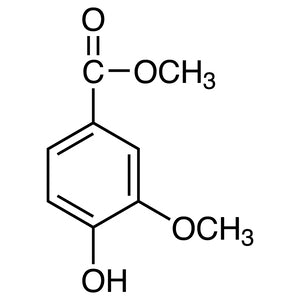
Methyl Vanillate from TCI is the methyl ester of vanillic acid, an aromatic compound bearing a phenolic hydroxyl group and a methoxy group on the benzene ring. This structure is one of the most recognizable motifs in natural product chemistry because it is closely related to vanillin and belongs to the family of lignin-derived compounds. In the laboratory it plays a dual role: as a building block for organic synthesis, and as a reference compound in the analysis of lignin degradation products as well as in plant metabolite research that requires a clearly defined identity standard.
The characteristic that makes it a widely preferred choice is the combination of complementary functional groups on a single aromatic ring. The phenolic hydroxyl group provides a site for etherification, esterification, and oxidative coupling reactions, while at the same time conferring the free-radical scavenging ability that underlies the interest of antioxidant researchers. The adjacent methoxy group modulates the electron density of the ring and guides the regioselectivity of subsequent substitution reactions. The methyl ester group keeps the carboxyl function protected and can be converted into an amide, an alcohol, or the free acid as required.
In Indonesian laboratories, this compound is typically used in university and institutional research settings working on natural product chemistry, lignin valorisation, and the synthesis of aromatic derivatives. It is commonly kept as part of a building block collection for multi-step synthesis programmes, and also serves analytical groups that need a well-defined comparison compound when characterising phenolic constituents from plant materials or from processed lignocellulosic biomass.
Related TCI products
- Organic synthesis building block: the phenolic hydroxyl, methoxy, and methyl ester groups on one ring give chemists three independent handles for constructing more elaborate aromatic targets in a controlled sequence.
- Reference compound for lignin degradation analysis: because it belongs to the lignin-derived family, it serves as a clearly defined identity standard when identifying phenolic fragments released during lignin breakdown studies.
- Plant metabolite research: analytical groups characterising phenolic constituents of plant materials use it as a comparison compound where an unambiguous identity standard is required for peak confirmation.
- Antioxidant studies: the phenolic hydroxyl group provides free-radical scavenging capability, making this compound a relevant subject or comparison material for researchers investigating antioxidant behaviour in aromatic systems.
- Functional group transformation work: the methyl ester keeps the carboxyl function protected and can be converted into an amide, an alcohol, or the free acid, supporting derivatisation and protecting-group strategy exercises.
| Brand | TCI |
|---|---|
| CAS number | 3943-74-6 |
| Molecular formula | — |
| Purity | — |
| Category | Chemistry > Building Blocks > Non-Heterocyclic Building Blocks |
| Pack sizes | available in the standard TCI catalogue pack sizes; please confirm the required quantity when ordering |
| Physical form | — |
| Storage | store in a closed container under the conditions stated on the manufacturer's label |
- Product code: M1738
Store the material in its original tightly closed container, kept in a cool, dry, and well-ventilated area away from direct sunlight and from incompatible chemicals. Because the compound carries a phenolic hydroxyl group, containers should be closed promptly after use to limit exposure to air and moisture, and amber or opaque containers are preferable for longer-term storage. Handle the substance in a fume hood using standard personal protective equipment, including gloves, safety glasses, and a laboratory coat, and avoid generating or inhaling dust during weighing and transfer. Always follow the manufacturer's safety data sheet and the storage conditions printed on the product label, and record any transfer into secondary containers with complete labelling.
—
Produk Terkait
-
EthylVanillate TCI V0051
Regular price Rp 1.829.100,00Regular price
