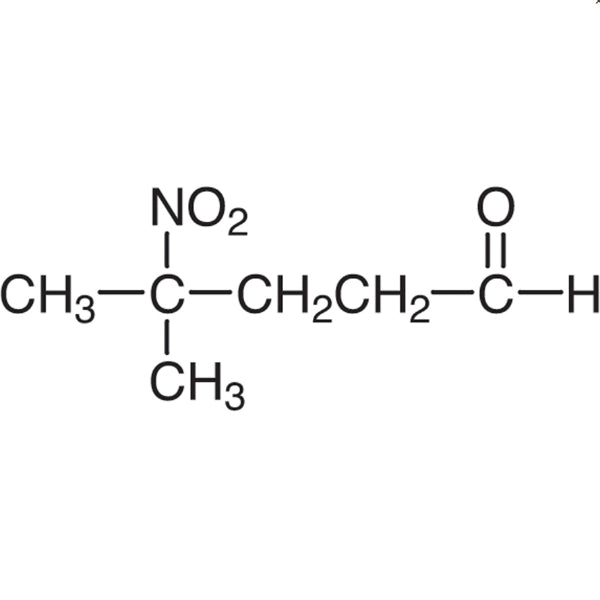
TCI M1825 4-Methyl-4-nitrovaleraldehyde is a doubly functionalised aliphatic compound carrying an aldehyde group at one end of the chain and a tertiary nitro group on a quaternary carbon at the other. The pairing of two functional groups with such contrasting reactivity makes it a valuable non-heterocyclic building block in the organic synthesis laboratory, because each group can be addressed in sequence to construct more elaborate molecular frameworks. It gives researchers rapid access to a pre-functionalised five-carbon chain without having to assemble that skeleton through many preliminary steps.
The property that leads chemists to select this material is the versatility of the transformations available at both ends of the molecule. The aldehyde group is open to reductive amination, aldol condensation, olefination, formation of protective acetals, and oxidation to the corresponding carboxylic acid. The tertiary nitro group, meanwhile, can be reduced to a quaternary-carbon tertiary amine that is difficult to obtain by other routes, and the product of that reduction frequently reacts intramolecularly with the carbonyl group to form nitrogen-containing rings. The quaternary carbon bearing the nitro group also imparts a characteristic steric environment around that end of the chain.
In Indonesian laboratories this building block is normally encountered in university and institutional research settings where multi-step organic synthesis is carried out, as well as in development work that requires functionalised intermediates prepared on a small scale. It is typically ordered as a catalogue reagent for exploratory route development rather than bulk production, and is handled within the general organic synthesis workflow alongside other TCI building blocks held in the laboratory's reagent inventory.
Related TCI products
- Reductive amination studies — the terminal aldehyde condenses readily with primary and secondary amines, giving a direct route to extended aminated chains under standard laboratory reducing conditions.
- Nitrogen heterocycle construction — reduction of the tertiary nitro group generates an amine that often closes intramolecularly onto the carbonyl, delivering nitrogen-containing rings in a controlled sequence.
- Aldol condensation and carbon chain extension — the aldehyde end serves as a reliable electrophilic partner for building longer or branched carbon skeletons from a pre-functionalised starting point.
- Olefination chemistry — the aldehyde group participates in standard olefination reactions, allowing chemists to install alkene units while leaving the tertiary nitro group untouched for later manipulation.
- Quaternary-carbon amine synthesis — the nitro group on a quaternary carbon provides access to tertiary amines bearing that substitution pattern, which are difficult to prepare by alternative synthetic routes.
| Brand | TCI (Tokyo Chemical Industry) |
|---|---|
| CAS number | 57620-49-2 |
| Molecular formula | — |
| Purity | — |
| Category | Chemistry > Building Blocks > Non-Heterocyclic Building Blocks |
| Pack sizes | supplied in standard TCI catalogue pack sizes; please confirm the available packaging when ordering |
| Physical form | — |
| Storage | store according to the conditions stated on the manufacturer's label and safety data sheet |
- Product code: M1825
Store the container tightly closed in a cool, dry, well-ventilated area away from heat, ignition sources, and incompatible materials, following the storage conditions specified on the manufacturer's label and safety data sheet. Keep the material in its original supplier container, or in a chemically compatible sealed vessel that is clearly labelled, and avoid prolonged exposure to air and moisture during handling. As with any nitro-functionalised organic compound, handle it inside a fume hood, wear appropriate gloves, safety goggles, and a laboratory coat, and avoid inhalation of vapours or contact with skin and eyes. Transfer only the quantity required for immediate use, close the container promptly afterwards, and dispose of residues and contaminated materials through the laboratory's designated chemical waste stream. Always consult the current safety data sheet before first use.
—
Produk Terkait
-
Valeraldehyde TCI V0001
Regular price From Rp 530.250,00Regular price -
Isovaleraldehyde TCI I0192
Regular price From Rp 505.050,00Regular price -
2-Methylvaleraldehyde TCI M0596
Regular price From Rp 505.050,00Regular price -
Isovaleraldehyde2,4-Dinitrophenylhydrazone TCI I0477
Regular price From Rp 823.200,00Regular price -
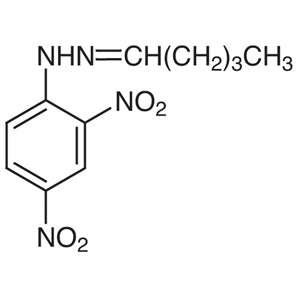
Valeraldehyde2,4-Dinitrophenylhydrazone TCI V0066
Regular price From Rp 477.750,00Regular price -
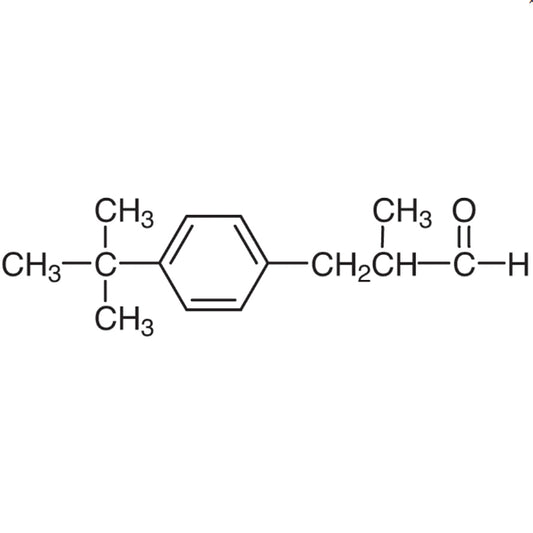
3-(4-tert-Butylphenyl)isobutyraldehyde TCI B1145
Regular price From Rp 795.900,00Regular price -
Butyraldehyde TCI B0751
Regular price From Rp 477.750,00Regular price -
6-Nitroveratraldehyde TCI N0538
Regular price From Rp 2.677.500,00Regular price