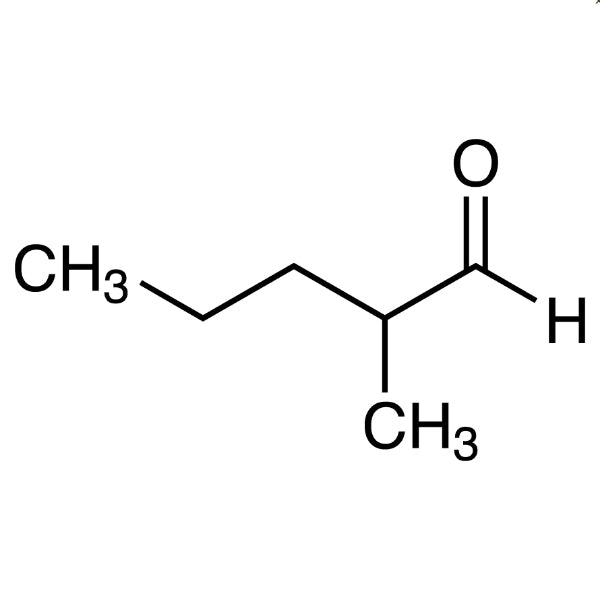
2-Methylvaleraldehyde (TCI M0596) is a versatile organic compound widely utilized in chemical laboratories for the synthesis of complex molecules. As a key building block in organic chemistry, it serves as a fundamental starting material for various chemical transformations. Its aldehyde functional group allows it to participate in a wide range of reactions, including condensation, oxidation, and reduction. This makes it an essential reagent for researchers aiming to develop new compounds with specific structural features.
The compound’s reactivity and volatility make it a preferred choice for applications requiring high reactivity and rapid reaction kinetics. Its ability to react with amines, hydroxyl groups, and other functional groups enables the synthesis of heterocyclic compounds, esters, and aromatic derivatives. Despite its usefulness, 2-Methylvaleraldehyde is volatile and can cause irritation to the skin and eyes, necessitating careful handling. Its sharp, pungent odor also requires proper ventilation during use.
In Indonesian laboratories, 2-Methylvaleraldehyde is commonly used in organic synthesis and research projects focused on the development of new chemical compounds. It is frequently found in academic and industrial settings, particularly in pharmaceutical and chemical research laboratories. Its role in creating complex molecular structures supports advancements in both basic and applied chemistry research.
- Organic synthesis: 2-Methylvaleraldehyde is widely used in the synthesis of complex organic molecules due to its reactive aldehyde group and versatility in chemical reactions.
- Heterocyclic compound development: The compound serves as a key intermediate in the synthesis of heterocyclic structures, which are essential in pharmaceutical and medicinal chemistry.
- Ester synthesis: Its aldehyde functionality allows for the formation of esters through condensation reactions, making it valuable in organic and industrial chemistry.
- Aromatic compound production: 2-Methylvaleraldehyde is used in the preparation of aromatic derivatives, contributing to the development of new chemical materials.
- Research and development: It is a common reagent in research laboratories, supporting the creation of new compounds and the exploration of chemical reactivity.
| Brand | TCI |
|---|---|
| CAS number | 123-15-9 |
| Molecular formula | — |
| Purity | — |
| Category | Chemistry > Building Blocks > Non-Heterocyclic Building Blocks |
| Pack sizes | Available in various quantities as per supplier specifications |
| Physical form | Liquid |
| Storage | Store in a cool, dry place away from light and incompatible materials |
2-Methylvaleraldehyde should be stored in a cool, dry place, away from direct sunlight and sources of heat. It is recommended to keep the compound in a tightly sealed container to prevent evaporation due to its high volatility. The container should be made of a material resistant to chemical corrosion, such as glass or high-density polyethylene. Due to its potential to cause skin and eye irritation, proper personal protective equipment, including gloves and safety goggles, should be worn during handling. Adequate ventilation is essential in the laboratory to minimize exposure to its sharp, pungent odor. Always follow standard safety protocols when working with reactive and volatile chemicals.
—
Produk Terkait
-
Valeraldehyde TCI V0001
Regular price From Rp 530.250,00Regular price -
Butyl2-Methylvalerate TCI B3359
Regular price From Rp 637.350,00Regular price -
4-MethylvalerylChloride TCI M2287
Regular price Rp 3.048.150,00Regular price -
4-MethylvalericAcid TCI M0750
Regular price Rp 1.565.550,00Regular price -
2-MethylvalericAcid TCI M0610
Regular price From Rp 689.850,00Regular price -
3-MethylvalericAcid TCI M0569
Regular price Rp 1.803.900,00Regular price -
3-Hydroxy-3-methylvalericAcid TCI H0626
Regular price From Rp 2.545.200,00Regular price -
Isovaleraldehyde TCI I0192
Regular price From Rp 505.050,00Regular price