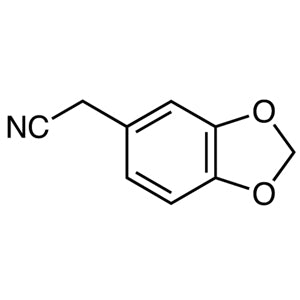
TCI M1923 3,4-Methylenedioxyphenylacetonitrile is an aromatic compound that combines a methylenedioxy-substituted benzene ring with an acetonitrile side chain. The methylenedioxy group — the –O–CH₂–O– bridge linking two adjacent positions on the ring — is a structural motif widely recognised in natural product chemistry, since it appears in a range of plant-derived compounds. In the laboratory, this material serves as a synthetic building block: a starting material that allows researchers to carry the piperonyl framework into a target molecule without having to construct that substitution pattern from scratch through many reaction steps.
The properties that make it a preferred choice lie in the reactivity of the nitrile group together with the acidity of the adjacent benzylic protons. The nitrile group can be hydrolysed to a carboxylic acid or an amide, reduced to a primary amine, or carried into the formation of heterocycles such as tetrazoles. The protons on the carbon between the aromatic ring and the nitrile are relatively acidic, so they are readily deprotonated for alkylation reactions or Knoevenagel condensations that extend the carbon skeleton. The methylenedioxy ring itself is reasonably stable under neutral and basic conditions.
In Indonesian laboratories, this type of reagent is typically used in organic synthesis research, natural product chemistry, and method development work where a pre-formed piperonyl framework shortens a synthetic route. It is handled in research and teaching laboratories at universities and in analytical or R&D settings where researchers build target molecules step by step and value a starting material that already carries the required substitution pattern.
Related TCI products
- TCI T2368 2338-75-2 4-(Trifluoromethyl)phenylacetonitrile
- TCI T2367 2338-76-3 3-(Trifluoromethyl)phenylacetonitrile
- TCI T2366 3038-47-9 2-(Trifluoromethyl)phenylacetonitrile
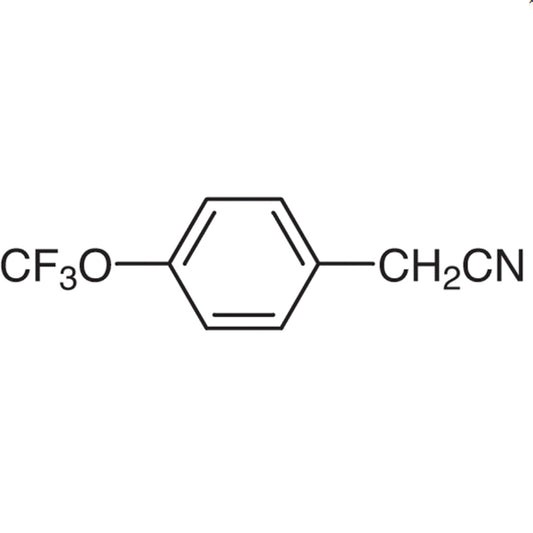
- TCI T1804 49561-96-8 4-(Trifluoromethoxy)phenylacetonitrile
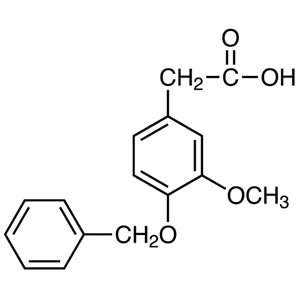
- TCI B4800 29973-91-9 4-Benzyloxy-3-methoxyphenylacetic Acid
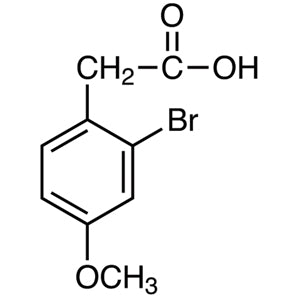
- TCI B4737 66916-99-2 2-Bromo-4-methoxyphenylacetic Acid
- Synthetic building block work — the pre-installed methylenedioxy pattern lets researchers introduce the piperonyl framework directly, removing several ring-functionalisation steps from the overall route.
- Nitrile transformation chemistry — the nitrile group can be hydrolysed to a carboxylic acid or amide, giving a single starting material access to several distinct functional group outcomes.
- Primary amine synthesis — reduction of the nitrile group yields a primary amine, making this compound a convenient entry point to amine-containing targets bearing the methylenedioxyphenyl motif.
- Heterocycle construction — the nitrile can be carried into heterocyclic ring formation such as tetrazole synthesis, supporting research programmes that require nitrogen heterocycles on an aromatic scaffold.
- Alkylation and Knoevenagel condensation — the relatively acidic benzylic protons are readily deprotonated, allowing chain extension of the carbon skeleton under standard base-mediated conditions.
| Brand | TCI |
|---|---|
| CAS number | 4439-02-5 |
| Molecular formula | — |
| Purity | — |
| Category | TCI |
| Pack sizes | available in standard laboratory pack sizes; please refer to the current catalogue listing |
| Physical form | — |
| Storage | store according to the conditions stated on the product label and in the accompanying safety data sheet |
- Product code: M1923
Store the container tightly closed in a cool, dry, well-ventilated area away from direct sunlight, heat sources, and incompatible materials, following the conditions stated on the product label and safety data sheet. Keep the material in its original supplier container wherever possible; if transfer is necessary, use a clean, chemically compatible, well-sealed container that is clearly labelled with the product name and CAS number. Handle in a fume hood using appropriate personal protective equipment, including safety glasses, gloves, and a laboratory coat. Avoid inhalation of vapours and contact with skin and eyes, and dispose of residues and contaminated materials in accordance with applicable laboratory waste procedures.
—
Produk Terkait
-
4-(Trifluoromethyl)phenylacetonitrile TCI T2368
Regular price Rp 1.353.450,00Regular price -
3-(Trifluoromethyl)phenylacetonitrile TCI T2367
Regular price From Rp 795.900,00Regular price -
2-(Trifluoromethyl)phenylacetonitrile TCI T2366
Regular price From Rp 1.140.300,00Regular price -
4-(Trifluoromethoxy)phenylacetonitrile TCI T1804
Regular price From Rp 610.050,00Regular price -
4-Benzyloxy-3-methoxyphenylaceticAcid TCI B4800
Regular price Rp 2.518.950,00Regular price -
2-Bromo-4-methoxyphenylaceticAcid TCI B4737
Regular price From Rp 848.400,00Regular price -
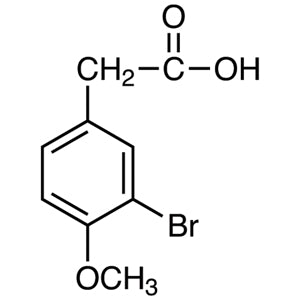
3-Bromo-4-methoxyphenylaceticAcid TCI B4677
Regular price From Rp 689.850,00Regular price -
3,5-Bis(trifluoromethyl)phenylacetonitrile TCI B2911
Regular price Rp 1.829.100,00Regular price