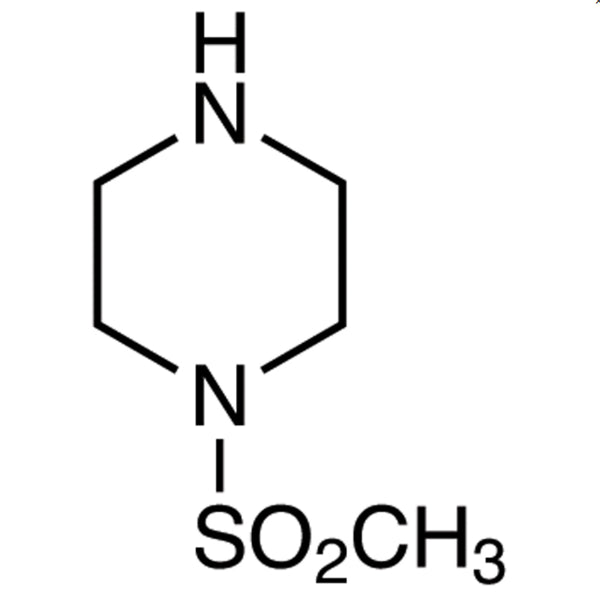
1-(Methylsulfonyl)piperazine is a chemical compound widely used in laboratory settings for the synthesis of heterocyclic compounds and their derivatives. This versatile building block plays a crucial role in organic chemistry by enabling the creation of complex molecular structures with piperazine rings substituted with a methylsulfonyl group. Its presence in chemical reactions allows for the development of various functional groups, making it a valuable tool in synthetic chemistry. Due to its stability and reactivity, it is frequently employed in both academic and industrial research environments.
The compound's chemical properties, including its ability to form stable bonds with a wide range of functional groups, make it a preferred choice for chemists. Its controlled reactivity ensures predictable outcomes in synthetic processes, which is essential for the development of pharmaceuticals and industrial chemicals. The compound's structural versatility allows it to be incorporated into diverse synthetic pathways, enhancing its utility in the laboratory. These characteristics contribute to its reliability and effectiveness in chemical synthesis.
In Indonesian laboratories, 1-(Methylsulfonyl)piperazine is extensively used in organic chemistry research, particularly in pharmacological studies and the synthesis of complex compounds. It is a fundamental component in the work of research institutions and universities, supporting advancements in drug discovery and chemical innovation. Its consistent performance and adaptability make it a trusted reagent in both teaching and research laboratories across Indonesia.
- Organic synthesis of heterocyclic compounds due to its structural versatility and reactivity in forming complex molecules.
- Pharmaceutical research for the development of new drugs, as it can be modified to create various bioactive derivatives.
- Industrial chemical production where stable and controllable reagents are essential for large-scale manufacturing.
- Teaching laboratories for demonstrating synthetic methods and the role of heterocyclic compounds in organic chemistry.
- Research institutions for the synthesis of complex organic molecules used in advanced chemical studies and material science.
| Brand | TCI |
|---|---|
| CAS number | 55276-43-2 |
| Molecular formula | — |
| Purity | — |
| Category | Chemistry > Building Blocks > Heterocyclic Building Blocks |
| Pack sizes | Available in various quantities as per supplier specifications |
| Physical form | Solid (as per standard chemical properties) |
| Storage | Store in a cool, dry place away from direct sunlight |
This compound should be stored in a cool, dry environment to maintain its chemical integrity and prevent degradation. It is recommended to use airtight containers to minimize exposure to moisture and air, which could affect its stability. Due to its chemical nature, it should be kept away from incompatible substances such as strong oxidizing agents. Proper labeling of storage containers is essential for safety and identification. Laboratory personnel should wear appropriate personal protective equipment, including gloves and safety goggles, when handling the compound. Regular monitoring of storage conditions ensures that the material remains in optimal condition for use in chemical experiments.
—
Produk Terkait
-
2-(4-Methoxybenzyl)-5-(methylsulfonyl)-2H-thiazolo[4,5-d][1,2,3]triazole TCI M3881
Regular price From Rp 1.936.200,00Regular price -
4,6-Dimethyl-2-(methylsulfonyl)pyrimidine TCI D3699
Regular price From Rp 1.273.650,00Regular price -
4,6-Dimethoxy-2-(methylsulfonyl)pyrimidine TCI D3101
Regular price Rp 1.670.550,00Regular price -
tert-Butyl3-[(Methylsulfonyl)oxy]azetidine-1-carboxylate TCI B5801
Regular price From Rp 1.140.300,00Regular price -
N-(2-Aminoethyl)piperazine TCI A0304
Regular price From Rp 505.050,00Regular price -
1-(o-Tolyl)piperazine TCI T3404
Regular price From Rp 1.670.550,00Regular price -
1-(2-Thiazolyl)piperazine TCI T3273
Regular price Rp 1.326.150,00Regular price -
1-(p-Tolyl)piperazine TCI T2956
Regular price From Rp 1.298.850,00Regular price
![3058958-92-9 2-(4-Methoxybenzyl)-5-(methylsulfonyl)-2H-thiazolo[4,5-d][1,2,3]triazole - AMI Scientific](http://amiscientific.com/cdn/shop/files/TCI2510M3881.jpg?v=1767128945&width=533)


![tert-Butyl 3-[(Methylsulfonyl)oxy]azetidine-1-carboxylate (CAS 141699-58-3) - TCI B5801 - AMI Scientific](http://amiscientific.com/cdn/shop/files/TCI2510B5801_6db46852-483a-4c64-9e5c-d41e819d6f08.jpg?v=1767863386&width=533)