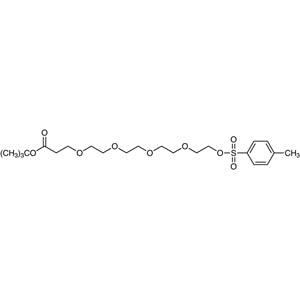
19-Maleimido-17-oxo-4,7,10,13-tetraoxa-16-azanonadecanoic Acid is a specialized chemical compound used in biochemical and biomedical research. This compound contains a polyethylene glycol (PEG) chain and a maleimide group, making it a key reagent in PEGylation processes. In laboratory settings, it plays a crucial role in modifying biological molecules by attaching PEG chains, which enhances the stability, solubility, and reduces immunogenicity of the target molecules. Its versatility makes it an essential tool for researchers working on drug development and molecular engineering.
The compound is valued for its high reactivity, particularly at the maleimide group, which allows for the formation of covalent bonds with various biomolecules such as proteins, peptides, and lipids. This reactivity ensures efficient conjugation reactions, making it a preferred choice in applications requiring precise molecular modifications. Additionally, its structural complexity and functional groups enable it to be tailored for specific research needs, contributing to its widespread use in both academic and industrial laboratories.
In Indonesian laboratories, this compound is commonly used in applied research projects such as vaccine development, biopharmaceuticals, and molecular modification for medical applications. Many research institutions and universities rely on it to advance their studies in biochemistry and biotechnology. Its reliability and effectiveness make it a standard reagent in experimental workflows across various scientific disciplines.
TCI brochures (PDF)
- Cross-linkers 2026-04-14 · p. 1
- Bioconjugation Reagents 2026-07-07 · p. 7
- Biomaterials Research Reagents 2025-02-19 · p. 8
- Reagents for Biological Research 2025-03-11 · p. 28
Related TCI products
- TCI A2526 905954-28-1 1-Amino-3,6,9,12,15,18-hexaoxahenicosan-21-oic Acid
- TCI P2283 1393330-40-9 Propargyl-PEG5-NHS Ester
- TCI L0314 2407442-47-9 Lipoamido-PEG12-carboxylic Acid
- TCI F1358 756526-02-0 (Fmoc-amino)-PEG8-carboxylic Acid
- TCI F0719 166108-71-0 8-[(9H-Fluoren-9-ylmethoxy)carbonylamino]-3,6-dioxa-n-octanoic Acid
- TCI T3114 208827-90-1 Triethylene Glycol Mono(2-propynyl) Ether
- PEGylation of Proteins: This compound is ideal for attaching PEG chains to proteins, enhancing their solubility and reducing immunogenicity, which is crucial for drug development.
- Peptide Conjugation: The maleimide group allows for efficient covalent bonding with peptides, making it suitable for creating modified peptides for therapeutic or diagnostic applications.
- Lipid Modification: It is used to modify lipid structures, enabling the development of more stable and bioavailable lipid-based drug delivery systems.
- Vaccine Formulation: The compound aids in the modification of vaccine components, improving their stability and immunogenic profile for better therapeutic outcomes.
- Molecular Imaging Studies: Its ability to form covalent bonds with biomolecules makes it useful in creating targeted imaging agents for diagnostic purposes.
| Brand | TCI |
|---|---|
| CAS number | 1263045-16-4 |
| Molecular formula | — |
| Purity | — |
| Category | Chemistry > Chemical Biology > PEGylation |
| Pack sizes | Available in various quantities as per supplier specifications |
| Physical form | Solid or liquid, depending on formulation |
| Storage | Store in a cool, dry place away from light |
This compound should be stored in a cool, dry environment, away from direct sunlight and sources of heat. It is recommended to use airtight containers to prevent moisture absorption and contamination. Due to its reactivity, it should be handled with appropriate personal protective equipment, including gloves and safety goggles. Storage conditions should maintain a stable temperature to preserve its chemical integrity. In laboratory settings, it is important to ensure that the compound is kept in a secure location to prevent accidental exposure. Proper labeling and documentation are essential for safe handling and compliance with laboratory safety protocols.
—
Product Categories
- Chemical BiologyPEGylationHeterobifunctional PEG and Oligoethylene Glycols
- Chemical BiologyLinkers and CrosslinkersHeterobifunctional Cross-Linkers
- Chemical BiologyBioconjugationHeterobifunctional Cross-Linkers
- Chemical BiologyBioconjugationPEGylation Reagents and PEG Spacers
- Pharmaceutical Development and Drug Discovery Research ReagentsPEGylationHeterobifunctional PEG and Oligoethylene Glycols
- Pharmaceutical Development and Drug Discovery Research ReagentsLinkers and CrosslinkersHeterobifunctional Cross-Linkers
- Biochemicals and ReagentsBioconjugationHeterobifunctional Cross-Linkers
- Biochemicals and ReagentsBioconjugationPEGylation Reagents and PEG Spacers
- Pharmaceutical Development and Drug Discovery ResearchBioconjugationHeterobifunctional Cross-Linkers
- Pharmaceutical Development and Drug Discovery ResearchBioconjugationPEGylation Reagents and PEG Spacers
- Pharmaceutical Development and Drug Discovery ResearchPEGylationHeterobifunctional PEG and Oligoethylene Glycols
- Pharmaceutical Development and Drug Discovery ResearchLinkers and CrosslinkersHeterobifunctional Cross-Linkers
Produk Terkait
-
1-Amino-3,6,9,12,15,18-hexaoxahenicosan-21-oicAcid TCI A2526
Regular price From Rp 3.763.200,00Regular priceRp 2.647.050,00Sale price From Rp 3.763.200,00 -
Propargyl-PEG5-NHSEster TCI P2283
Regular price Rp 4.266.150,00Regular priceRp 2.998.800,00Sale price Rp 4.266.150,00 -
Lipoamido-PEG12-carboxylicAcid TCI L0314
Regular price Rp 14.626.500,00Regular priceRp 10.243.800,00Sale price Rp 14.626.500,00 -
(Fmoc-amino)-PEG8-carboxylicAcid TCI F1358
Regular price Rp 2.942.100,00Regular priceRp 2.072.700,00Sale price Rp 2.942.100,00 -
8-[(9H-Fluoren-9-ylmethoxy)carbonylamino]-3,6-dioxa-n-octanoicAcid TCI F0719
Regular price From Rp 2.384.550,00Regular priceRp 1.683.150,00Sale price From Rp 2.384.550,00 -
TriethyleneGlycolMono(2-propynyl)Ether TCI T3114
Regular price From Rp 2.464.350,00Regular priceRp 1.738.800,00Sale price From Rp 2.464.350,00 -
DiethyleneGlycolMono(2-propyn-1-yl)Ether TCI D4580
Regular price Rp 4.559.100,00Regular priceRp 3.203.550,00Sale price Rp 4.559.100,00 -
tert-Butyl1-(Tosyloxy)-3,6,9,12-tetraoxapentadecan-15-oate TCI B5902
Regular price From Rp 5.592.300,00Regular priceRp 3.925.950,00Sale price From Rp 5.592.300,00


![TCI F0719 166108-71-0 8-[(9H-Fluoren-9-ylmethoxy)carbonylamino]-3,6-dioxa-n-octanoic Acid](http://amiscientific.com/cdn/shop/files/TCI2510F0719_d7ad62d6-711f-4def-8930-31f3e7ce0360.jpg?v=1792642355&width=533)
![8-[(9H-Fluoren-9-ylmethoxy)carbonylamino]-3,6-dioxa-n-octanoic Acid (CAS 166108-71-0) - TCI F0719 - AMI Scientific](http://amiscientific.com/cdn/shop/files/TCI2510F0719.jpg?v=1767113836&width=533)