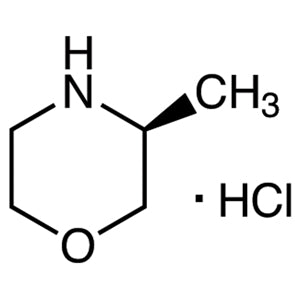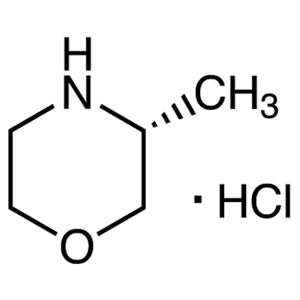
(R)-3-Methylmorpholine Hydrochloride is a chiral compound widely used in asymmetric synthesis, playing a crucial role in laboratories that require precise control over stereochemistry. This compound is derived from morpholine, with a methyl group attached at the third position and a hydrochloride group on the nitrogen atom. Its chiral nature makes it an essential building block in the synthesis of complex organic molecules. In research settings, it serves as a key reagent for creating enantiomerically pure compounds, which are vital in pharmaceutical and industrial applications.
The compound’s stability under normal chemical conditions and its solubility in organic solvents make it a preferred choice for synthetic chemists. Its ability to participate in asymmetric reactions with high selectivity ensures consistent results in laboratory experiments. Additionally, its availability in small pack sizes and solid form simplifies handling and storage, making it ideal for routine laboratory use. The compound’s predictable behavior in various reaction conditions further enhances its reliability in chemical synthesis.
In Indonesian laboratories, (R)-3-Methylmorpholine Hydrochloride is commonly used in organic chemistry research, particularly in the development of pharmaceutical compounds and industrial chemicals. Researchers and students rely on this compound for experiments that require controlled stereoselectivity and reactivity. Its application in both academic and industrial settings highlights its importance in advancing chemical synthesis techniques in the region.
TCI brochures (PDF)
- Chiral Building Blocks 2025-04-14 · p. 4
Related TCI products
- TCI M2848 1022094-03-6 (S)-3-Methylmorpholine Hydrochloride
- TCI M3564 27550-90-9 2-Methylmorpholine
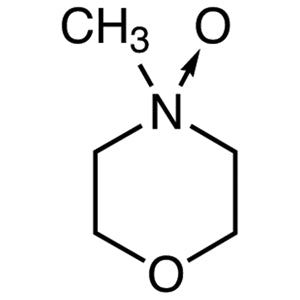
- TCI M2192 7529-22-8 4-Methylmorpholine N-Oxide
- TCI M0981 7529-22-8 4-Methylmorpholine N-Oxide (50% in Water, ca. 4.8mol/L)
- TCI M0370 109-02-4 4-Methylmorpholine
- TCI E1166 65756-41-4 4-Ethyl-4-methylmorpholinium Bromide
- Asymmetric Synthesis: This compound is ideal for creating enantiomerically pure compounds, essential in pharmaceutical research where stereochemistry directly affects drug efficacy.
- Chiral Building Block Applications: Its chiral structure makes it a preferred choice for constructing complex molecules with specific stereochemical configurations.
- Organic Chemistry Research: Widely used in Indonesian labs for synthesizing bioactive compounds and industrial chemicals requiring precise stereochemical control.
- Drug Development Studies: Its role in synthesizing pharmacologically active compounds supports research into new therapeutic agents.
- Educational Use in Chemistry Labs: Frequently used in academic settings to teach students about chiral synthesis and stereochemical control in organic reactions.
| Brand | TCI |
|---|---|
| CAS number | 953780-78-4 |
| Molecular formula | — |
| Purity | — |
| Category | Chemistry > Asymmetric Synthesis > Chiral Building Blocks |
| Pack sizes | Available in small quantities suitable for laboratory use |
| Physical form | Solid |
| Storage | Store in a cool, dry place away from moisture and direct light |
This compound should be stored in a cool, dry environment to maintain its stability and prevent degradation. It is recommended to use airtight containers to protect it from moisture and humidity, which can affect its chemical integrity. Since it is a solid, it should be kept in a secure location away from potential contaminants. In laboratory settings, it is important to handle it with care, using appropriate personal protective equipment when necessary. Due to its chiral nature, it is crucial to maintain its purity and avoid any contamination that could compromise its effectiveness in synthetic reactions. Proper storage ensures that the compound remains viable for use in research and educational applications.
—
Product Categories
Produk Terkait
-
(S)-3-MethylmorpholineHydrochloride TCI M2848
Regular price From Rp 1.246.350,00Regular price -
2-Methylmorpholine TCI M3564
Regular price Rp 3.763.200,00Regular price -
4-MethylmorpholineN-Oxide TCI M2192
Regular price From Rp 1.035.300,00Regular price -
4-MethylmorpholineN-Oxide(50%inWater,ca.4.8mol/L) TCI M0981
Regular price From Rp 717.150,00Regular price -
4-Methylmorpholine TCI M0370
Regular price From Rp 477.750,00Regular price -
4-Ethyl-4-methylmorpholiniumBromide TCI E1166
Regular price From Rp 2.916.900,00Regular price -
4-Ethylmorpholine TCI E0145
Regular price From Rp 505.050,00Regular price -
4-(4,6-Dimethoxy-1,3,5-triazin-2-yl)-4-methylmorpholin-4-iumTetrafluoroborate TCI D6289
Regular price Rp 2.625.000,00Regular price