TCI M3095 4-Methoxy-3-(trifluoromethyl)benzoic Acid is a fluorinated building block that combines three important structural elements within a single aromatic molecule: a carboxylic acid group that serves as the reactive coupling point, a methoxy group acting as an electron donor, and a trifluoromethyl group acting as a strong electron-withdrawing substituent. This combination makes it a widely sought intermediate in organic synthesis, particularly in drug discovery research and the development of agricultural active ingredients. In the laboratory it functions as a ready-to-use aromatic fragment that saves several synthetic steps, allowing researchers to direct their effort straight toward forming amide, ester, or heterocyclic bonds in the following stage.
The properties that make this compound a preferred choice come chiefly from the trifluoromethyl group, which is known to improve metabolic stability, lipophilicity, and membrane permeability in candidate drug molecules. That same group also produces a highly informative signal in fluorine NMR analysis, so the progress of a reaction can be monitored easily without additional or complicated procedures. The methoxy group, positioned para to the carboxylic acid, modulates the distribution of electron density around the ring, giving chemists a predictable electronic profile to work with when planning a coupling or derivatisation sequence on the aromatic core.
In Indonesian laboratories this material is typically found in academic and institutional research settings where medicinal chemistry and agrochemical synthesis programmes are carried out, as well as in industrial R&D groups preparing novel aromatic derivatives. Because it arrives as a defined aromatic fragment rather than something that must be built up in-house, it suits laboratories that need to shorten synthetic routes and concentrate their limited bench time and reagent budget on the later, more decisive bond-forming steps of a project.
Related TCI products
- TCI T1302 433-97-6 2-(Trifluoromethyl)benzoic Acid
- TCI B5334 328-89-2 2-Bromo-4-(trifluoromethyl)benzoic Acid
- TCI B4843 320-31-0 4-Bromo-2-(trifluoromethyl)benzoic Acid
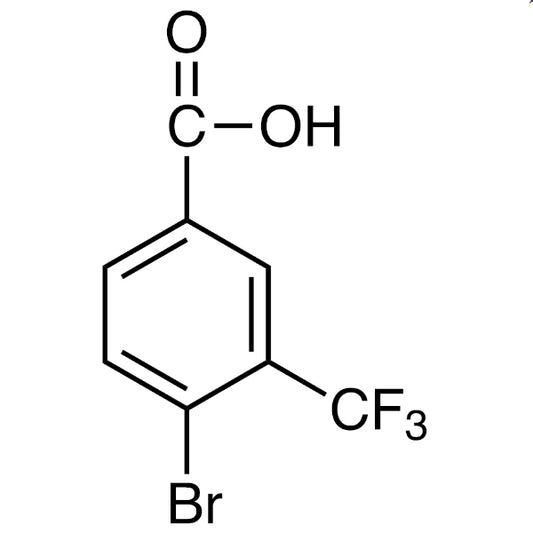
- TCI B4821 161622-14-6 4-Bromo-3-(trifluoromethyl)benzoic Acid
- TCI B4533 328-67-6 3-Bromo-5-(trifluoromethyl)benzoic Acid
- TCI B1420 725-89-3 3,5-Bis(trifluoromethyl)benzoic Acid
- Drug discovery intermediate synthesis: the ready-made aromatic core carrying a trifluoromethyl group lets medicinal chemists reach candidate scaffolds in fewer steps than building the ring from scratch.
- Amide bond formation and library preparation: the free carboxylic acid group is a direct coupling handle, so a single batch can be branched into many amide analogues for screening.
- Esterification and derivatisation chemistry: the same carboxylic acid functionality converts cleanly to esters, giving access to varied derivatives while the fluorinated ring stays structurally intact throughout.
- Heterocycle construction: the acid group serves as the entry point for cyclisation chemistry, allowing the fluorinated and methoxylated aromatic unit to be carried into larger heterocyclic systems.
- Agrochemical active ingredient research: the electron-withdrawing trifluoromethyl group and electron-donating methoxy group together provide the electronic profile often sought in agricultural active ingredient development programmes.
| Brand | TCI (Tokyo Chemical Industry) |
|---|---|
| CAS number | 213598-09-5 |
| Molecular formula | — |
| Purity | — |
| Category | Chemistry > Building Blocks > Fluorinated Building Blocks |
| Pack sizes | available in standard TCI research-scale packaging; please confirm the size required when ordering |
| Physical form | — |
| Storage | keep in the closed original container, in a cool and dry place |
- Chemical name: 4-Methoxy-3-(trifluoromethyl)benzoic Acid
Store the material in its original tightly closed container, in a cool, dry and well-ventilated place away from direct sunlight, moisture and incompatible chemicals. Amber glass or the supplier's original packaging is suitable, and the container should be resealed promptly after each use to limit exposure to atmospheric humidity. Handle the compound inside a fume hood using standard laboratory personal protective equipment, including safety glasses, gloves and a laboratory coat. Avoid generating dust when weighing, and transfer the solid with clean, dry spatulas to prevent cross-contamination between batches. Always consult the manufacturer's safety data sheet before first use and follow institutional waste disposal procedures for chemical residues.
—
Produk Terkait
-
2-(Trifluoromethyl)benzoicAcid TCI T1302
Regular price Rp 1.803.900,00Regular price -
2-Bromo-4-(trifluoromethyl)benzoicAcid TCI B5334
Regular price From Rp 1.378.650,00Regular price -
4-Bromo-2-(trifluoromethyl)benzoicAcid TCI B4843
Regular price From Rp 1.326.150,00Regular price -
4-Bromo-3-(trifluoromethyl)benzoicAcid TCI B4821
Regular price From Rp 505.050,00Regular price -
3-Bromo-5-(trifluoromethyl)benzoicAcid TCI B4533
Regular price From Rp 2.068.500,00Regular price -
3,5-Bis(trifluoromethyl)benzoicAcid TCI B1420
Regular price Rp 2.174.550,00Regular price -
4-(Trifluoromethyl)benzoicAcid TCI T1145
Regular price From Rp 505.050,00Regular price -
3-(Trifluoromethyl)benzoicAcid TCI T1034
Regular price From Rp 769.650,00Regular price