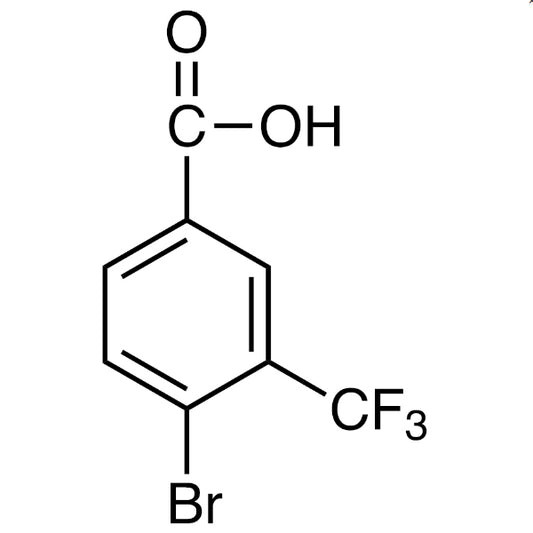
4-(Trifluoromethyl)benzoic Acid is a benzoic acid that carries a trifluoromethyl group at the para position of the benzene ring. It belongs to the family of fluorinated building blocks and is widely used in organic synthesis, particularly in medicinal chemistry and agrochemical research. This TCI T1145 product combines a carboxylic acid group, which is easily converted into esters, amides, or acyl chlorides, with a CF3 group that gives its derivatives distinctive characteristics. In the laboratory it serves as a starting material for introducing an aromatic trifluoromethyl unit into larger target molecules.
The trifluoromethyl group is known as a strongly electron-withdrawing substituent that is also fairly lipophilic and relatively stable chemically. In molecular design, it is often used to influence the acidity, lipophilicity, and metabolic resistance of a compound. Because the para position preserves the symmetry of the ring, this material is convenient to use in coupling reactions and amide formation, and the resulting products are generally straightforward to analyze. Researchers also use it as a fluorinated aromatic carboxylic acid for spectroscopic comparison, including fluorine-19 NMR.
In Indonesian laboratories, this material suits research groups working in organic synthesis, pharmaceutical science, and materials chemistry that want to incorporate an aromatic CF3 group into their target molecules. It is a practical choice for teams that need a dependable fluorinated building block from an established brand. It is available in 5 g and 25 g pack sizes, so laboratories can choose a quantity that matches the scale of their work, from initial route scouting to repeated synthesis.
TCI brochures (PDF)
- Fluorination Reagents, Fluorinated Building Blocks 2026-03-18 · p. 40
Related TCI products
- TCI T1302 433-97-6 2-(Trifluoromethyl)benzoic Acid
- TCI B5334 328-89-2 2-Bromo-4-(trifluoromethyl)benzoic Acid
- TCI B4843 320-31-0 4-Bromo-2-(trifluoromethyl)benzoic Acid
- TCI B4821 161622-14-6 4-Bromo-3-(trifluoromethyl)benzoic Acid
- TCI B4533 328-67-6 3-Bromo-5-(trifluoromethyl)benzoic Acid
- TCI B1420 725-89-3 3,5-Bis(trifluoromethyl)benzoic Acid
- Organic synthesis of trifluoromethylated compounds: the carboxylic acid group reacts readily to form esters, amides, or acyl chlorides, which makes this material a convenient way to introduce an aromatic CF3 unit into target molecules.
- Medicinal chemistry research: the CF3 group is often used to influence acidity, lipophilicity, and metabolic resistance, so this building block suits teams designing and comparing candidate molecules in drug discovery programs.
- Agrochemical research: as a fluorinated building block frequently used in this field, it supports the preparation of new candidate structures that carry an aromatic trifluoromethyl group for further evaluation.
- Coupling and amide formation reactions: the para substitution keeps the ring symmetrical, so the acid performs well in coupling reactions and gives products that are generally easy to analyze and characterize.
- Spectroscopic reference work: as a fluorinated aromatic carboxylic acid, it can serve as a comparison compound in analytical studies, including fluorine-19 NMR, where a clear fluorine signal is useful.
| Brand | TCI |
|---|---|
| CAS number | 455-24-3 |
| Molecular formula | — |
| Purity | — |
| Category | Chemistry > Building Blocks > Fluorinated Building Blocks |
| Pack sizes | 5 g and 25 g |
| Physical form | — |
| Storage | keep tightly closed in a cool, dry place, and follow the supplier's label and safety data sheet |
- Product code: T1145
Store 4-(Trifluoromethyl)benzoic Acid in its original, tightly closed container in a cool, dry, well-ventilated area, away from moisture, heat, and incompatible materials such as strong bases and strong oxidizing agents. Always confirm the exact storage conditions on the label and in the supplier's safety data sheet. Use clean, dry spatulas and glassware when weighing, and reseal the bottle promptly after use. As with any laboratory chemical, wear safety glasses, gloves, and a laboratory coat, and work in a fume hood or well-ventilated space to avoid inhaling dust. Wash hands after handling, and dispose of waste according to your institution's chemical waste procedures.
—
Produk Terkait
-
2-(Trifluoromethyl)benzoicAcid TCI T1302
Regular price Rp 1.856.400,00Regular priceRp 1.313.550,00Sale price Rp 1.856.400,00 -
2-Bromo-4-(trifluoromethyl)benzoicAcid TCI B5334
Regular price From Rp 1.431.150,00Regular priceRp 1.016.400,00Sale price From Rp 1.431.150,00 -
4-Bromo-2-(trifluoromethyl)benzoicAcid TCI B4843
Regular price From Rp 1.378.650,00Regular priceRp 979.650,00Sale price From Rp 1.378.650,00 -
4-Bromo-3-(trifluoromethyl)benzoicAcid TCI B4821
Regular price From Rp 557.550,00Regular priceRp 405.300,00Sale price From Rp 557.550,00 -
3-Bromo-5-(trifluoromethyl)benzoicAcid TCI B4533
Regular price From Rp 2.121.000,00Regular priceRp 1.498.350,00Sale price From Rp 2.121.000,00 -
3,5-Bis(trifluoromethyl)benzoicAcid TCI B1420
Regular price Rp 2.227.050,00Regular priceRp 1.572.900,00Sale price Rp 2.227.050,00 -
3-(Trifluoromethyl)benzoicAcid TCI T1034
Regular price From Rp 822.150,00Regular priceRp 590.100,00Sale price From Rp 822.150,00 -
4-Nitro-2-(trifluoromethyl)benzoicAcid TCI N1037
Regular price Rp 875.700,00Regular priceRp 627.900,00Sale price Rp 875.700,00