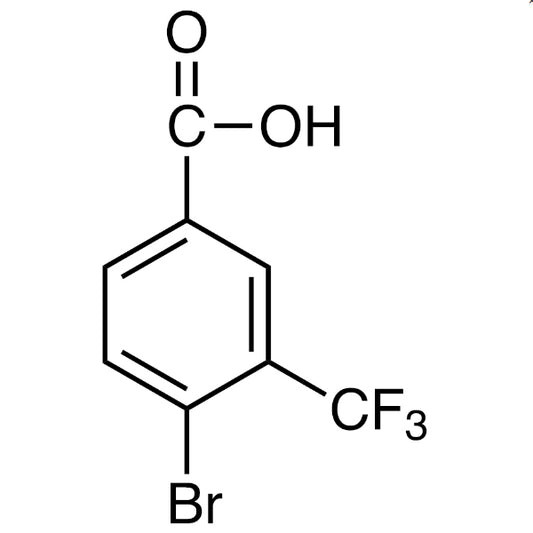
3-Bromo-5-(trifluoromethyl)benzoic Acid is a specialized organic compound widely used in laboratory settings for its unique chemical properties. As a fluorinated building block, it plays a crucial role in the synthesis of complex molecules, particularly those requiring bromine and trifluoromethyl substitutions. This compound is essential in modern organic chemistry for its ability to participate in various reaction mechanisms, making it a valuable tool for researchers. Its presence in chemical reactions allows for the creation of new molecular structures with tailored functional groups.
The compound's fluorine atoms significantly influence its electronic properties and reactivity, making it a preferred choice in synthetic chemistry. The trifluoromethyl group enhances the compound’s stability and reactivity, enabling precise chemical modifications. Its molecular structure supports a range of substitution and functionalization reactions, which are vital in the development of pharmaceuticals, industrial chemicals, and advanced materials. These characteristics make it an indispensable component in synthetic pathways requiring controlled reactivity and selectivity.
In Indonesian laboratories, 3-Bromo-5-(trifluoromethyl)benzoic Acid is commonly used in organic synthesis research. It is frequently employed in academic and research institutions for the development of new compounds and materials. Its availability and consistent quality make it a reliable choice for scientists working on complex chemical syntheses. The compound supports a wide range of experimental applications, contributing to advancements in chemical research and innovation.
Related TCI products
- TCI B5334 328-89-2 2-Bromo-4-(trifluoromethyl)benzoic Acid
- TCI B4843 320-31-0 4-Bromo-2-(trifluoromethyl)benzoic Acid
- TCI B4821 161622-14-6 4-Bromo-3-(trifluoromethyl)benzoic Acid
- TCI T1302 433-97-6 2-(Trifluoromethyl)benzoic Acid
- TCI B1420 725-89-3 3,5-Bis(trifluoromethyl)benzoic Acid
- TCI T1145 455-24-3 4-(Trifluoromethyl)benzoic Acid
- Organic synthesis of fluorinated compounds due to its bromine and trifluoromethyl substituents, enabling precise functional group modifications.
- Development of pharmaceuticals and agrochemicals where fluorine atoms enhance biological activity and metabolic stability.
- Creation of advanced materials with tailored properties through controlled chemical reactions involving fluorinated building blocks.
- Research in fluorinated chemistry for academic and industrial applications requiring high reactivity and selectivity.
- Synthesis of complex molecules in academic laboratories, supporting innovation in chemical research and drug discovery.
| Brand | TCI |
|---|---|
| CAS number | 328-67-6 |
| Molecular formula | — |
| Purity | — |
| Category | Chemistry > Building Blocks > Fluorinated Building Blocks |
| Pack sizes | Available in various quantities as per supplier specifications |
| Physical form | Solid, crystalline appearance |
| Storage | Store in a cool, dry place away from moisture and direct sunlight |
This compound should be stored in a cool, dry environment to maintain its chemical integrity. It is recommended to keep it in a sealed container to prevent exposure to moisture and air. Due to its fluorinated nature, it is important to handle it with care to avoid any potential reactivity with incompatible substances. Proper ventilation should be ensured when working with this material to minimize inhalation risks. Laboratory personnel should wear appropriate personal protective equipment, including gloves and safety goggles, to ensure safe handling. Storage conditions should be monitored to maintain optimal stability and prevent degradation over time.
—
Produk Terkait
-
2-Bromo-4-(trifluoromethyl)benzoicAcid TCI B5334
Regular price From Rp 1.431.150,00Regular priceRp 1.016.400,00Sale price From Rp 1.431.150,00 -
4-Bromo-2-(trifluoromethyl)benzoicAcid TCI B4843
Regular price From Rp 1.378.650,00Regular priceRp 979.650,00Sale price From Rp 1.378.650,00 -
4-Bromo-3-(trifluoromethyl)benzoicAcid TCI B4821
Regular price From Rp 557.550,00Regular priceRp 405.300,00Sale price From Rp 557.550,00 -
2-(Trifluoromethyl)benzoicAcid TCI T1302
Regular price Rp 1.856.400,00Regular priceRp 1.313.550,00Sale price Rp 1.856.400,00 -
3,5-Bis(trifluoromethyl)benzoicAcid TCI B1420
Regular price Rp 2.227.050,00Regular priceRp 1.572.900,00Sale price Rp 2.227.050,00 -
4-(Trifluoromethyl)benzoicAcid TCI T1145
Regular price From Rp 557.550,00Regular priceRp 405.300,00Sale price From Rp 557.550,00 -
3-(Trifluoromethyl)benzoicAcid TCI T1034
Regular price From Rp 822.150,00Regular priceRp 590.100,00Sale price From Rp 822.150,00 -
4-Nitro-2-(trifluoromethyl)benzoicAcid TCI N1037
Regular price Rp 875.700,00Regular priceRp 627.900,00Sale price Rp 875.700,00