


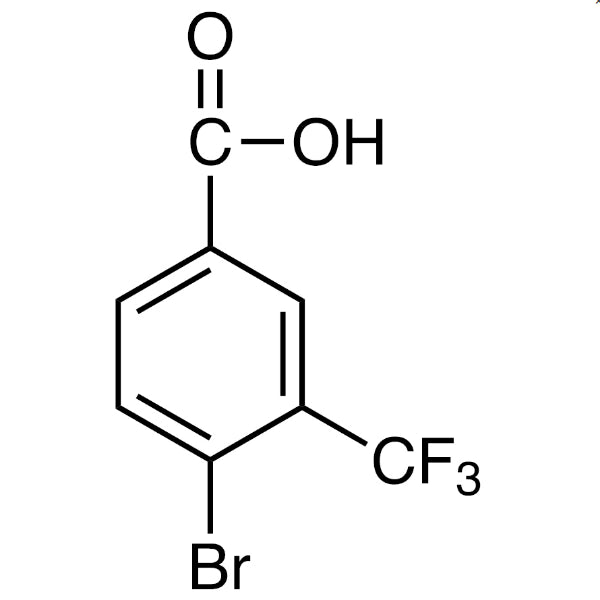
4-Bromo-3-(trifluoromethyl)benzoic Acid is a chemical compound widely used in synthetic reactions to produce complex molecules with fluorinated and brominated structures. This compound plays a crucial role in chemical laboratories, especially in research focused on organic compounds with high biological activity. As a fundamental building block, it serves as a key precursor in the development of pharmaceuticals, industrial chemicals, and functional compounds. Its unique molecular structure enables it to participate in various chemical transformations, making it indispensable for synthetic chemists.
The compound’s key properties include the presence of a bromine atom and a trifluoromethyl group, which contribute to its reactivity and stability. These functional groups provide specific chemical behavior, allowing the compound to be used in substitution, replacement, and electrophilic reactions. Its chemical and physical characteristics make it a preferred choice in the synthesis of complex, structurally diverse compounds. The combination of fluorine and bromine atoms enhances its utility in creating molecules with tailored properties for specialized applications.
In Indonesian laboratories, this compound is frequently used in organic chemistry research, particularly by academic institutions and research organizations. It is a vital tool in the development of new compounds with potential applications across various scientific fields. Its versatility and reactivity make it an essential component in both educational and industrial research settings.
Related TCI products
- TCI B5334 328-89-2 2-Bromo-4-(trifluoromethyl)benzoic Acid
- TCI B4843 320-31-0 4-Bromo-2-(trifluoromethyl)benzoic Acid
- TCI B4533 328-67-6 3-Bromo-5-(trifluoromethyl)benzoic Acid
- TCI T1302 433-97-6 2-(Trifluoromethyl)benzoic Acid
- TCI B1420 725-89-3 3,5-Bis(trifluoromethyl)benzoic Acid
- TCI T1145 455-24-3 4-(Trifluoromethyl)benzoic Acid
- Organic synthesis research utilizes this compound to create complex molecules with fluorinated and brominated structures, enhancing the diversity of chemical compounds.
- Pharmaceutical development benefits from its reactivity, allowing for the synthesis of drug candidates with targeted biological activities.
- Industrial chemical production relies on its stability and functional groups to create high-performance materials and specialty chemicals.
- Functional compound research leverages its unique molecular structure to design molecules with specific chemical and physical properties.
- Academic teaching and research use it as a foundational building block to illustrate synthetic strategies and chemical transformations.
| Brand | TCI |
|---|---|
| CAS number | 161622-14-6 |
| Molecular formula | — |
| Purity | — |
| Category | Chemistry > Building Blocks > Fluorinated Building Blocks |
| Pack sizes | Available in various quantities as per supplier specifications |
| Physical form | Solid |
| Storage | Store in a cool, dry place away from light and moisture |
This compound should be stored in a cool, dry environment, away from direct light and moisture to maintain its chemical integrity. It is recommended to use airtight containers made of materials that are chemically inert, such as glass or high-density polyethylene, to prevent contamination and degradation. Due to its reactivity, it should be handled with appropriate personal protective equipment, including gloves and safety goggles, to ensure laboratory safety. Proper ventilation is essential when working with this compound to minimize exposure. Regular monitoring of storage conditions is advised to ensure optimal preservation and safe handling.
—
Produk Terkait
-
2-Bromo-4-(trifluoromethyl)benzoicAcid TCI B5334
Regular price From Rp 1.431.150,00Regular priceRp 1.016.400,00Sale price From Rp 1.431.150,00 -
4-Bromo-2-(trifluoromethyl)benzoicAcid TCI B4843
Regular price From Rp 1.378.650,00Regular priceRp 979.650,00Sale price From Rp 1.378.650,00 -
3-Bromo-5-(trifluoromethyl)benzoicAcid TCI B4533
Regular price From Rp 2.121.000,00Regular priceRp 1.498.350,00Sale price From Rp 2.121.000,00 -
2-(Trifluoromethyl)benzoicAcid TCI T1302
Regular price Rp 1.856.400,00Regular priceRp 1.313.550,00Sale price Rp 1.856.400,00 -
3,5-Bis(trifluoromethyl)benzoicAcid TCI B1420
Regular price Rp 2.227.050,00Regular priceRp 1.572.900,00Sale price Rp 2.227.050,00 -
4-(Trifluoromethyl)benzoicAcid TCI T1145
Regular price From Rp 557.550,00Regular priceRp 405.300,00Sale price From Rp 557.550,00 -
3-(Trifluoromethyl)benzoicAcid TCI T1034
Regular price From Rp 822.150,00Regular priceRp 590.100,00Sale price From Rp 822.150,00 -
4-Nitro-2-(trifluoromethyl)benzoicAcid TCI N1037
Regular price Rp 875.700,00Regular priceRp 627.900,00Sale price Rp 875.700,00


