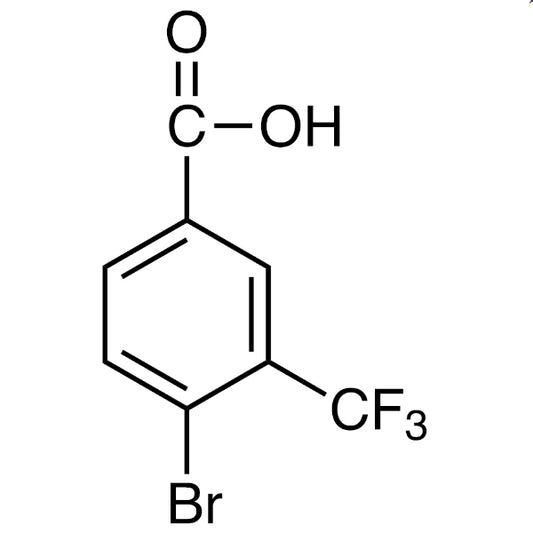
4-Nitro-2-(trifluoromethyl)benzoic Acid is a versatile organic compound widely used in laboratory settings for synthetic chemistry applications. As a fluorinated building block, it plays a crucial role in the development of complex molecules with tailored chemical properties. Its unique structure, featuring both a nitro group and a trifluoromethyl group, makes it an essential component in the synthesis of pharmaceuticals, advanced materials, and specialty chemicals. This compound is particularly valued for its ability to participate in various substitution reactions, offering researchers a reliable tool for molecular modification.
The compound's chemical stability and controlled reactivity make it a preferred choice for precise chemical synthesis. The presence of the trifluoromethyl group enhances its stability during chemical reactions, while the nitro group contributes to its reactivity and functional versatility. These properties allow it to be selectively modified in different reaction conditions, making it suitable for a wide range of synthetic strategies. Its predictable behavior under controlled laboratory conditions ensures reproducibility and reliability in research and development processes.
In Indonesian laboratories, 4-Nitro-2-(trifluoromethyl)benzoic Acid is commonly used in organic chemistry research and the development of new compounds. It is a key reagent in academic and industrial settings, supporting advancements in pharmaceutical research, material science, and chemical synthesis. Its application is widespread across research institutions and universities, where it contributes to the expansion of chemical knowledge and technological innovation.
TCI brochures (PDF)
- Fluorination Reagents, Fluorinated Building Blocks 2026-03-18 · p. 43
Related TCI products
- TCI N0720 320-94-5 2-Nitro-4-(trifluoromethyl)benzoic Acid
- TCI T1302 433-97-6 2-(Trifluoromethyl)benzoic Acid
- TCI B5334 328-89-2 2-Bromo-4-(trifluoromethyl)benzoic Acid
- TCI B4843 320-31-0 4-Bromo-2-(trifluoromethyl)benzoic Acid
- TCI B4821 161622-14-6 4-Bromo-3-(trifluoromethyl)benzoic Acid
- TCI B4533 328-67-6 3-Bromo-5-(trifluoromethyl)benzoic Acid
- Organic synthesis applications benefit from its structural versatility, allowing for the creation of complex molecules with specific functional groups.
- Pharmaceutical research utilizes this compound to develop new drugs with targeted chemical properties and improved therapeutic effects.
- Material science applications leverage its fluorinated structure to design advanced polymers and specialty coatings with enhanced performance.
- Chemical modification processes rely on its reactivity and stability to produce derivatives with tailored chemical behavior.
- Academic research in chemistry uses it as a fundamental building block for exploring new synthetic pathways and molecular transformations.
| Brand | TCI |
|---|---|
| CAS number | 320-37-6 |
| Molecular formula | — |
| Purity | — |
| Category | Chemistry > Building Blocks > Fluorinated Building Blocks |
| Pack sizes | Available in various quantities as per supplier specifications |
| Physical form | Solid |
| Storage | Store in a cool, dry place away from moisture and direct sunlight |
This compound should be stored in a cool, dry environment to maintain its chemical stability. It is recommended to keep it in a tightly sealed container to prevent exposure to moisture and air. Due to its fluorinated nature, it is important to handle it with appropriate personal protective equipment, such as gloves and safety goggles, to ensure safety in the laboratory. Storage should be away from incompatible materials to avoid any potential chemical interactions. Regular monitoring of storage conditions is advised to ensure the compound remains in optimal condition for use in research applications.
—
Produk Terkait
-
2-Nitro-4-(trifluoromethyl)benzoicAcid TCI N0720
Regular price From Rp 1.035.300,00Regular price -
2-(Trifluoromethyl)benzoicAcid TCI T1302
Regular price Rp 1.803.900,00Regular price -
2-Bromo-4-(trifluoromethyl)benzoicAcid TCI B5334
Regular price From Rp 1.378.650,00Regular price -
4-Bromo-2-(trifluoromethyl)benzoicAcid TCI B4843
Regular price From Rp 1.326.150,00Regular price -
4-Bromo-3-(trifluoromethyl)benzoicAcid TCI B4821
Regular price From Rp 505.050,00Regular price -
3-Bromo-5-(trifluoromethyl)benzoicAcid TCI B4533
Regular price From Rp 2.068.500,00Regular price -
3,5-Bis(trifluoromethyl)benzoicAcid TCI B1420
Regular price Rp 2.174.550,00Regular price -
4-(Trifluoromethyl)benzoicAcid TCI T1145
Regular price From Rp 505.050,00Regular price