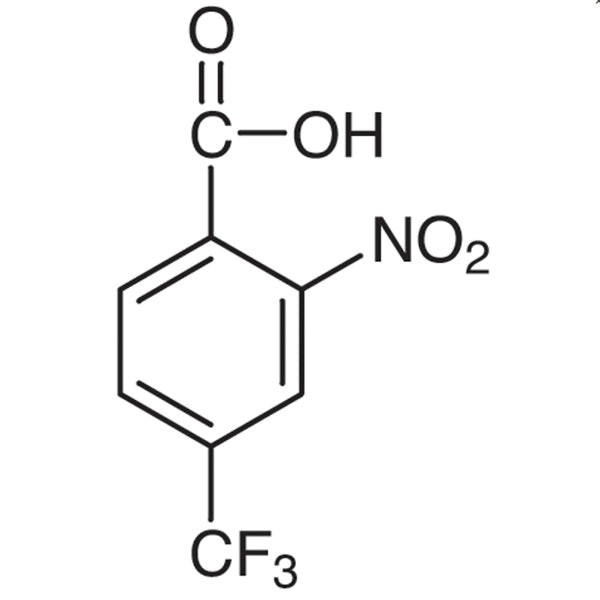
2-Nitro-4-(trifluoromethyl)benzoic Acid from TCI (product code N0720) is a substituted benzoic acid. It carries a nitro group ortho to the carboxyl group and a trifluoromethyl group para to it. The compound is classed as a fluorinated building block. In the laboratory it is used as an intermediate for building fluorine-containing aromatic molecules. Its main uses are in medicinal chemistry, agrochemical research and heterocyclic synthesis, where chemists need a dependable starting point for multi-step routes toward more complex fluorinated targets.
Chemists choose this material because its three functional groups complement each other. The carboxyl group can be converted into esters, amides or acyl chlorides, which gives flexible entry points for coupling and derivatisation. The nitro group can be reduced to an amine to give an anthranilic acid derivative. Anthranilic acid derivatives are classic precursors to quinazolinones, benzoxazinones and other heterocycles. The trifluoromethyl group adds lipophilicity and metabolic stability, two properties that matter a great deal in the design of bioactive compounds. Together, these features make the compound an efficient starting point for stepwise synthesis.
In Indonesia, this compound suits organic synthesis laboratories at universities, pharmaceutical research laboratories, and agrochemical development laboratories that design fluorinated analogues. Academic groups can use it in teaching and research projects on functional group transformations and heterocycle construction. Industrial and institutional research teams can use it to prepare fluorinated intermediates for screening libraries. The 5g pack size fits laboratory-scale synthesis, method development and exploratory work, where researchers need a trusted supply of a well-defined, branded building block.
Related TCI products
- TCI N1037 320-37-6 4-Nitro-2-(trifluoromethyl)benzoic Acid
- TCI T1302 433-97-6 2-(Trifluoromethyl)benzoic Acid
- TCI B5334 328-89-2 2-Bromo-4-(trifluoromethyl)benzoic Acid
- TCI B4843 320-31-0 4-Bromo-2-(trifluoromethyl)benzoic Acid
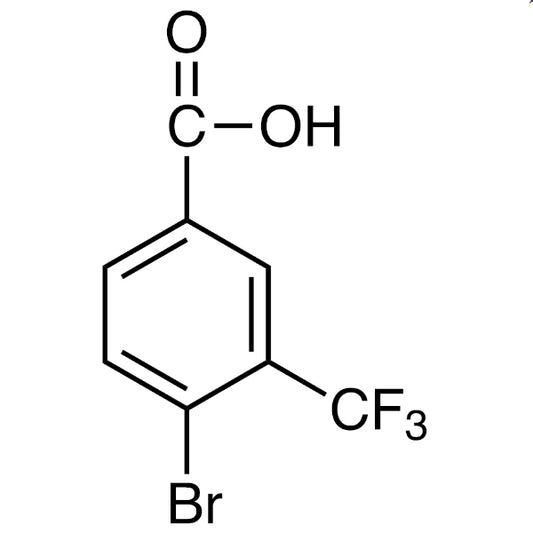
- TCI B4821 161622-14-6 4-Bromo-3-(trifluoromethyl)benzoic Acid
- TCI B4533 328-67-6 3-Bromo-5-(trifluoromethyl)benzoic Acid
- Medicinal chemistry intermediate synthesis: the trifluoromethyl group improves lipophilicity and metabolic stability, so this acid is a useful precursor for fluorinated drug-like candidates.
- Anthranilic acid derivative preparation: reducing the ortho nitro group to an amine gives a fluorinated anthranilic acid scaffold that can be used in many further transformations.
- Heterocyclic synthesis of quinazolinones and benzoxazinones: the reduced amino acid derivative is a classic precursor for building these fused heterocyclic ring systems in research laboratories.
- Agrochemical analogue development: fluorine-containing aromatic cores are widely studied in crop-protection research, and this building block gives a direct entry point to such analogues.
- Carboxyl group derivatisation studies: the acid function converts readily into esters, amides or acyl chlorides, so chemists can couple the fluorinated aromatic unit onto many different molecular partners.
| Brand | TCI (product code N0720) |
|---|---|
| CAS number | 320-94-5 |
| Molecular formula | — |
| Purity | — |
| Category | Chemistry > Building Blocks > Fluorinated Building Blocks |
| Pack sizes | 5g |
| Physical form | see the product label and the supplier's certificate of analysis |
| Storage | keep tightly closed in a cool, dry place, following the TCI label and Safety Data Sheet |
Store 2-Nitro-4-(trifluoromethyl)benzoic Acid in its original, tightly sealed container in a cool, dry, well-ventilated area, away from direct sunlight, heat sources and incompatible substances such as strong bases, strong reducing agents and strong oxidisers. Keep the container clearly labelled and close it promptly after each use to protect the contents from moisture and contamination. Handle the material in a fume hood or another well-ventilated workspace. Wear standard personal protective equipment, including safety glasses, chemical-resistant gloves and a laboratory coat. Avoid creating dust and avoid contact with skin, eyes or clothing. Always read the TCI Safety Data Sheet before use, and dispose of residues according to institutional and local chemical waste regulations.
—
Produk Terkait
-
4-Nitro-2-(trifluoromethyl)benzoicAcid TCI N1037
Regular price Rp 823.200,00Regular price -
2-(Trifluoromethyl)benzoicAcid TCI T1302
Regular price Rp 1.803.900,00Regular price -
2-Bromo-4-(trifluoromethyl)benzoicAcid TCI B5334
Regular price From Rp 1.378.650,00Regular price -
4-Bromo-2-(trifluoromethyl)benzoicAcid TCI B4843
Regular price From Rp 1.326.150,00Regular price -
4-Bromo-3-(trifluoromethyl)benzoicAcid TCI B4821
Regular price From Rp 505.050,00Regular price -
3-Bromo-5-(trifluoromethyl)benzoicAcid TCI B4533
Regular price From Rp 2.068.500,00Regular price -
3,5-Bis(trifluoromethyl)benzoicAcid TCI B1420
Regular price Rp 2.174.550,00Regular price -
4-(Trifluoromethyl)benzoicAcid TCI T1145
Regular price From Rp 505.050,00Regular price