TCI M3199 1-Methylpyridinium Bis(trifluoromethanesulfonyl)imide, CAS 742086-10-8, is an ionic liquid composed of the 1-methylpyridinium cation paired with the bis(trifluoromethanesulfonyl)imide anion, commonly abbreviated as NTf2 or TFSI. Ionic liquids are organic salts with low melting points, which means they remain liquid across the ordinary working temperature range of a laboratory and consist entirely of ions without any molecular solvent present. In laboratory practice, this material serves as a reaction medium, as an electrolyte, and as a research subject in its own right within physical chemistry and electrochemistry studies.
The properties that make this compound a preferred choice centre on the NTf2 anion, which is highly delocalised, weakly coordinating, and hydrophobic in character. These features give the material a wide electrochemical window, good ionic conductivity, and a viscosity that is relatively low compared with many other ionic liquids, together with an extremely small vapour pressure so that it is practically non-volatile under ordinary laboratory conditions. The aromatic pyridinium cation contributes good thermal stability and a dissolution behaviour that differs from that of imidazolium cations, which is why this compound is frequently used as a comparison standard in studies of how cation structure influences the physical properties of ionic liquids.
In Indonesian laboratories, this ionic liquid is typically encountered in university research groups, institutional chemistry laboratories, and materials or energy research units where electrochemical and physical chemistry work is carried out. It is handled at the bench scale in small quantities, usually as part of electrolyte formulation work, solvent-effect investigations, or comparative characterisation studies. Because it is non-volatile and used in modest volumes, it fits well into the standard fume-hood and glassware practices already established in these laboratories.
TCI brochures (PDF)
- Ionic Liquids 2026-06-08 · p. 10
Related TCI products
- TCI B5763 475681-62-0 1-Butyl-4-methylpyridinium Bis(trifluoromethanesulfonyl)imide
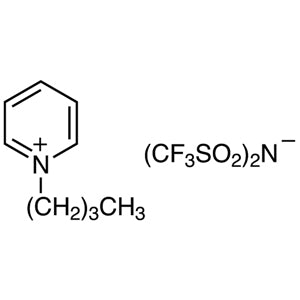
- TCI B5571 187863-42-9 1-Butylpyridinium Bis(trifluoromethanesulfonyl)imide
- TCI V0145 1013027-27-4 1-Vinylimidazole Bis(trifluoromethanesulfonyl)imide
- TCI T2761 268536-05-6 Trimethylpropylammonium Bis(trifluoromethanesulfonyl)imide
- TCI T2679 405514-94-5 Tributylmethylammonium Bis(trifluoromethanesulfonyl)imide
- TCI T2314 321746-49-0 Triethylsulfonium Bis(trifluoromethanesulfonyl)imide
- Electrolyte formulation for electrochemical cells: the wide electrochemical window and good ionic conductivity of the NTf2 anion allow the material to support potential sweeps and charge transfer studies without the solvent itself decomposing.
- Reaction medium for synthetic chemistry: as a fully ionic, non-volatile liquid it replaces conventional molecular solvents in reactions where solvent evaporation, vapour loss, or solvent participation in the reaction would otherwise complicate the work.
- Physical chemistry research into ion transport: the relatively low viscosity compared with other ionic liquids makes it a practical system for measuring conductivity, diffusion, and viscosity relationships in purely ionic media.
- Comparative studies of cation structure effects: the aromatic pyridinium cation behaves differently from imidazolium cations, so this compound serves as a reference point when researchers correlate cation architecture with measured physical properties.
- Investigations requiring a weakly coordinating, hydrophobic medium: the delocalised NTf2 anion interacts only weakly with dissolved species, which is valuable when the aim is to study solutes with minimal interference from the surrounding solvent environment.
| Brand | TCI (Tokyo Chemical Industry) |
|---|---|
| CAS number | 742086-10-8 |
| Molecular formula | — |
| Purity | — |
| Category | Chemistry > Specialty Synthesis > Ionic Liquids [Specialty Synthesis] |
| Pack sizes | available in standard TCI research-scale packaging; please confirm the currently listed pack size when ordering |
| Physical form | ionic liquid, liquid at laboratory working temperatures |
| Storage | — |
- Product code: M3199
Store the container tightly closed in a cool, dry place away from direct sunlight and sources of heat, following the storage conditions stated on the manufacturer's label and safety data sheet. Because the material is hygroscopically sensitive in the sense that moisture uptake can alter its measured physical and electrochemical behaviour, keep the container sealed and minimise exposure to humid air during transfer; use of a dry-atmosphere glovebox or a nitrogen-purged setup is advisable for demanding electrochemical work. Suitable containers are the original manufacturer packaging or clean, dry glass vessels with tight-fitting closures. Handle in a well-ventilated area or fume hood, wear chemical-resistant gloves, safety goggles, and a laboratory coat, and avoid contact with skin and eyes. Dispose of residues and contaminated materials through the laboratory's chemical waste procedure rather than through the drain.
—
Produk Terkait
-
1-Butyl-4-methylpyridiniumBis(trifluoromethanesulfonyl)imide TCI B5763
Regular price From Rp 955.500,00Regular priceRp 683.550,00Sale price From Rp 955.500,00 -
1-ButylpyridiniumBis(trifluoromethanesulfonyl)imide TCI B5571
Regular price From Rp 2.147.250,00Regular priceRp 1.517.250,00Sale price From Rp 2.147.250,00 -
1-VinylimidazoleBis(trifluoromethanesulfonyl)imide TCI V0145
Regular price Rp 2.809.800,00Regular priceRp 1.980.300,00Sale price Rp 2.809.800,00 -
TrimethylpropylammoniumBis(trifluoromethanesulfonyl)imide TCI T2761
Regular price From Rp 1.908.900,00Regular priceRp 1.350.300,00Sale price From Rp 1.908.900,00 -
TributylmethylammoniumBis(trifluoromethanesulfonyl)imide TCI T2679
Regular price From Rp 1.749.300,00Regular priceRp 1.239.000,00Sale price From Rp 1.749.300,00 -
TriethylsulfoniumBis(trifluoromethanesulfonyl)imide TCI T2314
Regular price Rp 2.862.300,00Regular priceRp 2.017.050,00Sale price Rp 2.862.300,00 -
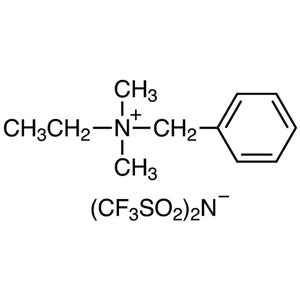
Benzyl(ethyl)dimethylammoniumBis(trifluoromethanesulfonyl)imide TCI B5427
Regular price Rp 3.790.500,00Regular priceRp 2.665.950,00Sale price Rp 3.790.500,00 -
3,3'-(Butane-1,4-diyl)bis(1-vinyl-3-imidazolium)Bis(trifluoromethanesulfonyl)imide TCI B5421
Regular price Rp 2.439.150,00Regular priceRp 1.720.950,00Sale price Rp 2.439.150,00