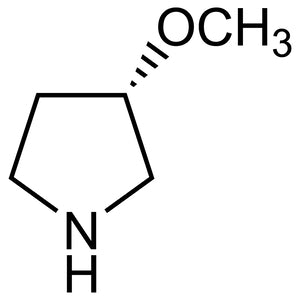
TCI M3875 is (S)-3-Methoxypyrrolidine, a chiral building block consisting of a five-membered pyrrolidine ring bearing a methoxy group at the three position with a defined S configuration. The compound belongs to the chiral building block class, meaning it is an enantiopure starting material used to introduce a stereogenic center into a target molecule without the need for costly and time-consuming asymmetric synthesis or enantiomer resolution. Because the pyrrolidine ring is among the most frequently encountered motifs in modern pharmaceuticals, the availability of a derivative that already carries both an ether substituent and a set configuration substantially shortens a synthetic route.
The properties that make this material a preferred choice are the combination of a nucleophilic, basic cyclic secondary amine with a stable, unreactive methoxy ether group. The secondary amine serves as the principal point of attachment for amidation, sulfonylation, reductive alkylation, nucleophilic aromatic substitution, and palladium-catalyzed coupling reactions. The methoxy group, meanwhile, does not interfere with these transformations yet meaningfully alters the molecular profile: it lowers lipophilicity, contributes a hydrogen bond acceptor, and frequently improves the overall property balance of the resulting compound.
In Indonesian laboratories this building block is typically used in medicinal chemistry and organic synthesis groups at universities, research institutes, and pharmaceutical development units, where routes toward nitrogen-heterocyclic candidate compounds are assembled on a small scale. It is handled in standard synthetic glassware under inert conditions and is generally purchased in small quantities appropriate to exploratory route-scouting work, method development, and the preparation of analytical reference materials.
Related TCI products
- TCI M3610 62848-20-8 3-Methoxypyrrolidine
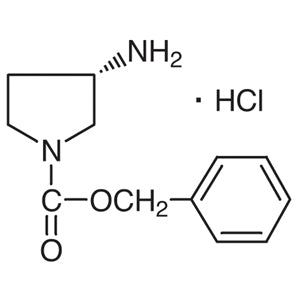
- TCI A2324 550378-39-7 (S)-3-Amino-1-carbobenzoxypyrrolidine Hydrochloride
- TCI T2902 97538-67-5 (2R,5S)-2-Trichloromethyl-3-oxa-1-azabicyclo[3.3.0]octan-4-one
- TCI T2312 5022-65-1 L-Tryptophanamide Hydrochloride
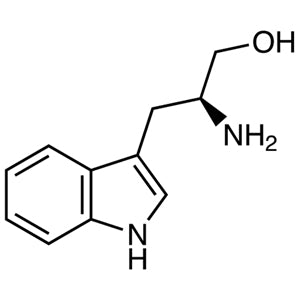
- TCI T1537 2899-29-8 L-(-)-Tryptophanol
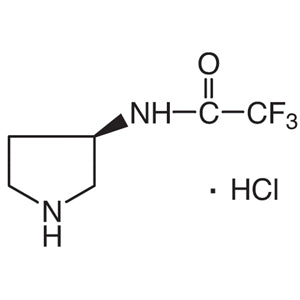
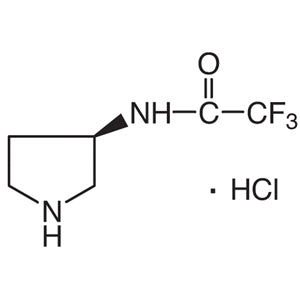
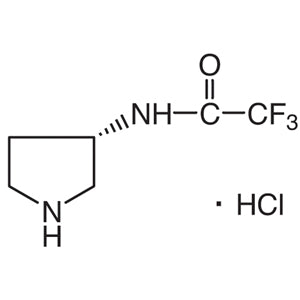
- TCI T1369 141043-16-5 (3R)-(+)-3-(Trifluoroacetamido)pyrrolidine Hydrochloride
- Introduction of stereogenic centers into target molecules, since the S configuration is already set and removes the need for a separate asymmetric synthesis or enantiomer resolution step.
- Amidation and sulfonylation reactions, where the cyclic secondary amine acts as a reliable nucleophile to form amide and sulfonamide linkages with acyl or sulfonyl partners.
- Reductive alkylation of the ring nitrogen, allowing the secondary amine to be converted into tertiary amine derivatives while the methoxy ether remains untouched under the reaction conditions.
- Nucleophilic aromatic substitution on activated aryl halides and heteroaryl systems, using the amine as the incoming nucleophile to build aryl-pyrrolidine connections common in drug scaffolds.
- Palladium-catalyzed coupling chemistry, in which the amine serves as the coupling partner to install the substituted pyrrolidine ring onto aromatic frameworks in medicinal chemistry route development.
| Brand | TCI |
|---|---|
| CAS number | 120099-61-8 |
| Molecular formula | — |
| Purity | — |
| Category | Chemistry > Asymmetric Synthesis > Chiral Building Blocks |
| Pack sizes | available in standard research-scale catalogue pack sizes |
| Physical form | — |
| Storage | keep tightly closed in the recommended conditions stated on the product label |
- Chemical name: (S)-3-Methoxypyrrolidine
Store the container tightly closed in a cool, dry, well-ventilated place away from heat sources, ignition sources, and direct sunlight, following the conditions stated on the manufacturer label. Keep the material in its original tightly sealed container or in an equivalent chemically compatible vessel, and protect it from moisture and air by working under an inert atmosphere where the synthetic procedure requires it. As a basic amine, handle it only in a functioning fume hood using safety glasses, chemically resistant gloves, and a laboratory coat. Avoid contact with skin, eyes, and clothing, avoid breathing vapors, and keep it separated from strong acids and strong oxidizing agents. Transfer the material with clean dry equipment, reseal the container promptly after use, and dispose of residues and contaminated materials in accordance with institutional chemical waste procedures.
—
Produk Terkait
-
3-Methoxypyrrolidine TCI M3610
Regular price From Rp 2.068.500,00Regular price -
(S)-3-Amino-1-carbobenzoxypyrrolidineHydrochloride TCI A2324
Regular price From Rp 1.829.100,00Regular price -
(2R,5S)-2-Trichloromethyl-3-oxa-1-azabicyclo[3.3.0]octan-4-one TCI T2902
Regular price Rp 1.644.300,00Regular price -
L-TryptophanamideHydrochloride TCI T2312
Regular price From Rp 2.016.000,00Regular price -
L-(-)-Tryptophanol TCI T1537
Regular price Rp 2.121.000,00Regular price -
(3R)-(+)-3-(Trifluoroacetamido)pyrrolidineHydrochloride TCI T1369
Regular price From Rp 2.386.650,00Regular price -
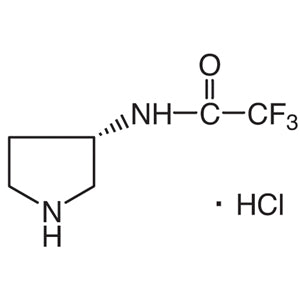
(3S)-(-)-3-(Trifluoroacetamido)pyrrolidineHydrochloride TCI T1366
Regular price From Rp 1.298.850,00Regular price -
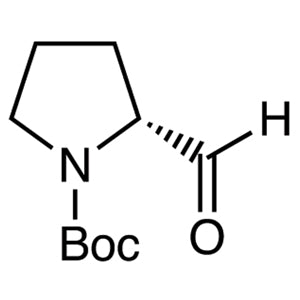
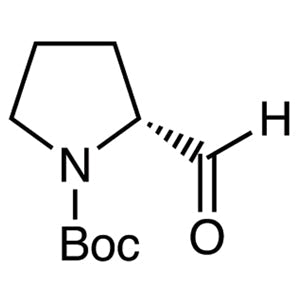
N-(tert-Butoxycarbonyl)-D-prolinal TCI B5395
Regular price Rp 1.881.600,00Regular price

![97538-67-5 (2R,5S)-2-Trichloromethyl-3-oxa-1-azabicyclo[3.3.0]octan-4-one - AMI Scientific](http://amiscientific.com/cdn/shop/files/TCI2510T2902.jpg?v=1767143504&width=533)