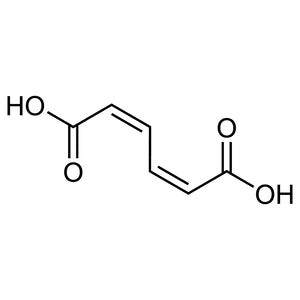
TCI M3914 (2Z,4Z)-Hexa-2,4-dienedioic Acid, more widely known as cis,cis-muconic acid, is an unsaturated dicarboxylic acid carrying two conjugated double bonds, both in the Z configuration. The compound occupies an important position in green chemistry and biotechnology because it is the product of aromatic ring cleavage by dioxygenase enzymes, and at the same time serves as a key intermediate on the route toward adipic acid derived from renewable sources. In the laboratory it is used as an analytical standard, as an enzyme substrate, and as a starting material for the synthesis of polymers and cyclic compounds.
The characteristic that makes this material a preferred choice is its conjugated diene system flanked by two carboxylate groups, which makes the molecule reactive toward hydrogenation, Diels-Alder cycloaddition, lactonization, and isomerization into the more stable trans form. It is specifically the cis,cis configuration that many experiments require, because only that isomer displays certain cyclization behaviour and acts as a specific marker for particular metabolic pathways. Researchers therefore select this defined stereochemistry rather than a mixed or isomerized grade when the outcome of the work depends on the geometry of the diene.
In Indonesian laboratories the compound appears in the same contexts in which it is used internationally: metabolic pathway studies, biocatalysis and fermentation research, and the development of bio-based monomers. It exists as a solid at room temperature, and like conjugated diene compounds in the cis configuration generally, the material requires protected storage so that its configuration is preserved. University and institutional laboratories working on renewable feedstock chemistry and enzymatic degradation of aromatics are the typical users.
Related TCI products
- Analytical standard preparation: the defined cis,cis stereochemistry allows the compound to serve as a reference point when identifying and quantifying muconic acid in experimental samples.
- Enzyme substrate studies: because it is the product of aromatic ring cleavage by dioxygenase enzymes, it is directly suited to assays that probe the activity of those enzymes.
- Renewable adipic acid research: as a key intermediate toward bio-based adipic acid, it is used in hydrogenation experiments aimed at replacing petroleum-derived routes to that monomer.
- Diels-Alder cycloaddition work: the conjugated diene system flanked by two carboxylate groups gives the molecule the reactivity needed for cycloaddition chemistry toward cyclic products.
- Polymer and cyclic compound synthesis: the two carboxylate groups make it a usable starting material where a difunctional unsaturated building block is required for chain building or lactonization.
| Brand | TCI |
|---|---|
| CAS number | 1119-72-8 |
| Molecular formula | — |
| Purity | — |
| Category | Chemistry > Building Blocks > Non-Heterocyclic Building Blocks |
| Pack sizes | as listed on this product page; please refer to the available packaging options shown |
| Physical form | solid at room temperature |
| Storage | protected storage is required so that the cis,cis configuration is preserved |
Store the material in its original tightly closed container, protected from light, heat, and air, since conjugated diene compounds in the cis configuration can isomerize into the more stable trans form under unfavourable conditions. Use tightly sealed glass containers and minimize the time the container remains open on the bench. Handle the compound in a fume hood while wearing gloves, safety goggles, and a laboratory coat, following the standard precautions applied to organic acids. Keep it away from incompatible materials, weigh it promptly, and always consult the manufacturer's safety data sheet before use.
—
Produk Terkait
-
trans-3-HexenedioicAcid TCI H0477
Regular price From Rp 2.386.650,00Regular price