

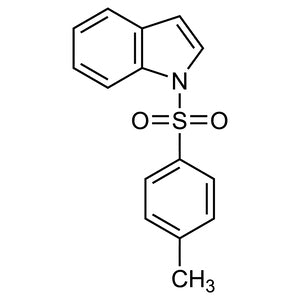
TCI M3915 1-Tosyl-1H-indole is an indole derivative in which the nitrogen atom has been protected by a tosyl group, that is, the para-toluenesulfonyl group. The compound serves as a highly practical heterocyclic building block in organic synthesis, particularly when researchers require an indole framework whose nitrogen is already protected from the very beginning of a reaction sequence. The indole core itself is one of the most important scaffolds in medicinal chemistry and natural product chemistry, because a great many alkaloids and bioactive molecules are built upon this structure.
The property that makes this material a frequent choice is the influence of the electron-withdrawing tosyl group on the reactivity of the indole ring. Protection at the nitrogen lowers the electron density at the C3 position and at the same time prevents side reactions at the N-H bond, so the selectivity pattern of the reaction shifts and directed functionalisation at the C2 position becomes easier to achieve. The tosyl group also acts as a directing group in many transition-metal-catalysed carbon-hydrogen bond activation reactions, and it can be removed again at a late stage using basic conditions.
The compound is a solid at room temperature with good storage stability and favourable solubility behaviour, which makes it convenient to weigh out and handle in ordinary Indonesian laboratory conditions. It is typically used in university and institutional synthetic chemistry laboratories, in medicinal chemistry research groups working on indole-based scaffolds, and in methodology work where a protected indole starting material is needed before subsequent functionalisation steps are carried out.
Related TCI products
- TCI I0743 1196-70-9 Indole-6-carboxaldehyde
- TCI I0852 19005-93-7 Indole-2-carboxaldehyde
- TCI T4293 1,1,2-Trimethyl-1H-benzo[e]indole-7-sulfonic Acid Monohydrate
- TCI T3351 55577-25-8 2-(p-Tolyl)indole
- TCI T3119 881219-73-4 1,2,3-Trimethyl-3H-benzo[e]indole
- TCI T3116 2047-91-8 1,2,3,4-Tetrahydrocyclopenta[b]indole
- Directed C2 functionalisation of the indole ring, where nitrogen protection by the tosyl group shifts selectivity away from the normally favoured C3 position and allows the C2 site to be addressed cleanly.
- Transition-metal-catalysed carbon-hydrogen bond activation, in which the tosyl group acts as a directing group that guides the metal centre toward the intended position on the indole framework.
- Multi-step synthesis of indole-based alkaloids and natural product analogues, providing a protected core that survives intermediate steps and is deprotected under basic conditions at the end.
- Medicinal chemistry scaffold preparation, supplying a ready-made protected indole unit for research groups building libraries of bioactive molecules around the indole nucleus.
- Synthetic methodology development, where the altered electron density of the tosyl-protected ring lets chemists study and compare reactivity patterns that free N-H indole substrates do not permit.
| Brand | TCI |
|---|---|
| CAS number | 31271-90-6 |
| Molecular formula | — |
| Purity | — |
| Category | Chemistry > Building Blocks > Heterocyclic Building Blocks |
| Pack sizes | available in standard TCI catalogue pack sizes; please refer to the packaging options listed for this item |
| Physical form | solid at room temperature |
| Storage | good storage stability under normal laboratory storage conditions |
Store the container tightly closed in a cool, dry and well-ventilated place, away from direct sunlight, moisture and sources of ignition. Keep the material in its original supplier container or in a clean, chemically compatible amber glass bottle with a well-sealing cap, clearly labelled with the compound name and CAS number. Handle the solid inside a fume hood to avoid inhalation of dust, and wear a laboratory coat, safety goggles and suitable chemical-resistant gloves. Weigh and transfer carefully to minimise dust generation, close the container immediately after use, and follow the institution's standard procedures for chemical waste disposal and for consulting the safety data sheet before first use.
—
Produk Terkait
-
Indole-6-carboxaldehyde TCI I0743
Regular price From Rp 2.359.350,00Regular price -
Indole-2-carboxaldehyde TCI I0852
Regular price From Rp 3.949.050,00Regular price -
AcidMonohydrate TCI T4293
Regular price From Rp 1.696.800,00Regular price -
2-(p-Tolyl)indole TCI T3351
Regular price From Rp 2.625.000,00Regular price -
1,2,3-Trimethyl-3H-benzo[e]indole TCI T3119
Regular price From Rp 1.035.300,00Regular price -
1,2,3,4-Tetrahydrocyclopenta[b]indole TCI T3116
Regular price Rp 1.115.100,00Regular price -
2,3,3-Trimethyl-3H-benzo[g]indole TCI T2601
Regular price Rp 4.452.000,00Regular price -
1-(Triisopropylsilyl)indole TCI T1822
Regular price Rp 5.460.000,00Regular price


![1,1,2-Trimethyl-1H-benzo[e]indole-7-sulfonic Acid Monohydrate - AMI Scientific](http://amiscientific.com/cdn/shop/files/TCI2510T4293.jpg?v=1767145027&width=533)

![881219-73-4 1,2,3-Trimethyl-3H-benzo[e]indole - AMI Scientific](http://amiscientific.com/cdn/shop/files/TCI2510T3119.jpg?v=1767143808&width=533)
![2047-91-8 1,2,3,4-Tetrahydrocyclopenta[b]indole - AMI Scientific](http://amiscientific.com/cdn/shop/files/TCI2510T3116.jpg?v=1767143800&width=533)
![74470-85-2 2,3,3-Trimethyl-3H-benzo[g]indole - AMI Scientific](http://amiscientific.com/cdn/shop/files/TCI2510T2601.jpg?v=1767143100&width=533)
