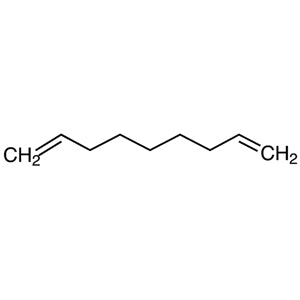
TCI N0332 4900-30-5 1,8-Nonadiene is a chemical compound widely used in laboratory settings for its role in constructing complex molecular structures. As a building block in organic chemistry, it plays a crucial part in various synthetic processes. Its unique structure, featuring a long carbon chain with two double bonds, allows for versatile chemical reactions. This makes it an essential component in the development of new chemical compounds and materials.
The compound is valued for its reactivity and structural versatility. Its double bonds enable participation in a range of reactions such as addition, substitution, and polymerization. These properties make it a preferred choice for chemists seeking to create functional molecules. Additionally, its stability under controlled conditions ensures reliable performance in experimental procedures. The compound’s ability to undergo multiple chemical transformations enhances its utility in research and development.
In Indonesian laboratories, 1,8-Nonadiene is commonly used in organic chemistry research and the synthesis of complex compounds. It is frequently found in labs focused on the development of new chemical materials and pharmaceuticals. Its role in scientific innovation makes it a sought-after reagent in both academic and industrial research settings. The compound’s properties support a wide array of applications, contributing to the advancement of chemical science in Indonesia.
- Organic synthesis is a key application where 1,8-Nonadiene is used to create complex molecular structures due to its reactive double bonds and structural versatility.
- Polymer research benefits from the compound’s ability to participate in polymerization reactions, making it suitable for developing new polymer materials.
- Pharmaceutical development often incorporates 1,8-Nonadiene as a building block in the synthesis of various organic compounds used in drug formulations.
- Industrial chemical production relies on this compound for the creation of specialized chemical products used in manufacturing processes.
- Research laboratories use 1,8-Nonadiene in the exploration of new chemical reactions and the development of advanced chemical compounds for scientific innovation.
| Brand | TCI |
|---|---|
| CAS number | 4900-30-5 |
| Molecular formula | — |
| Purity | — |
| Category | Chemistry > Building Blocks > Non-Heterocyclic Building Blocks |
| Pack sizes | — |
| Physical form | — |
| Storage | Store in a cool, dry place away from light and incompatible materials |
1,8-Nonadiene should be stored in a cool, dry environment, away from direct sunlight and sources of heat. It is recommended to keep the compound in airtight containers to prevent exposure to air and moisture. Due to its reactivity, it should be stored separately from strong oxidizing agents and other reactive chemicals. Proper ventilation is essential when handling this compound to minimize inhalation risks. Laboratory personnel should wear appropriate personal protective equipment, including gloves and safety goggles, when working with 1,8-Nonadiene. The compound’s sensitivity to oxidation means that it requires careful handling and storage to maintain its chemical integrity and ensure safe laboratory operations.
—
Produk Terkait
-
9-Vinylanthracene TCI V0130
Regular price From Rp 2.545.200,00Regular price -
5-Vinylbicyclo[221]hept-2-ene(stabilizedwithBHT) TCI V0062
Regular price From Rp 769.650,00Regular price -
1,3,5-Undecatriene(mixtureofisomers) TCI U0062
Regular price From Rp 3.155.250,00Regular price -
1-Undecene TCI U0052
Regular price From Rp 2.068.500,00Regular price -
1-Undecene TCI U0025
Regular price Rp 1.060.500,00Regular price -
1,10-Undecadiene TCI U0024
Regular price From Rp 2.491.650,00Regular price -
1,4,4a,5,8,8a-Hexahydro-1,4:5,8-dimethanonaphthalene(mixtureofisomers)(stabilizedwithBHT) TCI T4428
Regular price From Rp 4.056.150,00Regular price -
Triphenylethylene TCI T1834
Regular price Rp 1.724.100,00Regular price

![3048-64-4 5-Vinylbicyclo[2.2.1]hept-2-ene (stabilized with BHT) - AMI Scientific](http://amiscientific.com/cdn/shop/files/TCI2510V0062.jpg?v=1767145572&width=533)