

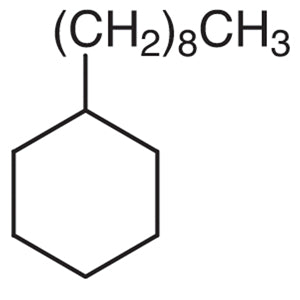
Nonylcyclohexane is a chemical compound widely used as a building block in various chemical reactions and the synthesis of complex molecules. It serves as a versatile solvent and intermediate in the production of organic compounds, making it an essential component in many laboratory processes. Its molecular structure is stable, allowing it to maintain its properties under a range of experimental conditions. This compound is commonly found in both academic and industrial research settings, where it plays a crucial role in facilitating chemical transformations and supporting the development of new materials and pharmaceuticals.
The non-polar and volatile nature of Nonylcyclohexane makes it a preferred choice for applications requiring a non-polar solvent. These characteristics enable it to dissolve a wide range of organic compounds and are particularly useful in separation and extraction processes. Its low reactivity also contributes to its safety profile in controlled laboratory environments, reducing the risk of unintended chemical interactions. This combination of stability, solubility, and chemical inertness ensures that Nonylcyclohexane remains a reliable and effective material for chemical synthesis and analysis.
In Indonesian laboratories, Nonylcyclohexane is frequently used in pure chemical research and pharmaceutical development. Its availability and effectiveness in complex reactions make it a popular choice among researchers. It is also utilized in the formulation of chemical products that require specific solvent tolerances. The compound’s versatility and reliability have made it a staple in both academic and industrial laboratories across Indonesia.
- Used in organic synthesis for its ability to dissolve a wide range of organic compounds and act as a reaction medium.
- Applied in purification processes due to its non-polar nature, aiding in the separation of compounds through distillation or extraction.
- Utilized in pharmaceutical research for the development of drug compounds requiring specific solvent conditions.
- Employed in analytical chemistry for sample preparation and as a solvent in chromatographic techniques.
- Integrated into industrial chemical formulations where non-polar solvents are necessary for product stability and performance.
| Brand | TCI |
|---|---|
| CAS number | 2883-02-5 |
| Molecular formula | — |
| Purity | — |
| Category | Chemistry > Building Blocks > Non-Heterocyclic Building Blocks |
| Pack sizes | Available in various sizes as per supplier specifications |
| Physical form | Liquid |
| Storage | Store in a cool, dark place away from heat and direct sunlight |
Nonylcyclohexane should be stored in a cool, dark location, away from heat and direct sunlight to maintain its stability and prevent degradation. It is recommended to use sealed, airtight containers made of materials compatible with organic solvents, such as glass or high-density polyethylene. Due to its volatile nature, proper ventilation is essential when handling this compound. Laboratory personnel should wear appropriate personal protective equipment, including gloves and safety goggles, to minimize exposure. The compound should not be stored near incompatible materials such as strong oxidizers or reactive substances. Regular monitoring of storage conditions ensures the material remains safe and effective for use in laboratory applications.
—
Produk Terkait
-
Undecylcyclohexane TCI U0037
Regular price Rp 6.599.250,00Regular price -
Undecane TCI U0002
Regular price From Rp 505.050,00Regular price -
1,3,5-Trimethyladamantane TCI T3872
Regular price From Rp 2.199.750,00Regular price -
Tetratriacontane TCI T2938
Regular price From Rp 3.260.250,00Regular price -
exo-Tetrahydrodicyclopentadiene TCI T1994
Regular price From Rp 1.246.350,00Regular price -
1,1,2,2-Tetramethylcyclopropane TCI T1721
Regular price Rp 3.180.450,00Regular price -
1,1,3,5-Tetramethylcyclohexane TCI T1717
Regular price Rp 6.148.800,00Regular price -
2,2,4,4-Tetramethylpentane TCI T1704
Regular price From Rp 1.220.100,00Regular price


