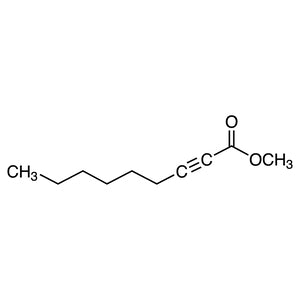
Methyl 2-Nonynoate from TCI is the methyl ester of 2-nonynoic acid. This straight-chain organic compound has a carbon-carbon triple bond (an alkyne) right next to the ester carbonyl group. In the laboratory it serves as a non-heterocyclic building block for making more complex molecules. Because the alkyne is conjugated with the ester, the compound works well as a Michael acceptor and as a substrate for many addition and cyclization reactions. This makes it useful to synthetic chemists who want to build new carbon frameworks in a controlled way.
Researchers choose this material because one compact molecule carries two important functional groups. The ester group is easy to convert into the matching acid, alcohol, or amide. The activated alkyne can serve as a branching point for further synthesis. The seven-carbon alkyl chain at the end of the molecule makes it lipophilic, so it suits target structures that need a hydrophobic segment. The product is sold by volume and is handled as a liquid. TCI packaging makes it easy to measure out portions for small- to medium-scale reactions, and quality stays consistent from batch to batch.
In Indonesia, Methyl 2-Nonynoate is relevant to organic chemistry laboratories at universities, government and private research institutes, and industrial research and development units working on synthetic methods. Graduate students and researchers can use it in reaction development, methodology studies, and multistep synthesis projects that need a reliable conjugated alkyne ester. Its clear structure also makes it a good model substrate for teaching and research on addition chemistry, where the same starting material must give reproducible results across repeated experiments.
- Michael addition studies: the alkyne conjugated with the ester makes the compound an effective Michael acceptor, so it suits research that adds nucleophiles to activated triple bonds.
- Cyclization reactions: the activated alkyne next to the ester carbonyl gives a reactive site for building ring systems, which helps chemists who design new cyclic carbon frameworks.
- Functional group interconversion: the methyl ester can be converted into an acid, alcohol, or amide, so the compound fits synthetic routes that need a flexible handle for later changes.
- Building hydrophobic segments: the seven-carbon alkyl chain adds lipophilic character, so the compound suits target molecules that need a hydrophobic portion in their final structure.
- Reaction methodology development: its compact structure with two clearly defined functional groups makes it a practical model substrate for testing and optimizing new addition and coupling conditions.
| Brand | TCI (product code N0595) |
|---|---|
| CAS number | 111-80-8 |
| Molecular formula | — |
| Purity | — |
| Category | Chemistry > Building Blocks > Non-Heterocyclic Building Blocks |
| Pack sizes | sold by volume; see the product listing for available pack options |
| Physical form | liquid |
| Storage | keep the container tightly closed in a cool, dry place, following the TCI label and safety data sheet |
Store Methyl 2-Nonynoate in its original TCI container, tightly closed, in a cool, dry, well-ventilated place away from heat sources, direct sunlight, and ignition sources. Keep it apart from strong oxidizing agents, strong bases, and reactive nucleophiles, since the activated alkyne ester can react with them. Handle the liquid in a fume hood and wear nitrile gloves, safety glasses, and a lab coat. Use clean, dry glass pipettes or syringes to measure portions, and close the container right after use to limit moisture and air exposure. Always read the supplier's safety data sheet before use, and dispose of waste according to institutional and local chemical waste rules.
—
Produk Terkait
-
TCI B5774 5,10-Bis(4,4,5,5-tetramethyl-1,3,2-dioxaborolan-2-yl)naphtho[1,2-c:5,6-c']bis([1,2,5]oxadiazole)
Regular price Rp 10.255.350,00Regular price -
Dihydroiodide TCI B6569
Regular price From Rp 1.936.200,00Regular price -
Trifluoromethanesulfonate TCI B7003
Regular price From Rp 1.936.200,00Regular price
![5,10-Bis(4,4,5,5-tetramethyl-1,3,2-dioxaborolan-2-yl)naphtho[1,2-c:5,6-c']bis([1,2,5]oxadiazole) - TCI B5774 - AMI Scientific](http://amiscientific.com/cdn/shop/files/TCI2510B5774.jpg?v=1769180228&width=533)