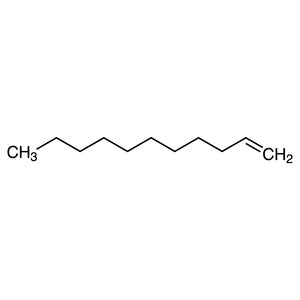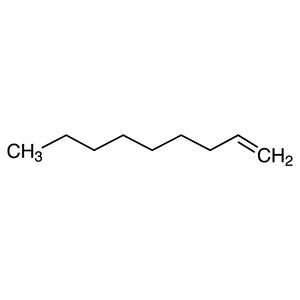
1-Nonene from TCI is a straight-chain alkene with nine carbon atoms and a double bond at the end of the chain, which makes it a terminal alkene, or α-olefin. It is classed as a non-heterocyclic building block. In the laboratory it serves as a substrate for many alkene addition and functionalization reactions. It is also used as a comonomer in olefin polymerization research and as a reference material in hydrocarbon analysis. Because its structure is simple and clearly defined, it works well as a model compound in catalysis studies.
Researchers choose 1-Nonene because its terminal double bond is easier to reach and usually more reactive than the double bond of an internal alkene. It is also a convenient compound for studying Markovnikov versus anti-Markovnikov regioselectivity. The heptyl chain makes the molecule hydrophobic and gives it a boiling point high enough for reactions at moderate temperatures. The molecule has no other functional groups, so reaction products are easy to analyze by GC and NMR. The product is a liquid and is sold by volume, which makes it easy to measure out.
In Indonesia, 1-Nonene is useful to catalysis, polymer chemistry, and organic chemistry laboratories at universities, research institutions, and petrochemical companies. Groups studying hydroformylation, olefin metathesis, and related alkene transformations can use it as a dependable substrate for screening catalysts and developing methods. Analytical laboratories working with hydrocarbon mixtures can also use it as a well-defined reference compound. It fits teaching, academic research, and industrial process development alike.
Related TCI products
- Alkene addition reactions: its reactive terminal double bond makes it a good substrate for hydration, halogenation, and hydroboration, including studies of Markovnikov and anti-Markovnikov selectivity.
- Olefin functionalization and catalysis studies: its simple, well-defined structure with no other functional groups makes it a clear model compound for comparing catalyst activity and selectivity.
- Hydroformylation and metathesis research: as an α-olefin with an easily reached terminal double bond, it suits studies of catalytic hydroformylation and olefin metathesis in petrochemical and academic laboratories.
- Olefin polymerization research: it can be used as a comonomer in polymerization experiments, where its heptyl side chain helps researchers study how α-olefin comonomers affect polymer structure.
- Hydrocarbon analysis: its defined linear C9 alkene structure makes it a useful reference material for identifying and comparing components in GC analysis of hydrocarbon samples.
| Brand | TCI (product code N0613) |
|---|---|
| CAS number | 124-11-8 |
| Molecular formula | — |
| Purity | — |
| Category | Chemistry > Building Blocks > Non-Heterocyclic Building Blocks |
| Pack sizes | Sold by volume; see the product listing for the sizes available |
| Physical form | Liquid |
| Storage | Keep tightly closed in a cool, dry, well-ventilated place away from heat and ignition sources |
Store 1-Nonene in its original, tightly sealed container in a cool, dry, well-ventilated area, away from heat, sparks, open flames, and oxidizing agents. As with other volatile organic liquids, handle it in a fume hood or a well-ventilated workspace. Wear suitable personal protective equipment, including chemical-resistant gloves, safety glasses, and a lab coat. Use clean, dry glassware or compatible containers when transferring it, and close the container right after use to limit evaporation and contamination. Avoid breathing vapors and prevent contact with skin and eyes. Always read the supplier's Safety Data Sheet for full hazard, storage, and disposal information, and follow local laboratory safety rules and waste regulations.
—
Produk Terkait
-
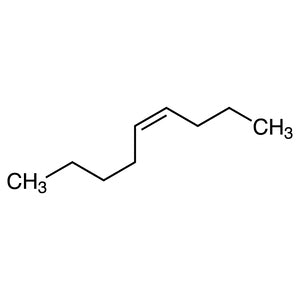
cis-4-Nonene TCI N0384
Regular price Rp 8.931.300,00Regular price -
9-Bromo-1-nonene TCI B3256
Regular price From Rp 769.650,00Regular price -
1-Nonene[StandardMaterialforGC] TCI S0339
Regular price Rp 2.650.200,00Regular price -
1,5-Diazabicyclo[4.3.0]-5-nonene TCI D1313
Regular price From Rp 1.035.300,00Regular price -
9-Vinylanthracene TCI V0130
Regular price From Rp 2.545.200,00Regular price -
5-Vinylbicyclo[221]hept-2-ene(stabilizedwithBHT) TCI V0062
Regular price From Rp 769.650,00Regular price -
1,3,5-Undecatriene(mixtureofisomers) TCI U0062
Regular price From Rp 3.155.250,00Regular price -
1-Undecene TCI U0052
Regular price From Rp 2.068.500,00Regular price

![124-11-8 1-Nonene [Standard Material for GC] - AMI Scientific](http://amiscientific.com/cdn/shop/files/TCI2510S0339.jpg?v=1768363009&width=533)
![1,5-Diazabicyclo[4.3.0]-5-nonene (CAS 3001-72-7) - TCI D1313 - AMI Scientific](http://amiscientific.com/cdn/shop/files/TCI2510D1313.jpg?v=1767102883&width=533)

![3048-64-4 5-Vinylbicyclo[2.2.1]hept-2-ene (stabilized with BHT) - AMI Scientific](http://amiscientific.com/cdn/shop/files/TCI2510V0062.jpg?v=1767145572&width=533)