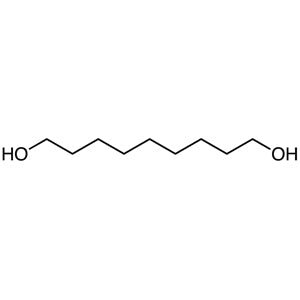
1,2-Nonanediol from TCI is an aliphatic vicinal diol. It has a straight nine-carbon chain with two adjacent hydroxyl groups on carbon atoms 1 and 2. One hydroxyl group is primary and the other is secondary. Two neighbouring hydroxyl groups joined to a hydrophobic hydrocarbon tail make the compound amphiphilic. In the laboratory, 1,2-Nonanediol is used as a non-heterocyclic building block for organic synthesis. It is also used in surfactant and formulation research, and as a model compound in studies of diol reactions.
The vicinal diol group gives this compound its distinctive reactivity. The two hydroxyl groups can form cyclic acetals or ketals, such as acetonides, which serve as protecting groups. They can also form cyclic carbonates, cyclic sulfates, or boronate esters. Periodate oxidation cleaves the C1–C2 bond and gives shorter-chain aldehydes, so the compound is useful for teaching experiments and for studying how diols are cleaved. The primary and secondary hydroxyl groups react differently, which allows selective functionalisation. The seven-carbon alkyl tail also gives a hydrophilic–lipophilic balance that is useful in interfacial studies.
In Indonesia, 1,2-Nonanediol is used by university chemistry departments, research institutes, and industrial R&D laboratories. It suits organic synthesis projects that need a simple diol building block with a straight chain. It is also a good choice for undergraduate and postgraduate practicals on protecting-group chemistry and oxidative diol cleavage. Formulation and surfactant researchers use it as a model amphiphile when studying structure–property relationships. AMI Scientific supplies this TCI reagent to laboratories that need a well-characterised starting material from an established manufacturer.
Related TCI products
- Organic synthesis building block: the nine-carbon chain and adjacent hydroxyl groups make this a versatile non-heterocyclic starting material for making more complex aliphatic molecules.
- Protecting-group chemistry: the vicinal diol readily forms cyclic acetals or ketals such as acetonides, so it is well suited to demonstrating and optimising diol protection strategies.
- Periodate cleavage studies: periodate oxidation breaks the C1–C2 bond and gives shorter-chain aldehydes, which makes the compound a clear model for mechanistic work and teaching practicals.
- Selective functionalisation research: the primary and secondary hydroxyl groups react differently, so chemists can study and develop regioselective esterification, etherification, or other derivatisation methods.
- Surfactant and interfacial studies: the polar diol head and hydrophobic seven-carbon alkyl tail give an amphiphilic balance suited to formulation and interface research.
| Brand | TCI (product code N0651) |
|---|---|
| CAS number | 42789-13-9 |
| Molecular formula | — |
| Purity | — |
| Category | Chemistry > Building Blocks > Non-Heterocyclic Building Blocks |
| Pack sizes | as offered by TCI for this product code; please confirm with AMI Scientific when enquiring |
| Physical form | — |
| Storage | follow the conditions given on the TCI label and Safety Data Sheet |
- Chemical class: aliphatic vicinal diol (straight nine-carbon chain, hydroxyl groups at C1 and C2)
Keep 1,2-Nonanediol in its original tightly closed container in a cool, dry, well-ventilated place, away from direct sunlight, heat sources, and strong oxidising agents. Reseal the container promptly after use so the reagent does not pick up moisture or get contaminated. Handle it according to good laboratory practice: wear safety glasses, chemical-resistant gloves, and a lab coat, and work in a well-ventilated area or fume hood. Avoid contact with skin and eyes, and do not inhale any dust or vapour. Always read the TCI Safety Data Sheet before use. Dispose of waste in line with local regulations and your institution's procedures.
—
Produk Terkait
-
1,9-Nonanediol TCI N0287
Regular price From Rp 1.008.000,00Regular price