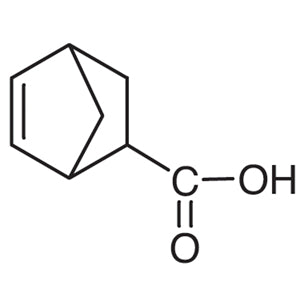
5-Norbornene-2-carboxylic Acid from TCI (product code N0667) is a bicyclic carboxylic acid built on a norbornene framework, supplied as a mixture of endo and exo isomers. The norbornene skeleton comes from the Diels-Alder reaction between cyclopentadiene and acrylic acid, and it keeps a strained, highly reactive double bond. In the laboratory, this compound is used as a versatile building block. It offers two chemical handles: a carboxylic acid group for conjugation and a norbornene double bond for polymerization or click chemistry.
The main appeal of this material is the ring strain of its bicyclic structure. Because of this strain, the norbornene double bond reacts readily in Ring-Opening Metathesis Polymerization (ROMP) and in thiol-ene reactions, much more easily than an ordinary alkene. The carboxylic acid group can be turned into esters, amides, or activated esters, so the norbornene unit can be attached to polymers, peptides, and material surfaces. Since the product is an endo/exo mixture, users should keep in mind that the two isomers may react at slightly different rates, especially in polymerizations that are sensitive to stereochemistry.
In Indonesia, this material is relevant to research groups working in polymer chemistry, materials science, and organic synthesis at universities and research institutions. Laboratories developing functional polymers through ROMP, making hydrogels or crosslinked networks with thiol-ene chemistry, or modifying surfaces and biomolecules can use it as a dependable starting point. Its two reactive sites make it useful for both academic synthesis projects and applied materials research, where one compound needs to serve as both an anchoring point and a polymerizable unit.
Related TCI products
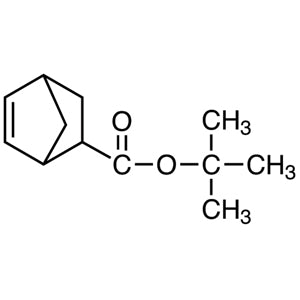
- TCI B4267 154970-45-3 tert-Butyl 5-Norbornene-2-carboxylate (endo- and exo- mixture)
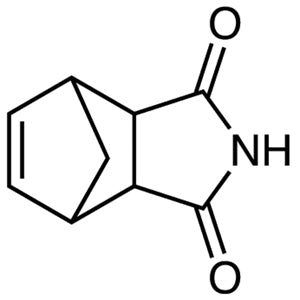
- TCI N0903 3647-74-3 5-Norbornene-2,3-dicarboximide
- TCI N0331 826-62-0 5-Norbornene-2,3-dicarboxylic Anhydride
- TCI N0907 95-10-3 5-Norbornene-2-methylamine (mixture of isomers)
- TCI N0897 95-11-4 5-Norbornene-2-carbonitrile (mixture of isomers)
- TCI N0764 85-39-2 5-Norbornene-2,3-dimethanol (mixture of endo- and exo-, predominantly endo-isomer)
- Ring-Opening Metathesis Polymerization (ROMP): the strained norbornene double bond polymerizes readily with metathesis catalysts, which makes this acid a practical monomer or comonomer for functional polymers that carry carboxylic groups.
- Thiol-ene click chemistry: the reactive norbornene alkene couples efficiently with thiols, so the compound suits the preparation of crosslinked networks, hydrogels, and modified materials under mild reaction conditions.
- Ester and amide synthesis: the carboxylic acid group converts easily into esters, amides, or activated esters, allowing researchers to add a polymerizable norbornene handle to many different molecules.
- Peptide and biomolecule functionalization: once activated, the acid can be conjugated to amine-bearing peptides or biomolecules, giving them a norbornene group for later click reactions or polymer attachment.
- Surface and material modification: the dual functionality lets the compound anchor to surfaces through its carboxylic group while leaving the norbornene double bond free for grafting, crosslinking, or further derivatization.
| Brand | TCI (product code N0667) |
|---|---|
| CAS number | 120-74-1 |
| Molecular formula | — |
| Purity | — |
| Category | Chemistry > Building Blocks > Non-Heterocyclic Building Blocks |
| Pack sizes | see the available options on the product listing |
| Physical form | — |
| Storage | follow the conditions stated on the TCI label and Safety Data Sheet |
- Composition: mixture of endo and exo isomers
Store 5-Norbornene-2-carboxylic Acid in its original, tightly closed container in a cool, dry, well-ventilated area, away from heat, direct sunlight, and incompatible materials such as strong oxidizing agents and strong bases. Always check the TCI label and Safety Data Sheet for the recommended storage temperature. Handle the compound in a fume hood or a well-ventilated workspace, and wear suitable personal protective equipment, including chemical-resistant gloves, safety glasses, and a lab coat. Avoid contact with skin and eyes, and do not inhale vapors or dust. Reseal the container promptly after use to limit exposure to moisture and air. Dispose of waste according to local regulations and your institution's chemical safety procedures.
—
Produk Terkait
-
tert-Butyl5-Norbornene-2-carboxylate(endo-andexo-mixture) TCI B4267
Regular price From Rp 1.485.750,00Regular price -
5-Norbornene-2,3-dicarboximide TCI N0903
Regular price Rp 4.584.300,00Regular price -
5-Norbornene-2,3-dicarboxylicAnhydride TCI N0331
Regular price From Rp 477.750,00Regular price -
5-Norbornene-2-methylamine(mixtureofisomers) TCI N0907
Regular price From Rp 2.068.500,00Regular price -
5-Norbornene-2-carbonitrile(mixtureofisomers) TCI N0897
Regular price From Rp 1.298.850,00Regular price -
5-Norbornene-2,3-dimethanol(mixtureofendo-andexo-,predominantlyendo-isomer) TCI N0764
Regular price From Rp 2.016.000,00Regular price -
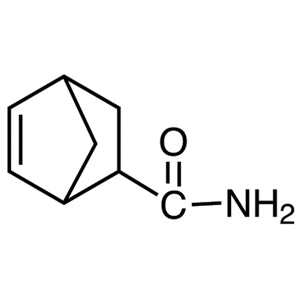
5-Norbornene-2-carboxamide(mixtureofisomers) TCI N0911
Regular price From Rp 717.150,00Regular price -
Methyl5-Norbornene-2-carboxylate(endo-andexo-mixture) TCI N0691
Regular price Rp 6.228.600,00Regular price