Methyl 5-Norbornene-2-carboxylate from TCI (product code N0691, CAS 6203-08-3) is a methyl ester derived from norbornene and is supplied as a mixture of endo and exo isomers. Norbornene is a bicyclic hydrocarbon whose double bond is under high ring strain, so the ring opens readily during polymerization. For this reason the compound is classified as a monomer for polymer and macromolecule research. In the laboratory it is used to prepare polynorbornenes that carry an ester group on every repeat unit, and those ester groups can be modified after polymerization.
The strain in the bicyclic ring makes the norbornene double bond highly reactive in ring-opening metathesis polymerization (ROMP) with ruthenium or molybdenum catalysts. When reaction conditions are well controlled, this allows polymers with controlled molecular weight and a relatively narrow distribution. The methyl ester group can be hydrolyzed to a carboxylic acid or converted to an amide, which lets researchers tune polymer properties such as polarity and solubility. The ratio of endo to exo isomers also affects the polymerization rate, which makes the mixture interesting to study in its own right.
In Indonesia, this monomer is relevant to chemistry laboratories at universities and research institutions working on polymer synthesis, materials science, and catalysis. Research groups studying ROMP can use it as a model monomer to test catalyst performance and to learn how reaction conditions shape the final polymer. Laboratories developing functional materials can also use the ester-bearing polynorbornene as a starting platform for post-polymerization modification, where polarity and solubility are adjusted to suit specific research goals in student and advanced projects alike.
Related TCI products
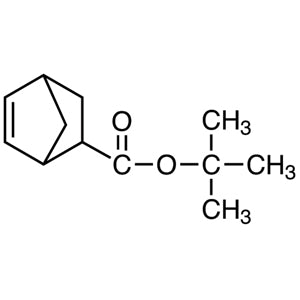
- TCI B4267 154970-45-3 tert-Butyl 5-Norbornene-2-carboxylate (endo- and exo- mixture)
- TCI N0907 95-10-3 5-Norbornene-2-methylamine (mixture of isomers)
- TCI N0897 95-11-4 5-Norbornene-2-carbonitrile (mixture of isomers)
- TCI N0764 85-39-2 5-Norbornene-2,3-dimethanol (mixture of endo- and exo-, predominantly endo-isomer)
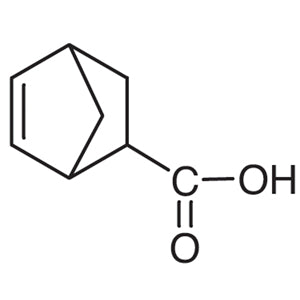
- TCI N0667 120-74-1 5-Norbornene-2-carboxylic Acid (endo- and exo- mixture)
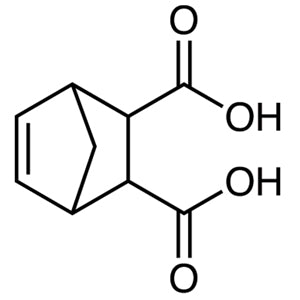
- TCI N1029 3813-52-3 5-Norbornene-2,3-dicarboxylic Acid
- ROMP studies: the strained norbornene double bond reacts readily with ruthenium or molybdenum catalysts, so the monomer suits experiments that look at catalyst activity and polymerization behavior.
- Synthesis of functional polynorbornenes: each repeat unit carries a methyl ester group, giving polymers with evenly distributed functional sites that can be modified in later steps.
- Post-polymerization modification: the ester groups can be hydrolyzed to carboxylic acids or converted to amides, letting researchers tune polarity and solubility without redesigning the monomer.
- Controlled molecular weight experiments: with well-controlled reaction conditions, ROMP of this monomer can give polymers with controlled molecular weight and a relatively narrow distribution, which is useful for method development.
- Isomer effect research: because it is supplied as an endo and exo mixture, the monomer is useful for studying how the isomer ratio affects polymerization rate and polymer formation.
| Brand | TCI (product code N0691) |
|---|---|
| CAS number | 6203-08-3 |
| Molecular formula | — |
| Purity | — |
| Category | Materials Science > Polymer/Macromolecule Reagents > Monomers |
| Pack sizes | see the available options on the product page |
| Physical form | — |
| Storage | follow the conditions on the TCI label and Safety Data Sheet |
- Composition: mixture of endo and exo isomers
Keep this monomer in its original, tightly closed container in a cool, dry, well-ventilated place, away from heat, direct sunlight, and ignition sources. Follow the storage conditions on the TCI label and in the Safety Data Sheet. Keep it separate from strong oxidizers and from reactive agents such as strong acids or bases, which could hydrolyze the ester. Handle it in a fume hood while wearing safety glasses, chemical-resistant gloves, and a lab coat. Avoid breathing vapors and avoid contact with skin and eyes. After opening, reseal the container right away and label it clearly. Dispose of residues and contaminated materials under your institution's chemical waste procedures.
—
Product Categories
Produk Terkait
-
tert-Butyl5-Norbornene-2-carboxylate(endo-andexo-mixture) TCI B4267
Regular price From Rp 1.485.750,00Regular price -
5-Norbornene-2-methylamine(mixtureofisomers) TCI N0907
Regular price From Rp 2.068.500,00Regular price -
5-Norbornene-2-carbonitrile(mixtureofisomers) TCI N0897
Regular price From Rp 1.298.850,00Regular price -
5-Norbornene-2,3-dimethanol(mixtureofendo-andexo-,predominantlyendo-isomer) TCI N0764
Regular price From Rp 2.016.000,00Regular price -
5-Norbornene-2-carboxylicAcid(endo-andexo-mixture) TCI N0667
Regular price From Rp 689.850,00Regular price -
5-Norbornene-2,3-dicarboxylicAcid TCI N1029
Regular price From Rp 1.273.650,00Regular price -
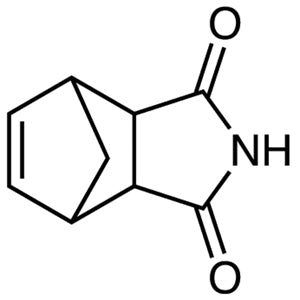
5-Norbornene-2,3-dicarboximide TCI N0903
Regular price Rp 4.584.300,00Regular price -
5-Norbornene-2-exo,3-exo-dimethanol TCI N0769
Regular price From Rp 2.837.100,00Regular price