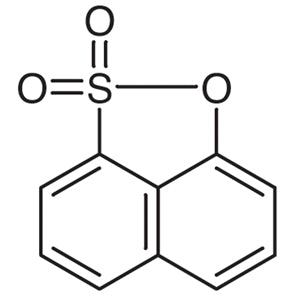
1,8-Naphthosultone from TCI is a heterocyclic compound: a cyclic sulfonate ester, or sultone, built on a naphthalene core. The sulfonate group at position 1 and the oxygen atom at position 8 are joined to form a five-membered ring. In the laboratory, the material serves as a heterocyclic building block and as an intermediate in the synthesis of sulfonated naphthalene derivatives. One example is the family of 8-hydroxy-1-naphthalenesulfonic acid derivatives, which have long been important in dye chemistry. The compound is also of interest as an electrophile for ring-opening reactions.
Chemists choose 1,8-naphthosultone mainly for the reactivity of its sultone ring. Nucleophiles such as amines, alkoxides, or hydroxide can open the sulfonate ester bond in the strained ring. The reaction gives naphthalene derivatives that carry a sulfonate group and an oxygen group together at the peri (1,8) positions. This peri arrangement is hard to make by other routes, so the sultone offers an efficient shortcut. Its rigid aromatic framework also makes it useful for studying the structure and reactivity of peri-substituted compounds.
In Indonesia, this material fits organic chemistry laboratories at universities and research institutions, especially groups working on heterocyclic synthesis, aromatic sulfonation chemistry, and dye or colorant chemistry. It also suits teaching and research labs that study ring-opening reactions and peri-substituted naphthalene systems. Laboratories developing synthetic intermediates for further functionalization can use it as a reliable starting material when a sulfonate and an oxygen group are needed on the same naphthalene scaffold.
- Heterocyclic building block synthesis: the cyclic sulfonate ester gives a compact, reactive naphthalene scaffold that can be built into more complex heterocyclic and aromatic target molecules.
- Preparation of sulfonated naphthalene derivatives: opening the sultone ring gives products with a sulfonate group directly, so a separate sulfonation step on the naphthalene core is not needed.
- Synthesis of 8-hydroxy-1-naphthalenesulfonic acid derivatives: the ring places the sulfonate and oxygen groups at the 1 and 8 positions, which matches the substitution pattern of these historically important dye intermediates.
- Nucleophilic ring-opening studies: the strained sulfonate ester bond reacts with amines, alkoxides, and hydroxide, making it a useful model electrophile for studying ring-opening reactivity.
- Research on peri-substituted aromatic compounds: the rigid naphthalene framework holds substituents at the 1,8 positions, which supports structural and reactivity studies of peri interactions in aromatic systems.
| Brand | TCI (product code N0766) |
|---|---|
| CAS number | 83-31-8 |
| Molecular formula | — |
| Purity | — |
| Category | Chemistry > Building Blocks > Heterocyclic Building Blocks |
| Pack sizes | available in the TCI pack sizes shown on the product page |
| Physical form | see the manufacturer's certificate of analysis and product label |
| Storage | keep tightly closed in a cool, dry place, following the manufacturer's recommendations on the label and safety data sheet |
Keep 1,8-Naphthosultone in its original, tightly sealed container in a cool, dry, well-ventilated area, away from moisture and direct sunlight. Because the sultone ring reacts with nucleophiles, store it apart from strong bases, amines, alkoxides, and other reactive nucleophilic reagents to avoid unwanted ring opening. Handle it under a fume hood with suitable personal protective equipment, including gloves, safety glasses, and a lab coat. Avoid inhaling dust and avoid contact with skin and eyes. Always read the manufacturer's safety data sheet before use, and dispose of waste according to institutional and local chemical waste regulations.
—
Produk Terkait
-
TCI B5774 5,10-Bis(4,4,5,5-tetramethyl-1,3,2-dioxaborolan-2-yl)naphtho[1,2-c:5,6-c']bis([1,2,5]oxadiazole)
Regular price Rp 10.255.350,00Regular price -
Dihydroiodide TCI B6569
Regular price From Rp 1.936.200,00Regular price -
Trifluoromethanesulfonate TCI B7003
Regular price From Rp 1.936.200,00Regular price
![5,10-Bis(4,4,5,5-tetramethyl-1,3,2-dioxaborolan-2-yl)naphtho[1,2-c:5,6-c']bis([1,2,5]oxadiazole) - TCI B5774 - AMI Scientific](http://amiscientific.com/cdn/shop/files/TCI2510B5774.jpg?v=1769180228&width=533)