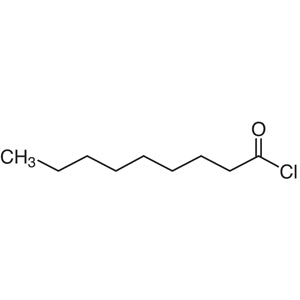
TCI N0813 Nonanoyl Chloride is the acid chloride of nonanoic acid, also called pelargonic acid. It is an aliphatic acyl chloride with a nine-carbon chain. In organic synthesis laboratories it works as a reactive acylating agent that attaches a nonanoyl group to alcohols, amines, phenols and aromatic compounds. These reactions usually run quickly under mild conditions, so chemists often use it to prepare esters, amides and ketones with medium-length alkyl chains. Research on lipids, surfactants and bioactive compounds needs these products, which makes this reagent a practical building block.
Chemists choose this material because an acyl chloride is far more reactive than the free carboxylic acid. Ester or amide bonds therefore form without extra coupling reagents, which keeps procedures simpler and workup cleaner. The nonanoyl chain adds a useful amount of lipophilicity without making the molecule too long. This helps researchers who need to tune the solubility or membrane interaction of a target compound. A well-known example is the synthesis of nonanoyl vanillylamide, a capsaicin analogue that is widely studied in pharmacological research.
In Indonesia, this reagent is useful for organic chemistry, pharmacy, oleochemistry and food technology laboratories. University research groups use it to prepare fatty-chain esters and amides for structure-activity studies. Oleochemical researchers use it to model derivatives of medium-chain fatty acids, and pharmaceutical laboratories use it to build lipophilic analogues of bioactive molecules. Food technology researchers who study pungent compounds and flavour-related amides can also use it as a starting material for capsaicin-type analogues in controlled experiments.
TCI brochures (PDF)
- Lipids 2025-12-17 · p. 7
- Ester synthesis: Nonanoyl chloride reacts quickly with alcohols and phenols under mild conditions, giving nonanoyl esters without the separate coupling reagents that the free acid would need.
- Amide formation: Its high acyl chloride reactivity lets it acylate primary and secondary amines efficiently, which suits the preparation of fatty-chain amides for medicinal and materials research.
- Capsaicin analogue research: It is the acyl source used to make nonanoyl vanillylamide, a capsaicin analogue that is widely studied in pharmacological and sensory research.
- Friedel-Crafts acylation: As a reactive acyl chloride, it can introduce a nonanoyl group onto aromatic compounds and give aryl ketones with a medium alkyl chain for further synthesis.
- Lipid and surfactant studies: The nine-carbon chain gives a balanced lipophilic character, so researchers can use it to build model lipids and amphiphilic molecules and adjust solubility or membrane interaction.
| Brand | TCI (product code N0813) |
|---|---|
| CAS number | 764-85-2 |
| Molecular formula | — |
| Purity | — |
| Category | Chemistry > Building Blocks > Non-Heterocyclic Building Blocks |
| Pack sizes | As listed on the product page |
| Physical form | Liquid (aliphatic acyl chloride) |
| Storage | Moisture-sensitive; keep tightly sealed in a cool, dry place |
Nonanoyl chloride is an acyl chloride, so it reacts with water and moist air and releases hydrogen chloride. Keep it in its original tightly closed container in a cool, dry and well-ventilated area, away from water, alcohols, amines, bases and oxidizing agents. Storing it under an inert gas such as nitrogen or argon helps preserve quality after opening. Handle it only in a fume hood while wearing chemical-resistant gloves, safety goggles and a lab coat, because the material is corrosive to skin, eyes and the respiratory tract. Use dry glassware and syringes for transfers. Collect waste and spills with an inert absorbent and dispose of them according to institutional chemical waste procedures. Always check the supplier's Safety Data Sheet before use.
—
Produk Terkait
-
NonanoylChloride TCI N0372
Regular price From Rp 610.050,00Regular price -
AdipoylChloride TCI A0169
Regular price From Rp 1.220.100,00Regular price -
AcetylChloride TCI A0082
Regular price From Rp 795.900,00Regular price -
ValerylChloride TCI V0010
Regular price From Rp 955.500,00Regular price -
UndecanoylChloride TCI U0026
Regular price From Rp 1.538.250,00Regular price -
10-UndecenoylChloride TCI U0008
Regular price From Rp 1.353.450,00Regular price -
ButyrylChloride TCI B0770
Regular price From Rp 530.250,00Regular price -
AzelaoylChloride TCI A0562
Regular price Rp 2.411.850,00Regular price